
Notion CEO Ivan Zhao — 'Steel, Steam and the Infinite Mind' essay
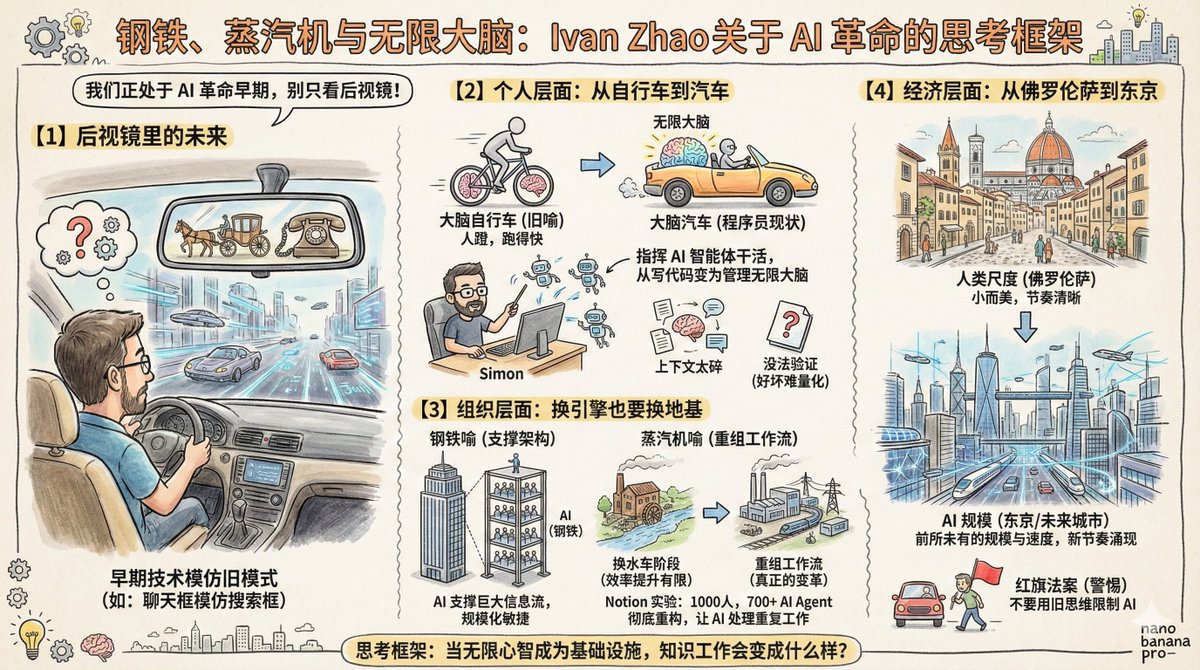
Notion CEO Ivan Zhao published an essay comparing AI's impact to steel and steam. • Ivan argues people interpret new tech through old frames; today’s AI is viewed through a search/chatbox lens. • He compares individual change to bikes→cars: programmers shift from writing code to directing AI agents. • Simon example: a top engineer manages multiple coding agents instead of typing. • Reasons only programmers first benefit: consolidated context (code repos) and verifiable outputs (errors/tests). • Organization-level metaphors: AI = steel (supports larger info flow); steam = rethinking factory layout and workflows. • Notion runs 700+ AI agents for internal tasks at ~1,000-person scale. • Economic/city analogy: AI could shift knowledge work from Florence-scale to Tokyo-scale organization. • Ivan calls for redesigning workflows and validation methods rather than bolting AI onto old processes.
Key insights
AI is currently understood through outdated metaphors
Ivan Zhao states that each generation interprets new technologies using older paradigms; current AI is often seen as a chat/search box because users map it to Google search. He argues this 'rearview-mirror' view limits imagining novel interfaces and organizational forms, urging designers and leaders to reconceptualize AI beyond existing tools and workflows.
Programmers are first to benefit: from 'bicycles' to 'cars'
Ivan presents a personal-level analogy: earlier computing was a 'brain bicycle' requiring human effort; modern AI makes work like driving a car. He gives the example of Simon, a formerly hands-on engineer who now orchestrates multiple AI programming agents, delegating coding while managing and validating outputs.
Context consolidation and verifiability explain early programmer gains
Ivan identifies two reasons programmers benefit first: codebases keep context centralized (repos, clear environments), and code failures are readily verifiable (errors/tests). In contrast, many non-engineering roles have fragmented context across Slack, docs, and memory, and outcomes are harder to quantify.
AI as organizational 'steel' enables larger agile companies
Zhao argues AI can act like steel in construction—supporting vast information flow and reducing communication fragility—so organizations of thousands could retain startup-like agility because AI will underpin decision and information scaffolding.
AI as 'steam' requires workflow and facility redesign
Using the steam-engine metaphor, Ivan notes early adopters merely swapped power sources without redesigning factories; real gains came when factories relocated and restructured. He says current AI adoptions often just 'replace the water wheel' (add chatbots) without rethinking organizational design and workflow boundaries.
Notion practices AI at scale: 700+ internal agents
Ivan reports Notion operates over 700 active AI agents within its ~1,000-person company, handling tasks like meeting notes, internal Q&A, IT requests and weekly reports, framing this as organizational restructuring rather than mere time savings.
Economic and urban-scale analogy: knowledge work will change shape
Ivan extends the metaphor to cities: steel and steam changed urban scale and social life; similarly, AI agents could shift knowledge work from 'human-scale' organizations (Florence) to 'hyper-scale' organizations (Tokyo), changing rhythms like meetings and annual planning.