
Notion CEO Ivan Zhao — 'Steel, Steam and the Infinite Mind' essay
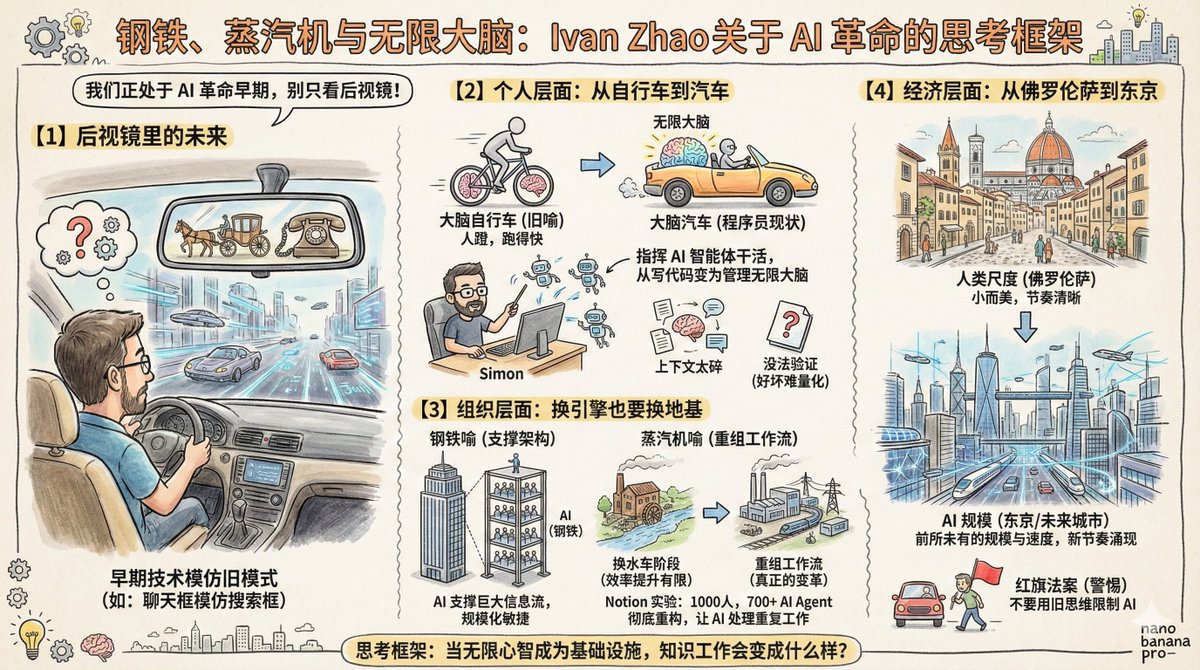
Ivan Zhao publishes a long essay framing AI as an infrastructure shift reshaping individuals, organizations, and cities. - Essay uses historical analogies: 'rearview mirror' view of new tech - Early-stage AI is misunderstood via old metaphors - Individual: computers were 'bicycles'; AI is 'cars' for programmers - Example: Notion cofounder Simon moved from coding to orchestrating AI agents - Reasons programmers lead: code is centralized and verifiable - Two org metaphors: 'steel' (supports scale) and 'steam engine' (rethink factory layout) - Notion runs 700+ AI agents internally at 1,000-person scale - Economic view: cities changed after steel/steam; knowledge economy may similarly transform - Analogy to UK's 1865 Red Flag Act: current human-confirmation norms may be transitional - Essay provides a framework for thinking about redesigning workflows, not definitive answers
Key insights
Ivan Zhao frames AI as an infrastructure-level transformation
Ivan Zhao argues AI should be viewed like historical infrastructure (steel, steam) that enables new organizational shapes rather than a drop-in productivity tool. He recommends moving beyond treating AI as an add-on and instead redesigning workflows and company foundations so AI agents become persistent, structural capabilities. The essay uses metaphors of steel (supporting large information flows) and steam (opportunity to re-site and reorganize processes) to illustrate different layers of change.
Individual productivity shifts: from 'bicycle' to 'automobile' for programmers
Zhao presents a personal-level thesis: where computers once served as 'bicycles' that amplified human effort, AI now functions like an 'automobile'—requiring direction rather than continuous manual input. He recounts Notion cofounder Simon becoming a manager of multiple AI coding agents, queuing tasks overnight and delegating execution, shifting the programmer role toward orchestration and intent specification.
Programmers adopted AI first due to centralized context and verifiability
Zhao identifies two reasons programmers saw earlier gains: codebases centralize context (repositories) making it easier for AI to act, and software has clear verification signals (tests, runtime errors) that let AI outputs be validated. Other roles with fragmented context and hard-to-measure outcomes (marketing, event planning) lag in AI augmentation.
Organizational redesign requires persistent AI agents, not mere tool swaps
Using the steam-engine analogy, Zhao warns that merely swapping AI into existing workflows (replacing water wheel with steam engine without re-siting the factory) yields limited gains. True transformation requires rethinking spatial and process constraints, creating persistent AI agents and infrastructure (Notion reports 700+ active AI agents internally) that let large organizations operate with startup-like agility.
Macroeconomic and urban analogies illustrate scale and rhythm changes
Zhao extends the metaphor to cities: steel and steam enabled new urban densities and rhythms; similarly, an 'infinite mind' layer of AI agents could change knowledge-economy scale, operating cadence, and organizational anonymity. He suggests management will move from step-by-step confirmations to higher-level supervision, comparing current human-confirmation norms to historical regulatory friction.