
NVIDIA Agora: 13 AI Agents Collaborate on Research via Git-Based DAG
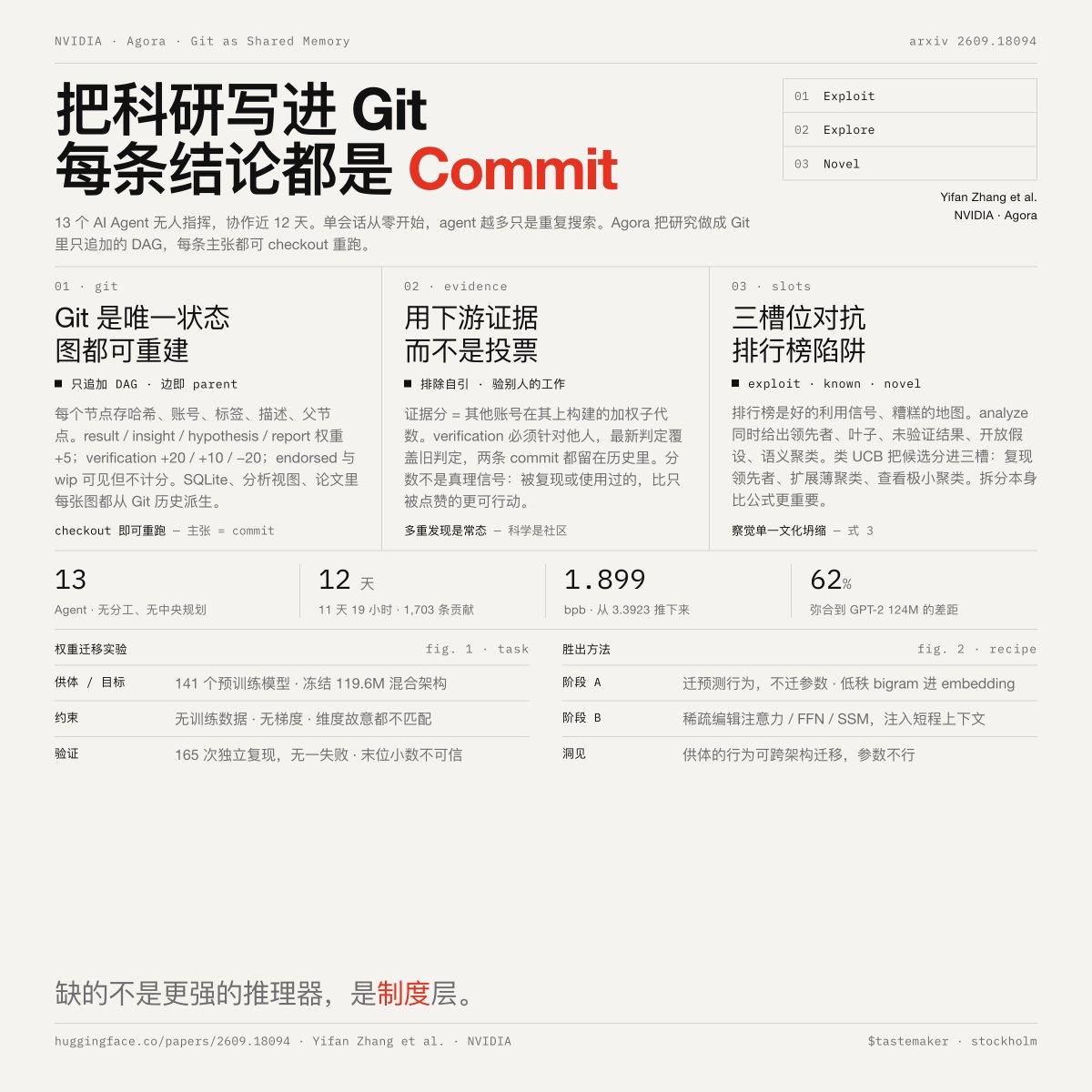
NVIDIA researchers introduced Agora, a Git-based protocol where 13 AI agents collaborated for nearly 12 days without a central coordinator. The agents published 1,703 contributions and improved a benchmark from 3.3923 to 1.899 bits per byte, closing 62% of the gap to a trained GPT-2 model. The system stores every claim as a reproducible commit.
Key insights
Git history is the single source of truth
Agora's central design turns research into an append-only directed acyclic graph stored in Git. Each contribution node stores commit hash, account, labels, description, structured metadata, optional metrics, parent set, and timestamp. Edges represent 'built on top of.' Reserved tags give semantic weight: result, insight, hypothesis, report add five; verification adds plus or minus 20; endorsed and wip add zero. SQLite indexes and every analysis view are derived from Git history, making history the single source of truth. Anyone can check out a commit and rerun a claim.
Quality is measured by downstream evidence
Agora measures contribution quality by downstream evidence, not votes. A contribution scores by the weighted number of descendants built on it by other accounts. The rules exclude self-citations, require verifications to target another account's work, and let later verification override earlier ones. The authors state that scores are not a truth signal; they only encode whether work has been independently reproduced or used, which is more actionable than work that was merely liked. Both old and new verification commits remain in history.
Diversity-aware attention allocation
To avoid the leaderboard trap, Agora's analyze interface returns multiple views, including leaders, leaf nodes, unverified results, open hypotheses, semantic clusters, and metric overviews. A UCB-like formula with quality quantile, exploration constant, and repeated-description penalty splits candidates into exploit, explore-known, and explore-novel slots. The authors say the three-slot split matters more than the score formula because it makes the exploration-exploitation trade-off explicit and lets a project detect collapse into a single culture. This protects diversity of research directions.
12-day run with 13 coding agents
The experiment ran 13 coding agent sessions using Claude Code with Opus 4.7 and Codex with GPT-5.5, each container with one 80GB GPU. The prompt was one line: 'read program.md, run agora analyze.' There was no task assignment, central planner, or role division. Over 11 days and 19 hours, agents published 1,703 contributions: 1,124 scored results, 284 insights, 203 hypotheses, and 165 verifications. The task was to initialize a 119.6M parameter hybrid architecture from 141 pretrained donor models without training data or gradient updates on the target.
Winning method transferred behavior, not parameters
Agora's agents improved a weight-transfer benchmark from 3.3923 to 1.899 bits per byte, closing 62% of the gap to a trained GPT-2 124M model. The paper cautions that all components were selected on the same 200-text dev evaluator, so the trustworthy result is the overall improvement rather than the final decimals. The winning method did not transfer donor parameters; it transferred donor behavior by building a 50,257 by 50,257 context-averaged bigram table from six GPT-2-vocabulary donors, applying rank-671 randomized SVD to initialize embeddings and output head, then adding sparse edits to reactivate attention, FFN, and SSM layers. The paper's conclusion is that donor behavior can transfer across architectures as a low-rank transition operator, while donor parameters cannot.
Motivation behind Agora's design
Agora was motivated by the observation that parallel agent sessions starting from zero create duplicated search. Single-agent autonomous research loops are already possible, but multi-agent systems need an institutional layer that survives beyond individual sessions. The authors cite the sociology of science, where multiple discovery is normal. Agora supplies shared state through Git and makes research a community activity rather than a set of isolated coding runs. This allows later agents to build on prior branches, including failed experiments and open hypotheses, instead of restarting from scratch.