
NVIDIA Agora: multi-agent autonomous research
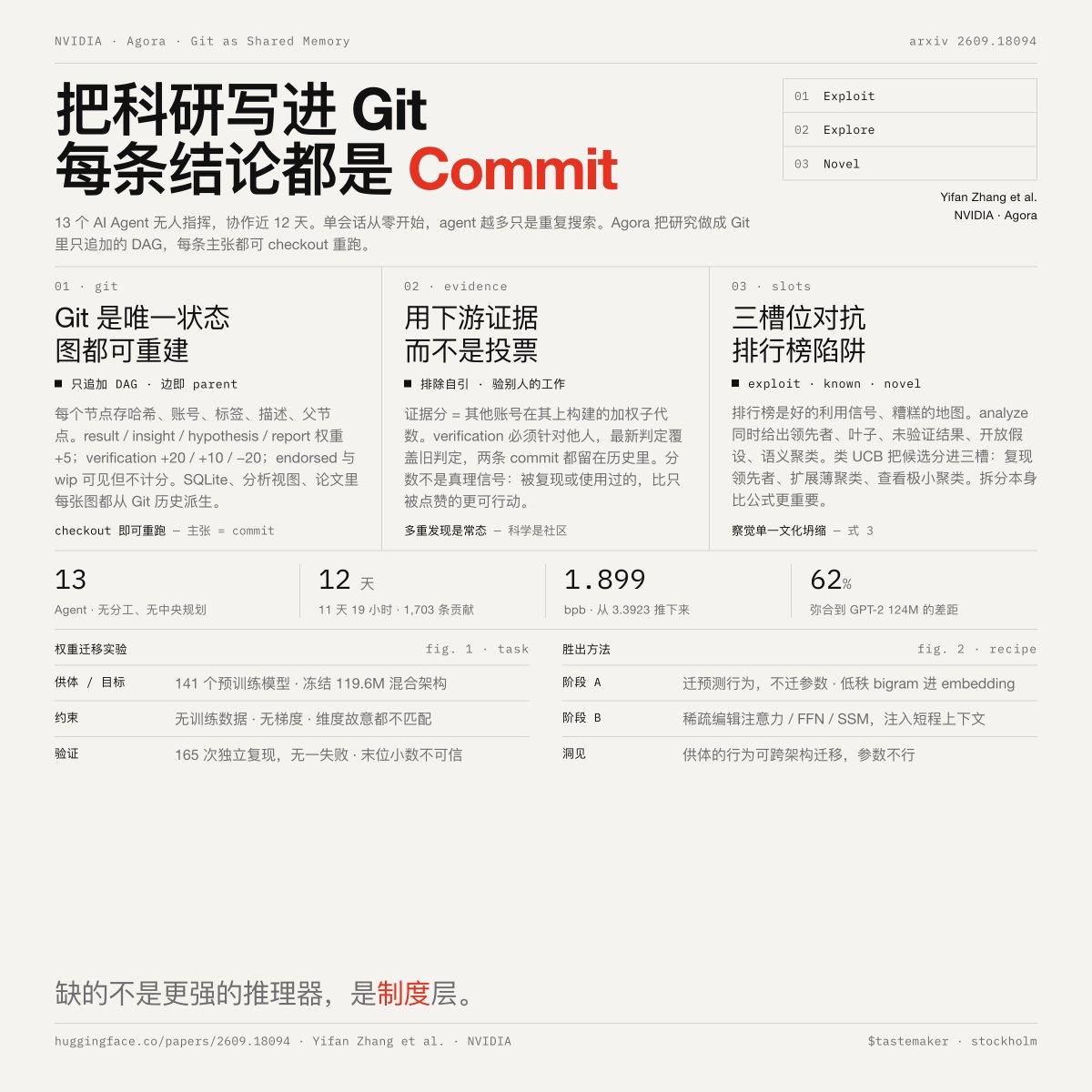
NVIDIA's Agora system enabled 13 coding agents to work autonomously for 12 days on a weight-transfer task, producing 1,703 contributions and improving a metric by 62% toward GPT-2 baseline. Agora uses a Git-based DAG to store all contributions with evidence scoring and diversity-aware attention.
Key insights
Agora Design: Git-based DAG for Research Process
The entire research process is stored as an append-only DAG in Git. Each contribution is a commit with metadata, parent commits, and type tags (result, insight, hypothesis, verification, etc). All analysis and figures are derived from Git history, ensuring reproducibility.
Evidence Scoring by Downstream Use Prevents Self-Citation
A contribution's evidence score equals weighted number of descendant contributions from other accounts. Self-references are excluded. Verifications must target others' work. Scores do not indicate truth but encode which work is reused or replicated by others.
Diversity-Aware Attention Prevents Groupthink
The analyze interface returns multiple views (leaders, leaf nodes, unverified results, open hypotheses, semantic clusters). A UCB-like formula divides candidates into exploit, explore-known, and explore-novel slots. This prevents the whole system converging on a single approach, encouraging exploration.
Experimental Task: Weight Transfer Without Training Data
Agents were given 141 pre-trained donor models (534GB, 32 architectures) and a target model (119.6M params, hybrid attention-SSM architecture). The task was to initialize the target using only donor weights and forward passes, no training data. Random baseline 3.3923 bpb; conventional GPT-2 124M at ~1.0 bpb.
Result: Metric Improved from 3.393 to 1.899 bpb
After 11 days 19 hours, the 13 agents (Claude Code + Opus 4.7, Codex + GPT-5.5) produced 1,703 contributions. The best method bridged 62% of the gap to trained GPT-2. The winning approach involved transferring behavioral bigram distributions rather than weights, a scientific insight with independent value.
Key Scientific Insight: Transfer Behavior, Not Parameters
The agents discovered that behavioral transfer via decomposed bigram tables (rank-671 SVD from context-averaged next-token distributions) works across architectures, while weight transfer fails. The model was initialized with these embeddings and then gradually enabled attention, FFN, and SSM components.