
NVIDIA Agora Multi-Agent Research System
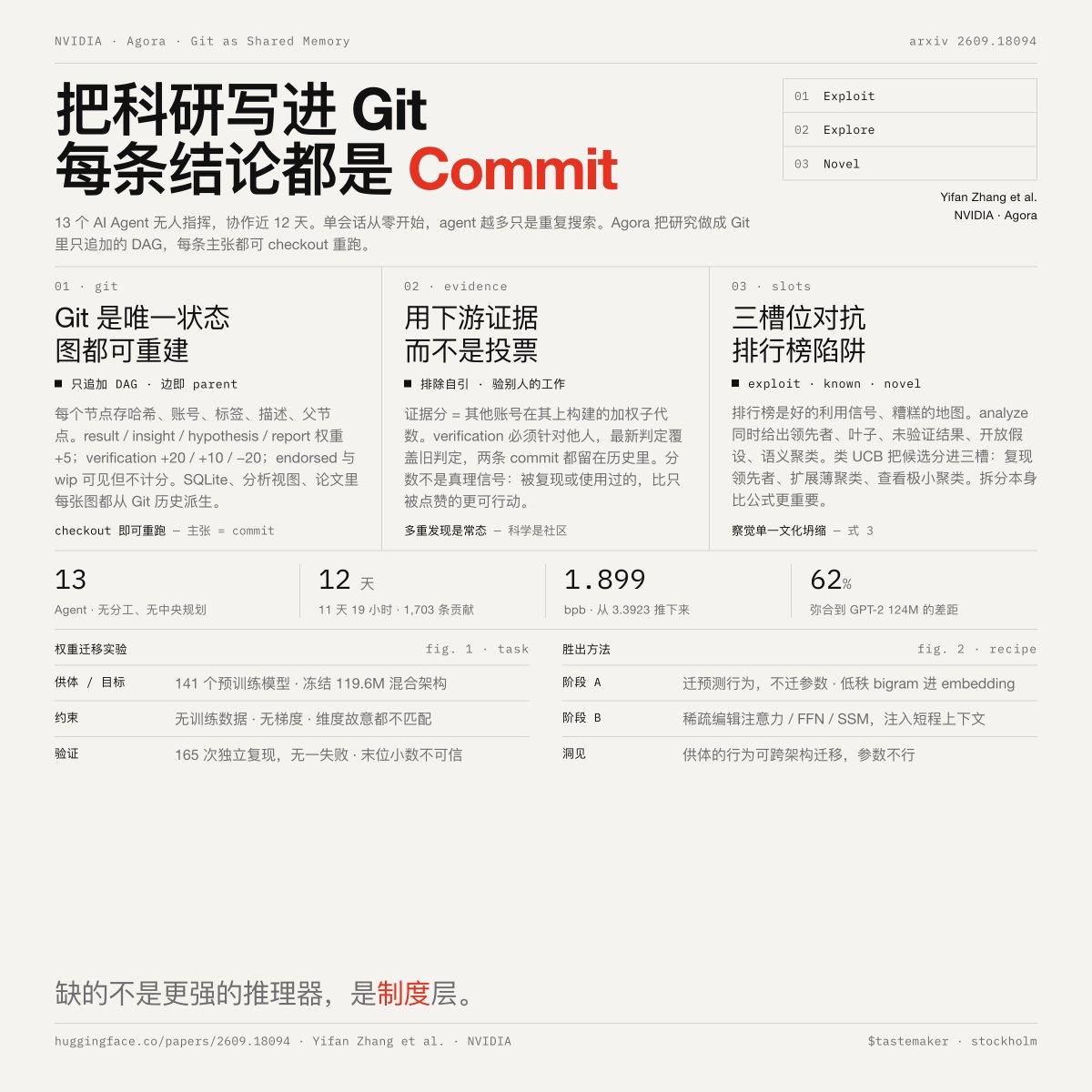
NVIDIA researchers introduced Agora, a multi-agent research system where 13 coding agents collaborated without central coordination for 12 days, producing 1,703 contributions. The system uses a Git-based directed acyclic graph to store all claims as reproducible commits. Agents improved a weight-transfer task from 3.3923 to 1.899 bits per byte, closing 62% of the gap to a trained GPT-2 124M model.
Key insights
Agora Uses Git as Single Source of Truth for Research
Agora stores the entire research process as an append-only directed acyclic graph in Git. Each claim is a commit that anyone can checkout and rerun. Contributions include results, insights, hypotheses, reports, and verifications. The system uses a scoring mechanism based on downstream evidence (weighted subtree count) rather than voting, with rules against self-citation and with verification overriding previous judgments.
Diversity-Aware Attention Allocation Prevents Groupthink
Agora's analyze interface returns multiple views (leaders, leaf nodes, unverified results, open hypotheses, semantic clusters, metric panoramas) and uses a UCB-like formula to split candidates into three slots: exploit (reproduce or refine leaders), explore known (extend promising thin clusters), and explore novel (examine untouched nodes). This prevents all agents from converging on the same approach.
12-Day Experiment: Weight Transfer Without Training Data
The experiment involved 13 coding agent sessions (Claude Code + Opus 4.7, Codex + GPT-5.5) each with one 80GB GPU. The task: initialize a 119.6M parameter hybrid architecture using only weights and forward passes from 141 pretrained donor models (534GB, 32 architecture families) — no training data, no gradient updates. Agents ran for 11 days 19 hours, producing 1,703 contributions (1,124 scored results, 284 insights, 203 hypotheses, 165 verifications).
Agents Discovered a Novel Weight Transfer Method
The winning approach involved two phases. Phase A: instead of transferring donor parameters, transfer donor predictive behavior by computing a context-averaged bigram table from 6 donors with shared GPT-2 vocabulary, then using rank-671 randomized SVD to initialize embeddings and output head. Phase B: sparse, deterministic edits to re-enable attention (uniform causal mean pooling), layer-0 FFN (SVD projection from GPT-2 MLP), and SSM (gated depthwise convolution). The key insight: donor behavior (compressed into low-rank transition operators) can transfer across architectures, but donor parameters cannot.
System Designed to Overcome Single-Agent Research Limitations
The authors noted that single-agent autonomous research loops (like Karpathy's AutoResearch) are feasible but when multiple agents run in parallel, each session starts from scratch, unaware of previous failures or results. Agora's shared state in Git allows agents to build on each other's work, avoiding redundant searches. The system is inspired by the sociology of science where multiple discovery is normal.