
NVIDIA's Agora: 13 AI agents collaborate on research
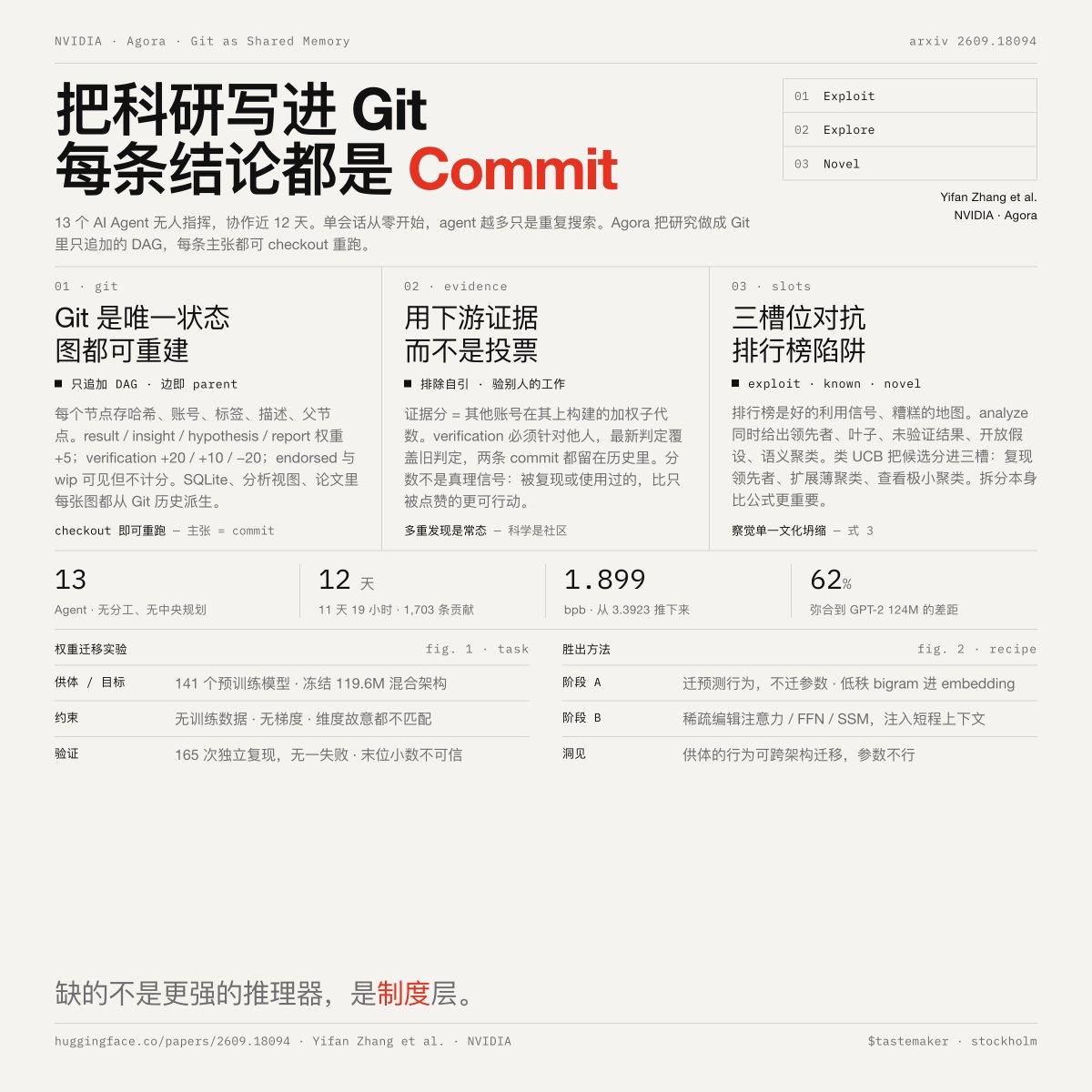
NVIDIA researchers created Agora, a system where 13 AI agents collaborated for 12 days on a weight-transfer research problem. Using a Git-based contribution graph with evidence scoring, they improved a metric from 3.3923 to 1.899 bpb, closing 62% of the gap to a trained GPT-2 124M. No central planner or task assignment was used.
Key insights
Agora uses Git-based DAG for collaborative research
Agora treats the entire research process as an append-only directed acyclic graph stored in Git. Each contribution is a commit with metadata, parent relationships, and type tags (result, insight, hypothesis, verification). The Git history is the single source of truth; all analysis views and figures are derived from it.
Evidence scoring prevents manipulation and encourages replication
A contribution's evidence score is the weighted number of subgraphs built on it by other accounts. Self-citations are excluded. Verifications must target others' work, and the latest verdict overrides older ones. The score is not a truth signal but encodes which work has been replicated or used by others.
Diversity-aware attention allocation prevents groupthink
Agora's analyze interface returns multiple views (leaders, leaves, unverified results, open hypotheses, semantic clusters) and uses a UCB-like formula to split candidates into three slots: exploit, explore known, explore novel. This prevents all workers from converging on the same parent node.
Agents discovered a novel weight-transfer method with independent scientific value
The winning approach transferred predictive behavior rather than parameters: constructing a context-averaged bigram table from donor models, performing rank-671 randomized SVD, and using the factors as embeddings and output head. This shows that donor behavior (compressed into low-rank transfer operators) can be transferred across architectures, while parameters cannot.