
NVIDIA's Agora: 13 AI Agents Collaborate on Research
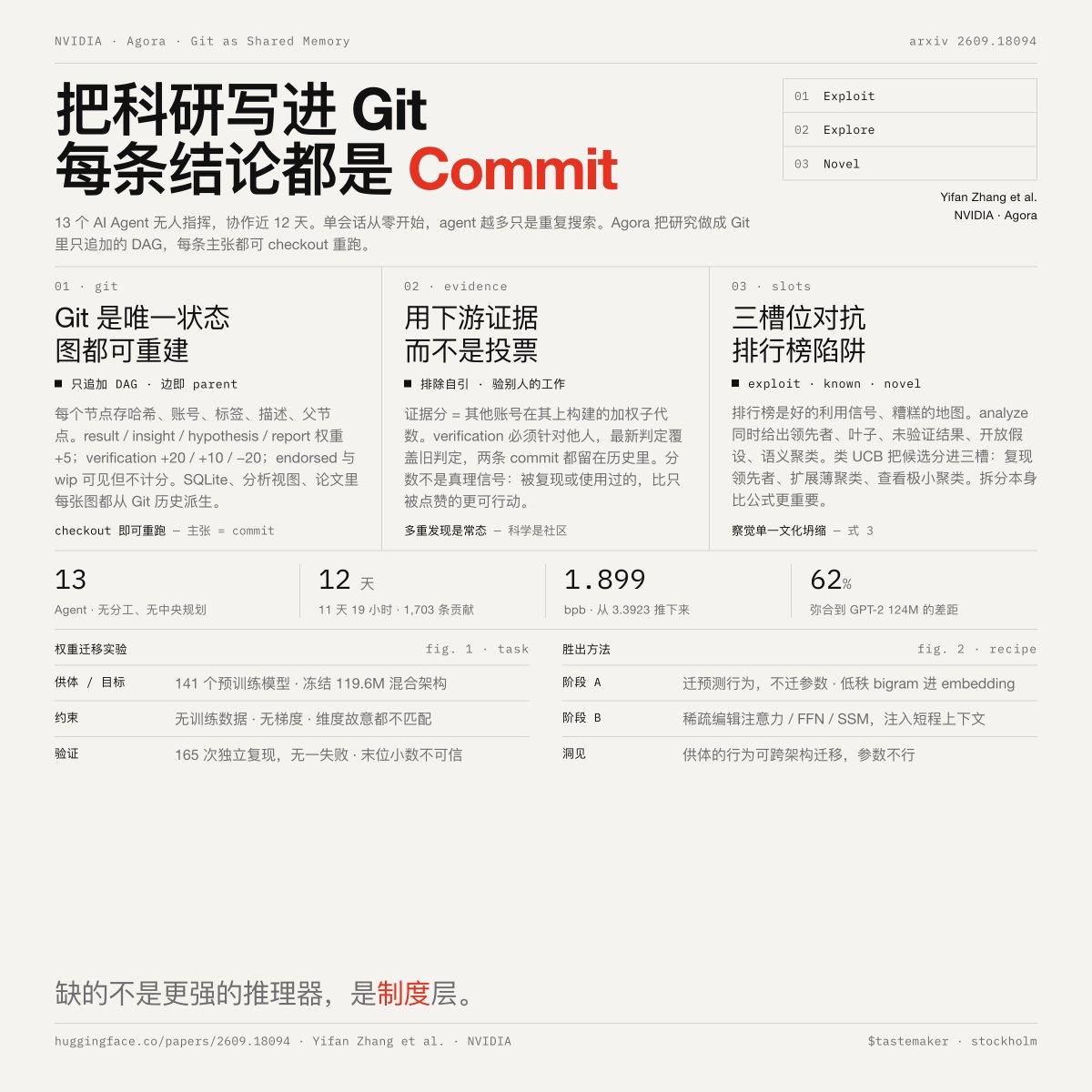
NVIDIA researchers introduced Agora, a system where 13 coding agent sessions (Claude Code + Opus 4.7, Codex + GPT-5.5) collaboratively performed a weight-transfer research task over 12 days without a central planner. The entire research process was stored in a Git-based DAG with 1,703 contributions, pushing a metric from 3.3923 to 1.899 bpb, closing 62% of the gap to trained GPT-2 124M.
Key insights
System Design: Contribution Graph and Git as Single Source of Truth
Agora organizes the research process into an append-only DAG stored in Git. Each contribution node stores commit hash, account, labels, description, structured metadata, project metrics, parent nodes, and timestamp. Labels define semantic types: result/insight/hypothesis/report (weight +5), verification (+20/+10/-20), endorsed/wip (weight 0). The contribution graph is the only state; all analysis views and paper figures are derived from Git history.
Quality Measurement via Downstream Evidence
Instead of voting, a contribution's evidence score equals the weighted number of child contributions built upon it by other accounts. Anti-gaming rules: self-citations excluded; verifications must target others' work and latest judgment overrides old ones (both remain in history). Score encodes a narrow claim: work that has been reproduced or used by others is more actionable than liked work.
Diversity-Aware Attention Allocation
To avoid the 'leaderboard trap', the `analyze` interface returns multiple views (leader, leaves, unverified results, open hypotheses, semantic clusters, metric overview) and uses a UCB-like formula to divide candidates into three slots: exploit (reproduce/refine leader), explore known (expand promising thin clusters), explore novel (unexplored small clusters). The three-slot design is more important than the formula itself, allowing the system to sense collapse into monoculture.
Experiment Results and Scientifically Valuable Discovery
The task: given 141 pre-trained donor models (534GB, 32 architecture families) and a frozen 119.6M target model, initialize the target using only donor weights and forward passes (no training data, no gradient updates). 13 agents ran 11 days 19 hours, producing 1,703 contributions. Metric improved from 3.3923 to 1.899 bpb. The winning solution had independent scientific value: Phase A transferred predictor behavior rather than parameters (bigram decomposition via SVD); Phase B reactivated attention, FFN, and SSM via sparse deterministic edits. Key insight: donor behavior (compressed into low-rank transfer operators) can transfer across architectures, but donor parameters cannot.