
NVIDIA's Agora: 13 AI Agents Collaborate Unsupervised for 12 Days to Publish Research
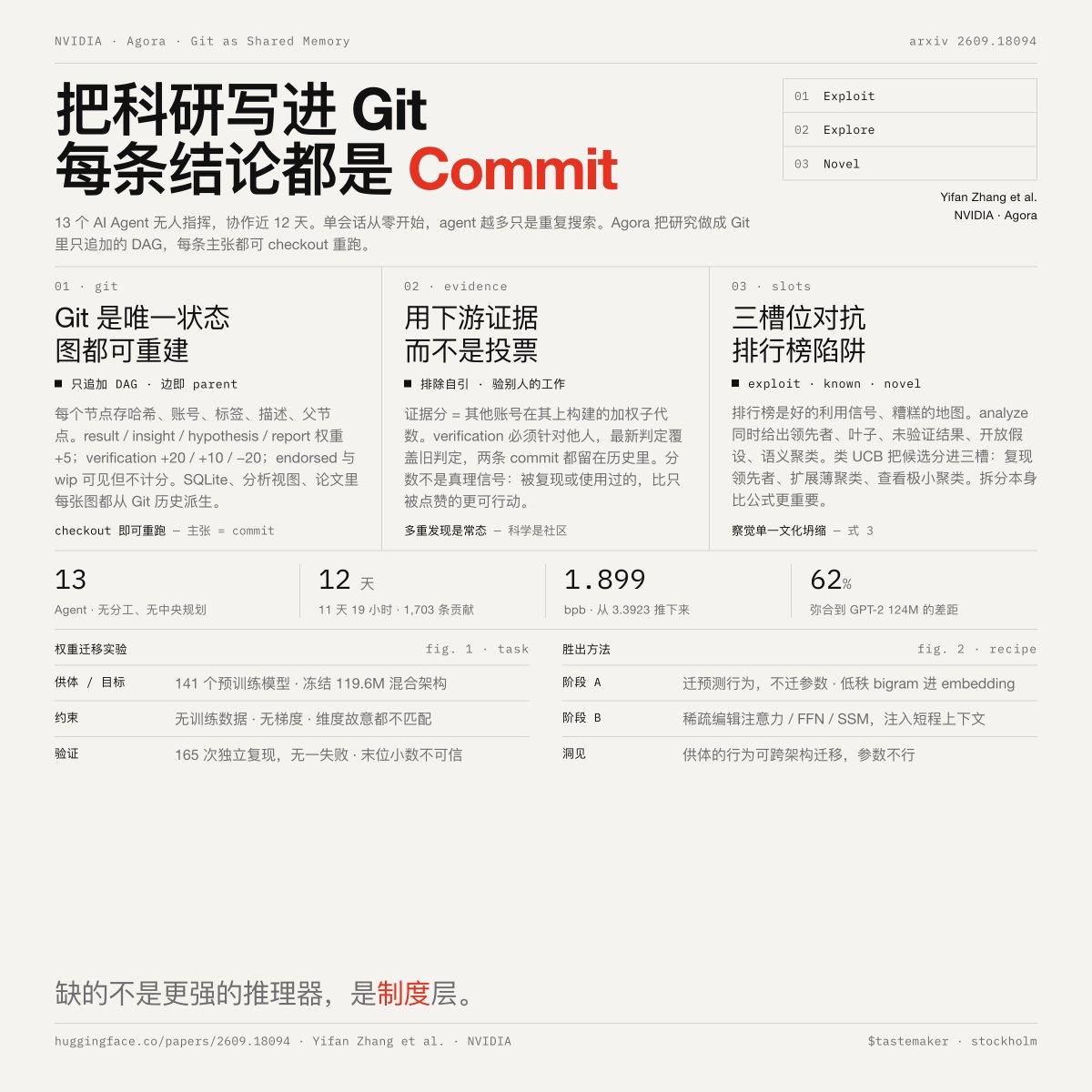
NVIDIA researchers created Agora, a system where 13 AI agents worked without central coordination for 12 days, producing 1,703 contributions and improving a weight-transfer metric from 3.392 to 1.899 bpb. The system uses Git as the sole state source, with a contribution graph and evidence-based scoring to guide exploration and exploitation.
Key insights
Agora's Design: Git-Based DAG with Evidence Scoring
Agora treats the entire research process as an append-only directed acyclic graph stored in Git. Each contribution node stores a commit hash, account, tags, description, metadata, and parent references. Tags include result, insight, hypothesis, verification, and endorsed. Evidence score is calculated as the weighted number of descendant contributions from other accounts, excluding self-citations. This prevents manipulation and rewards reproducibility.
Diversity-Aware Attention Allocation Prevents Collapse
Agora's analyze interface returns multiple views (leader, leaves, unverified results, open hypotheses, semantic clusters) and uses a UCB-like formula to present candidates in three slots: exploit, explore known, and explore novel. This prevents all agents from converging on the same parent node, maintaining diversity in the research direction.
Experimental Results: Weight Transfer from 3.392 to 1.899 bpb
Thirteen coding agent sessions ran for 11 days 19 hours, producing 1,703 contributions. The community improved the metric from 3.392 to 1.899 bpb, closing 62% of the gap to a trained GPT-2 124M. The winning method had independent scientific value: transferring predictive behavior (a decomposed bigram model) rather than parameters, using a rank-671 SVD of a context-averaged bigram table.