
NVIDIA's SoL-Pi Research: Automatically Optimizing Token Efficiency for Coding Agents
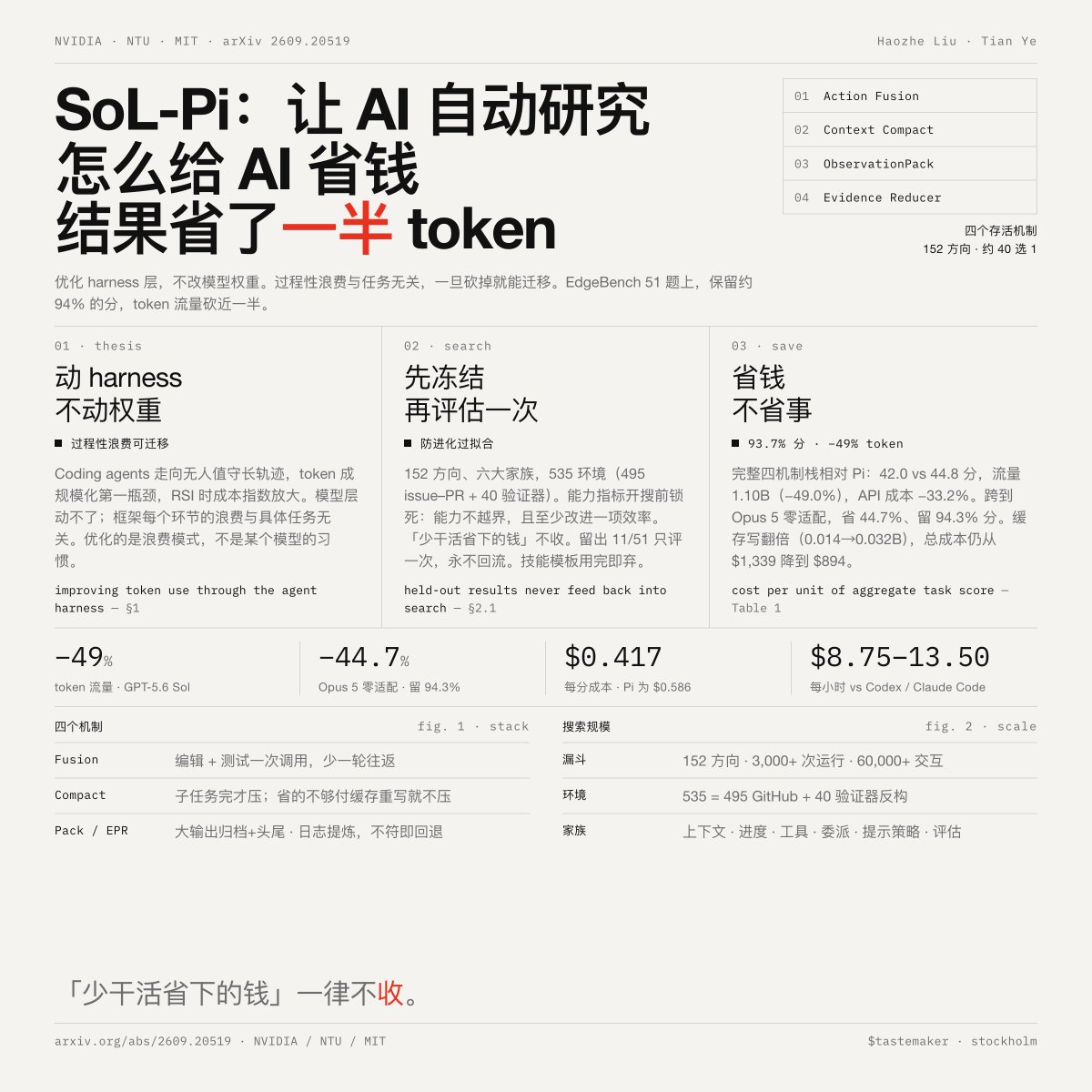
NVIDIA researchers developed SoL-Pi, an automated pipeline that discovers token efficiency optimizations for coding agents. After searching 152 research directions and running 3,000+ experiments, four mechanisms survived, including Action Fusion and Context Compact. On EdgeBench, SoL-Pi retained 94% of scores while reducing token traffic by 49% and API costs by one-third.
Key insights
Automated Research Pipeline with High Filtering Rate
SoL-Pi used an AI-driven research pipeline to automatically discover optimization mechanisms. It explored 152 research directions across six families, created 535 executable training environments, and ran over 3,000 agent-environment interactions. Only four mechanisms survived, a filtering rate of about 40:1. The pipeline used independent validation on a held-out set to prevent evolutionary overfitting.
Four Surviving Mechanisms Target Specific Token Waste Patterns
The four mechanisms are: Action Fusion (merge edit and test into one call), Context Compact (compress only when savings exceed cache rewrite cost), ObservationPack (archive large outputs locally, give model handle and excerpts), and Evidence Reducer (use cheap model to distill logs with verification). Each addresses a measurable waste pattern without degrading task performance.
Results: Token Savings Without Score Loss
On EdgeBench's 51 long-horizon tasks, SoL-Pi retained about 94% of scores while cutting token traffic by 49% and API costs by about one-third. The optimizations transferred to Opus 5 with similar savings (44.7%), confirming they target waste patterns rather than model-specific habits. Cost per unit score improved from $0.586 to $0.417.