
Open-source agent platforms: OpenTinker & Auto-Claude
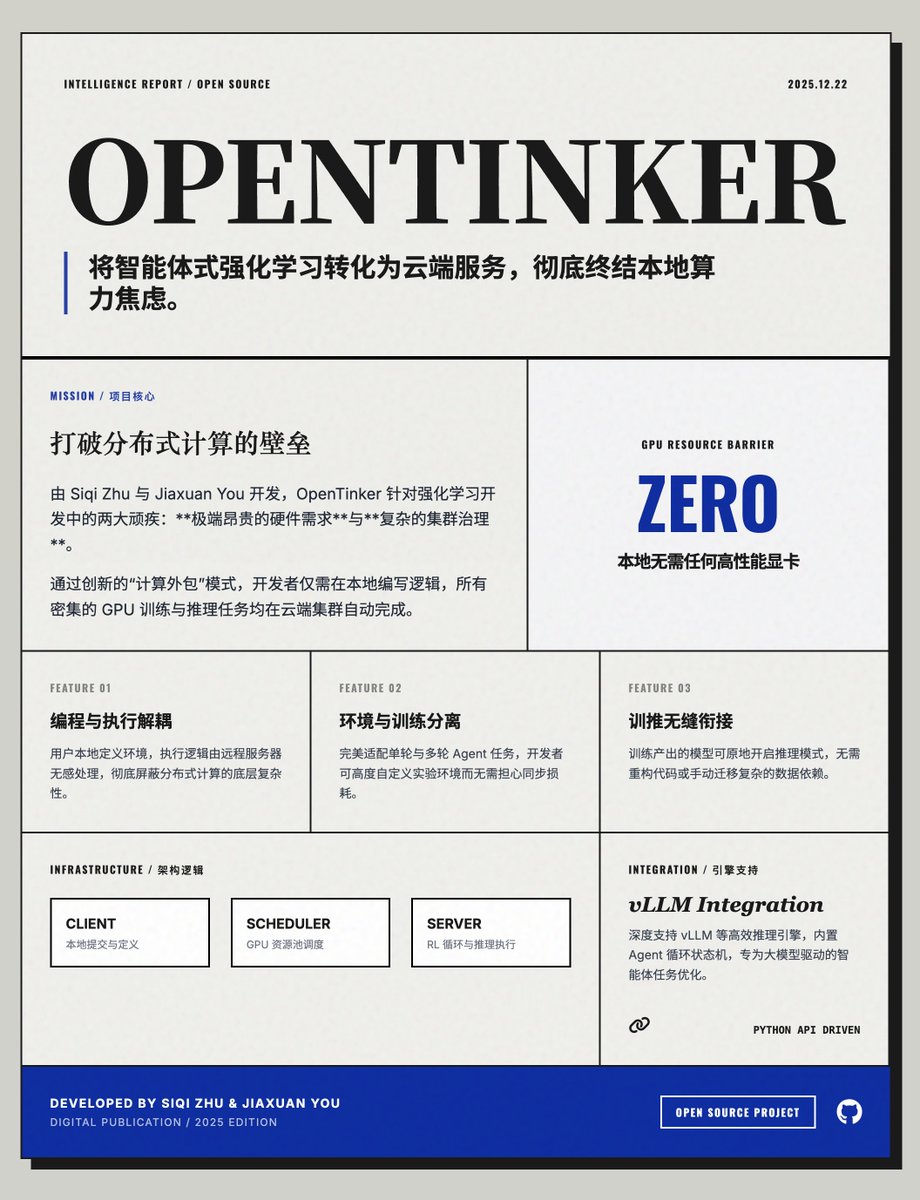
Two open-source projects offer cloud RL service and autonomous multi-session coding agents. - OpenTinker provides RL-as-a-service, no local GPU needed - OpenTinker separates programming and remote execution - OpenTinker uses scheduler + remote GPU worker pools - Supports vLLM inferencing and agent loop state machine - Auto-Claude builds autonomous multi-session coding agents - Auto-Claude uses Git worktrees to isolate work from main - Auto-Claude runs parallel Claude Code instances (up to 12) - Auto-Claude includes QA agents for self-validation and merge strategies - Auto-Claude stores cross-session memory in FalkorDB - Both emphasize context engineering and verification
Key insights
OpenTinker provides RL-as-a-service with cloud GPU scheduling
OpenTinker is an open-source platform designed to offer reinforcement-learning-as-a-service so researchers can train and infer without local GPUs. The system separates client programming from remote execution, uses a scheduler to manage GPU workers, supports environment and training separation, and exposes a unified Python API. It integrates with high-efficiency inference engines like vLLM and includes an agent loop state machine tailored for LLM-driven agents.
Auto-Claude automates multi-session coding with isolation and verification
Auto-Claude builds autonomous multi-session programming agents using Claude Code that plan, write, test, and verify code while protecting the main branch via Git worktrees. Key features include parallel multi-agent execution (up to 12 Claude Code instances), QA agents for self-validation, intelligent merge strategies for conflicts, cross-session memory via FalkorDB graph database, Kanban and changelog tools, and desktop UIs for macOS, Windows, and Linux.
Both projects emphasize context engineering and verification
OpenTinker and Auto-Claude emphasize architecture to separate concerns: OpenTinker separates client environment logic from cloud execution; Auto-Claude enforces context engineering by analyzing codebase structure, generating detailed specs, and running self-verifying QA loops before merging changes to main branches.
Auto-Claude includes long-term memory and parallelism for scale
Auto-Claude stores project insights and context in a graph database for cross-session memory and supports up to 12 simultaneous Claude Code endpoints to accelerate large tasks, plus UI tools for task boards and repository insights.