
Open-source agent tooling and developer frameworks
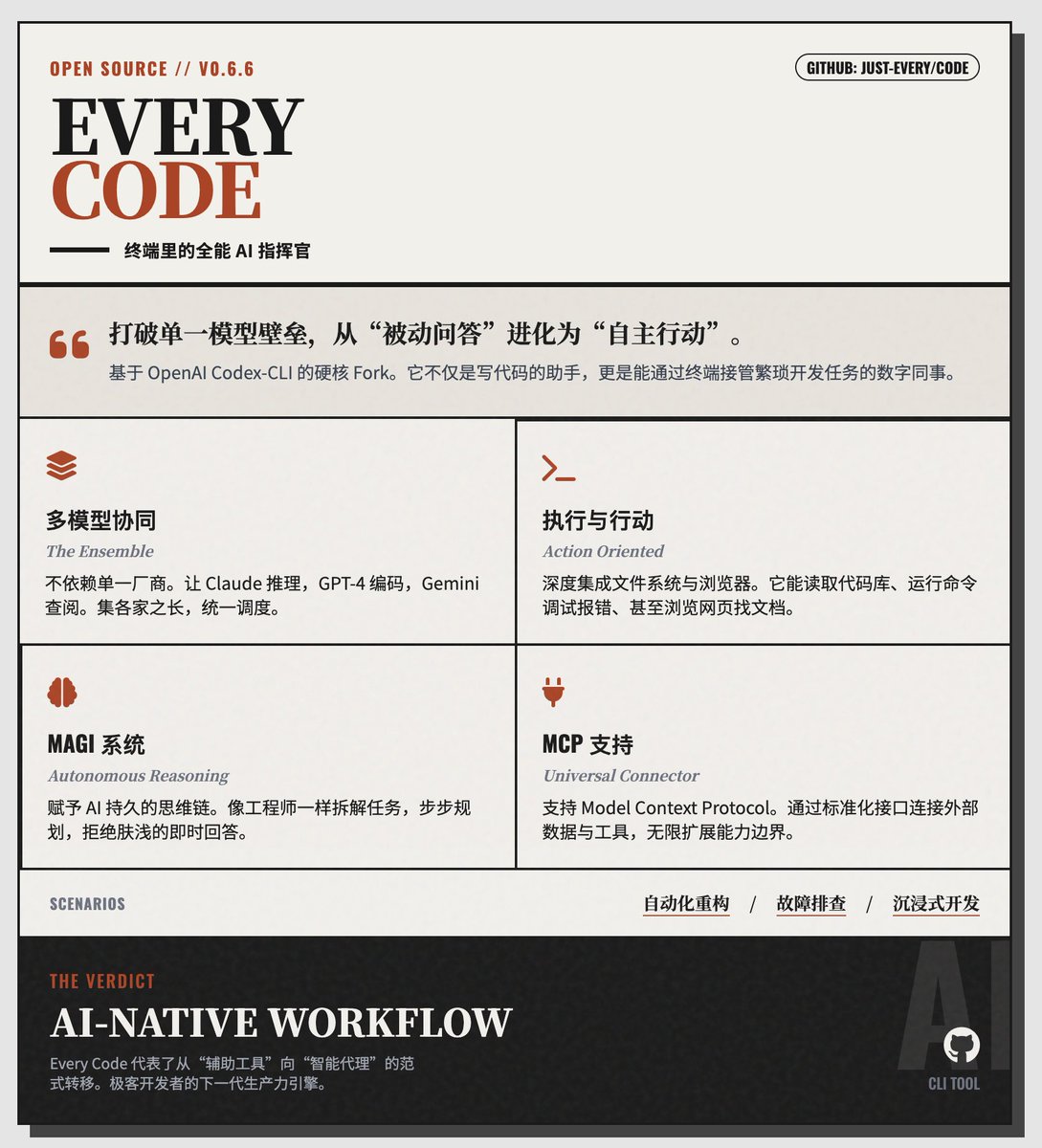
Open-source projects and integrations accelerate agent engineering and developer workflows. - Every Code unifies multiple models (OpenAI, Claude, Gemini) to read repos, run commands, and execute multi-step tasks with an Ensemble component. - OpenSkills provides a skills package manager for agents; v1.3.0 adds private repo installs, CI/CD options, and security protections. - pi is a minimalist terminal-first AI coding agent emphasizing transparency and four simple tools (read, bash, edit, write). - WarpGrep is a retrieval sub-agent optimized via RL for fast, high-recall codebase searches and reduces context pollution. - SonarQube MCP Server integrates static analysis into AI coding agents for real-time code quality checks within IDEs. - Simon Willison advocates single-file HTML Tools as a lightweight LLM-friendly development pattern. - Slide Deck and other projects illustrate rapid prototyping patterns for generative UI and content pipelines.
Key insights
Multi-model orchestration and execution with Every Code
Every Code is an open-source fork that integrates multiple LLM providers (OpenAI, Claude, Gemini) under one interface and adds execution capabilities: reading local code, running shell commands, debugging, and web browsing. It features an Ensemble component to rotate and combine models for different sub-tasks and a 'Magi' planner to break complex jobs into multi-step plans executed across tools.
OpenSkills standardizes agent skills and addresses context limits
OpenSkills functions as a package manager for agent 'skills', enabling agents to list minimal skill menus and dynamically load full manuals only when needed. Version 1.3.0 added private repo installs, non-interactive CI/CD flags, soft-linking for development, and path-traversal protections—enabling enterprise integration and safer, production-ready skill distribution.
Minimalist agents prioritize transparency and control
The 'pi' project implements an intentionally minimal AI coding agent focused on explicit, visible operations and a compact toolset (read, bash, edit, write). The approach rejects opaque heavy feature sets in favor of predictable behavior, manual visibility into steps, and developer control over model switching and debugging.
Specialized subagents and retrieval engines improve coding agent performance
WarpGrep separates codebase search into a reinforcement-learning-optimized subagent, providing parallel grep/list/read operations to reduce search time, lower token consumption, and limit context pollution. Reports indicate improved task completion rates and lower token costs when integrated with coding agents.
Code quality tools integrate into AI workflows
SonarQube's new MCP Server integrates static analysis into AI coding agent flows inside IDEs, providing real-time scanning and instantaneous feedback for security, maintainability, and reliability issues—supporting faster write-check-fix loops in AI-assisted development.
Lightweight front-end patterns support rapid LLM-driven tooling
Simon Willison's 'HTML Tools' pattern promotes single-file, zero-backend microapps that are LLM-friendly and portable. The pattern emphasizes no-build, CDN usage, URL-based state, localStorage for secrets, and browser-native capabilities, improving speed of prototyping and privacy.