
Open-source AI dev and knowledge tools (RAG, memory, notebooks)
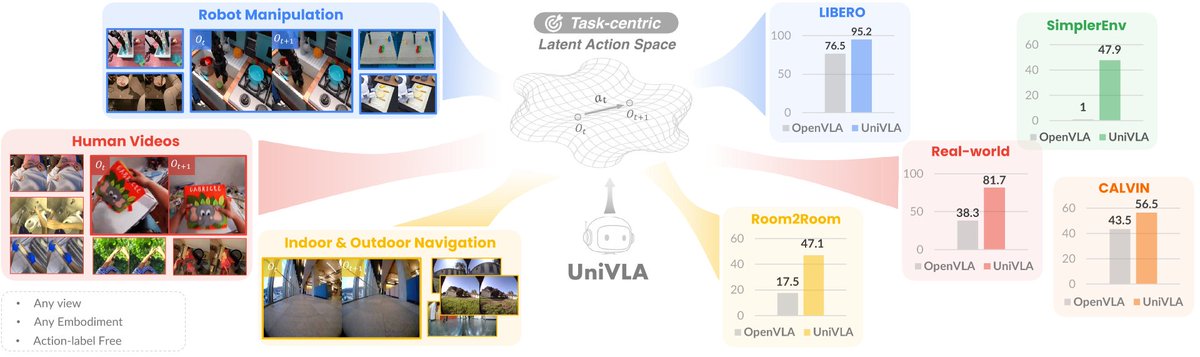
Multiple open-source projects advance AI dev, memory, RAG, and robot strategy tooling. - UniVLA proposes a unified cross-robot policy learning approach, reusing action spaces across morphologies - awesome-ai-memory lists vector/graph memory tools and compares projects like Cognee, Mem0, Zep - SurfSense offers an open-source personal knowledge assistant integrating Notion, GitHub, Slack and local models - Chroma Cookbooks provide example integrations for vector DB Chroma - RAG-Anything creates multi-modal RAG pipeline for text, images, tables, formulas - Tabminal provides persistent browser terminal with AI assist and mobile optimization - tensor.h teaches neural networks from scratch in C for pedagogical clarity - Voice Live API Sales Coach simulates sales conversations with speech and feedback - AI-for-Grant-Writing and other cookbooks collect templates and prompts for domain-specific tasks
Key insights
Open-source projects focus on reusable memory and multi-modal RAG infrastructure
Several projects provide curated toolkits: awesome-ai-memory catalogs memory backends (vector vs graph), RAG-Anything offers end-to-end multimodal RAG for complex documents, and Chroma Cookbooks provide practical integration recipes. These projects aim to reduce integration friction and standardize patterns for retrieval-augmented generation and long-term memory.
Personal knowledge and developer productivity apps are moving open-source and extensible
SurfSense positions itself as an open-source alternative to NotebookLM and Perplexity by connecting browser captures, Notion, GitHub, Slack and local models; Tabminal offers persistent web terminals with AI assistants. These projects prioritize user data control and integration extensibility.
Domain-specific open-source cookbooks and simulations accelerate practical adoption
Specialized repositories—Chroma Cookbooks for vector DB examples, Voice Live API Sales Coach for spoken sales practice, AI for Grant Writing templates—provide actionable examples and prompts, lowering the barrier for domain teams to build AI-enhanced workflows.
Robot policy learning sees efficiency gains via unified action spaces
UniVLA proposes a cross-morphology policy learning method that abstracts actions into task-centric latent spaces, enabling reuse across robot types and achieving strong performance with lower compute relative to prior baselines.
Source posts
- Original post by @GitHub_Daily on X
- Original post by @GitHub_Daily on X
- Original post by @shao__meng on X
- Original post by @GitHub_Daily on X
- Original post by @GitHub_Daily on X
- Original post by @GitHub_Daily on X
- Original post by @GitHub_Daily on X
- Original post by @GitHub_Daily on X
- Original post by @shao__meng on X