
Open-source AI GitHub projects (UniVLA, tensor.h, Claude Code Transcripts)
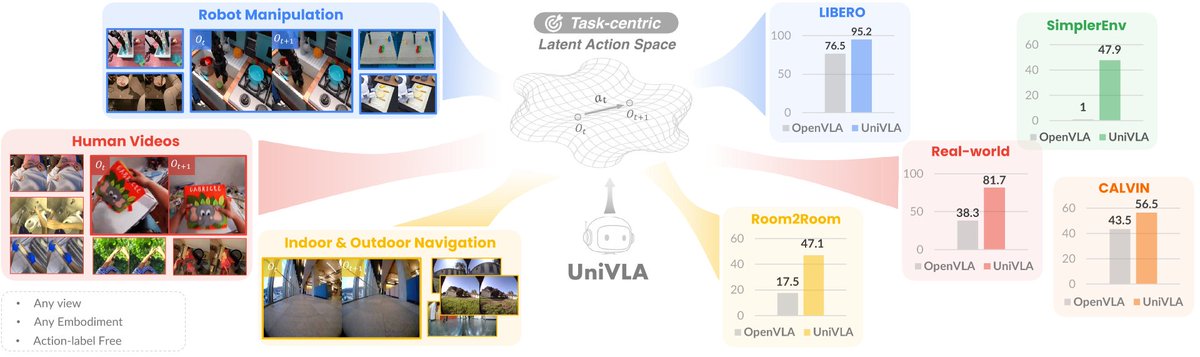
New GitHub projects publish tools advancing robotics, education, and developer workflows. - Proposes unified, cross-morph policy learning - Extracts task-centered latent actions - Unifies action space for cross-hardware training - Trains on cross-morph video data - Claims SOTA on multiple benchmarks using 5% OpenVLA compute - Provides rich pretrained model library - Supports LoRA for efficient fine-tuning - Converts Claude Code JSON/JSONL to paginated HTML - Generates index and per-page HTML for mobile - Sources sessions from local files and web APIs - Uses Python (Click, Jinja2, httpx) and Apache 2.0 license - Implements pure-C tensor tutorial with autograd and MNIST
Key insights
UniVLA proposes unified cross-morph robot policy
UniVLA proposes a unified, cross-morph policy-learning approach that extracts task-centered latent actions so models learn "what to do" rather than hard-coded motor trajectories. The project unifies action spaces to permit training on cross-morph video data rather than hardware-specific data, and provides a pretrained model library plus LoRA support for efficient fine-tuning and deployment. The project reports leading results on multiple benchmarks while using 5% of the compute of OpenVLA, and documents model and dataset combinations for reproducible use.
tensor.h teaches neural nets via a pure-C tensor library
tensor.h is an educational GitHub project that implements a minimal tensor library in pure C with no dependencies. The tutorial explains tensor creation, shape and stride mechanics, forward and backward operations, autograd implementation, loss functions, and training loops, and demonstrates end-to-end training on MNIST and cat-vs-dog classification. The repository pairs code with mathematical derivations to show how matrix multiplications, ReLU, LogSoftmax, and chain-rule gradient computation form the core of neural network training.
Claude Code Transcripts converts Claude sessions into shareable HTML
Claude Code Transcripts is a Python CLI tool that converts Claude Code JSON/JSONL session files or web sessions into paginated, mobile-friendly HTML (index and per-page views). It supports local session directories, web session extraction (via reverse-engineered Anthropic API), and batch archiving; features include code highlighting, timeline overviews, and one-click upload to GitHub Gist (via GitHub CLI). The tool uses Click, Jinja2, httpx, and pytest-based snapshot testing, is Apache 2.0 licensed, and extracts tokens from macOS Keychain for automated API access.
Open-source toolset emphasizes reproducibility and deployment
The three projects emphasize reproducibility and deployment: UniVLA ships pretrained models and LoRA-ready checkpoints for efficient adaptation to real robots; Claude Code Transcripts generates stable HTML archives with snapshot tests and Gist sharing to preserve dialogue-driven development logs; tensor.h surfaces low-level implementations and derivations to support reproducible learning of neural internals. Collectively, the repositories document dataset and implementation details to support model reuse and reproducible training workflows.