
OpenAI Agent Research: Context, Monitoring and GPT-5.2-Codex
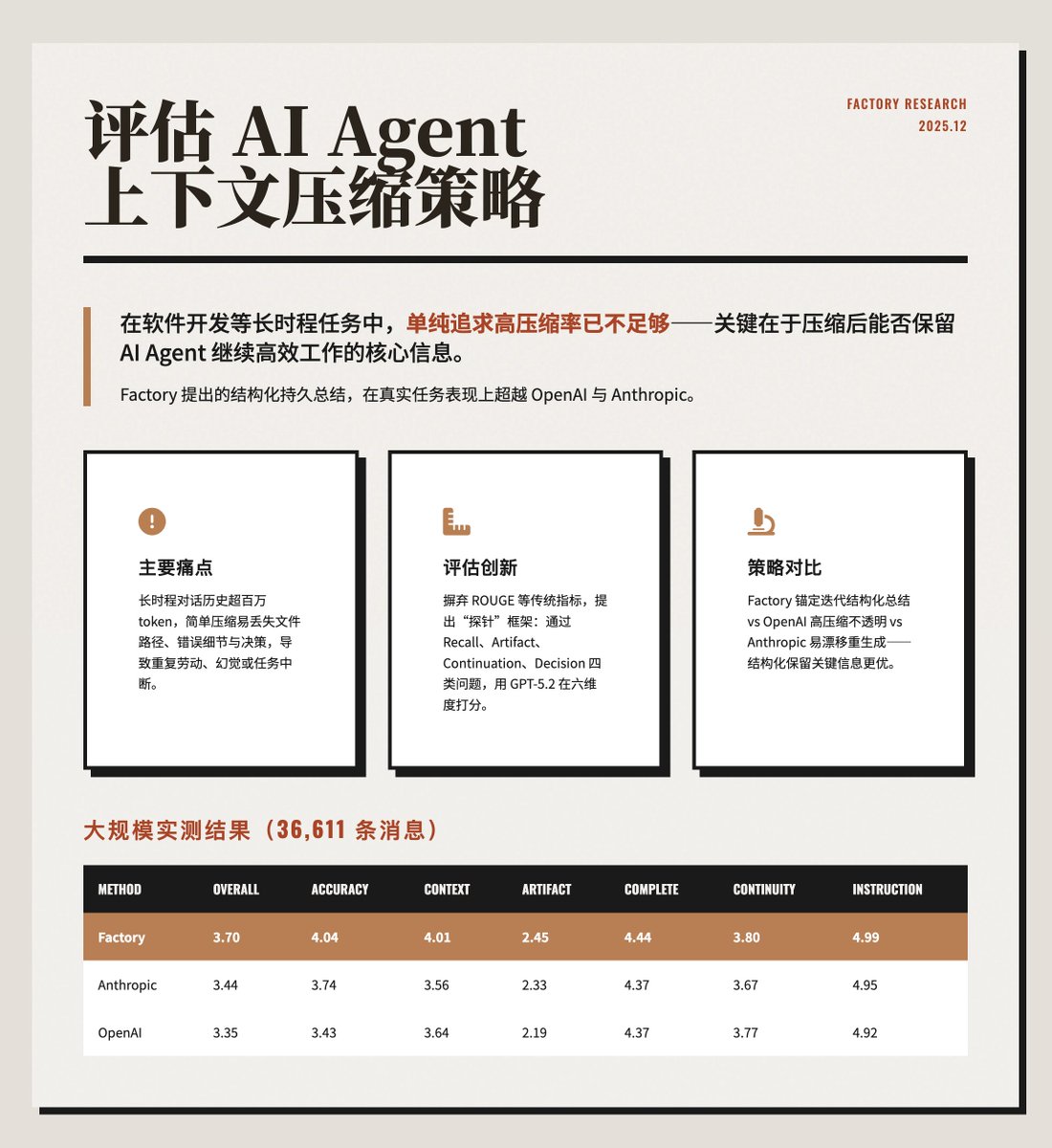
OpenAI publishes agent-focused research and a new coding model. - Evaluation compares context compression strategies for long-running AI agents. - For continuous tasks, high compression alone is insufficient; compressed context must retain key actionable details (file paths, errors, decisions). - FactoryAI’s anchored iterative structured summarization outperformed OpenAI and Anthropic on task continuation metrics. - OpenAI’s /responses/compact achieved 99.3% compression but lost low-entropy technical specifics. - Anthropic produced structured summaries but re-generated each time, causing drift. - New probe-based evaluation tests Recall, Artifact, Continuation, Decision using GPT-5.2 as grader. - Box CEO argues "context engineering" is the next system moat: retrieval, heuristic ranking, prompts, state/space optimization needed. - OpenAI research on Chain-of-Thought (CoT) monitorability: longer internal reasoning can improve monitorability; a “monitorability tax” exists favoring small-model+deep-think over large-model+shallow. - Reinforcement learning presently does not reduce CoT monitorability at current scales; follow-up questions can increase transparency. - OpenAI released GPT-5.2-Codex (Dec 18, 2025): positioned as an Agentic Coding Model for long tasks, with native context compression, stability, improved security capabilities, visual/UI understanding. - Benchmarks: SWE-Bench Pro 56.4%, Terminal-Bench 2.0 64.0%, improved over GPT-5.1.
Key insights
Structured summarization beats extreme compression for agent continuity
An evaluation comparing context compression strategies found that approaches prioritizing structured, persistent summaries (FactoryAI’s anchored iterative summarization) preserved actionable technical details such as file paths, error traces, decisions, and next steps, enabling AI agents to continue long-running tasks effectively. Methods that maximized compression (OpenAI’s /responses/compact with 99.3% reduction) frequently dropped low-entropy but crucial data, causing repeated work and hallucinations. The probe-based evaluation tested Recall, Artifact, Continuation and Decision with GPT-5.2 as a judge and scored across accuracy, context awareness, artifact tracking, integrity, continuity and instruction following.
Context engineering identified as the strategic moat for agent systems
Box’s CEO argued that failures of sophisticated agents are shifting from reasoning capability to lack of relevant background information. The post lists four investment areas: large-scale low-latency retrieval and recall, heuristic ranking of retrieved context, system prompt engineering to define tasks, and state/space optimization to fit more precise context into limited windows. The post highlights compute-driven information processing as a unique AI advantage.
Chain-of-thought monitorability improves with deeper reasoning but incurs a tax
OpenAI research describes "CoT monitorability," finding that allowing models longer internal reasoning often makes their reasoning more observable to external monitors. The work identifies a "monitorability tax": smaller models with deeper reasoning are easier to monitor than larger models with shallow responses. Current reinforcement learning signals have not materially reduced monitorability at leading scales, and targeted follow-up questioning can increase transparency.
GPT-5.2-Codex launched as an Agentic Coding Model with improved long-task handling and security
OpenAI announced GPT-5.2-Codex on Dec 18, 2025, positioning it as an Agentic Coding Model that operates like an autonomous engineer: executing in terminals, writing and debugging code, and maintaining focus on long tasks via native context compression and iterative stability. The model improves cybersecurity assistance (noted prior discovery of a React vulnerability with earlier models) and adds visual/UI understanding to convert design sketches into prototype code. Benchmark results list SWE-Bench Pro at 56.4% and Terminal-Bench 2.0 at 64.0%, exceeding GPT-5.1.