
OpenAI: ChatGPT App Design and AI Native Engineering Team Practices
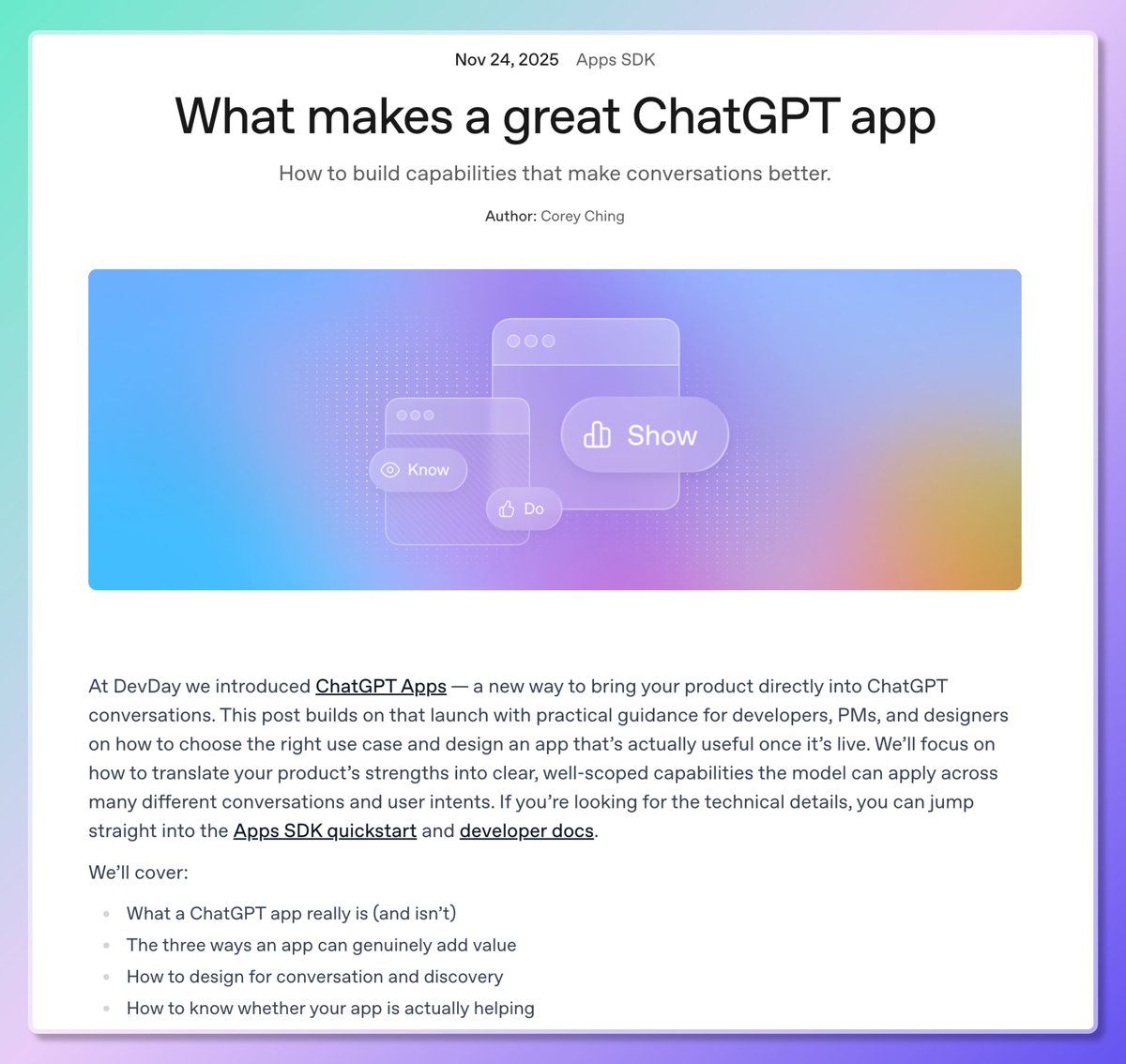
A summary of discussions surrounding OpenAI's App and engineering team practices: OpenAI published an article explaining how to design a truly user-friendly ChatGPT App, along with resources to guide the construction of AI native engineering teams. The community also discussed the impact of AI on the roles of engineers and collaborative methods.
Key insights
ChatGPT App Should Be Designed as a Set of Capabilities Rather Than a Simple Porting of Traditional Applications
OpenAI's design guidelines emphasize that the ChatGPT App cannot simply replicate existing web or mobile applications. In the ChatGPT context, users do not actively 'open' the app; instead, the model determines when to invoke a capability during the conversation. Therefore, a qualified ChatGPT App should be designed as a set of capabilities that can be invoked by the model, streamlined and refined for conversational scenarios, rather than directly porting existing products into the dialogue.
Practical Resources for Building AI Native Engineering Teams Available for Adoption
The community shared a PDF and practical suggestions on how to build AI native engineering teams, aimed at helping technical team managers understand team organization, role distribution, and how to integrate AI capabilities into the development process. These resources provide a reference path and principled guidance for teams transitioning from traditional engineering to AI native engineering.
AI Drives the Evolution of Engineer Roles Towards Full-Stack and End-to-End Capabilities
Community discussions pointed out that AI capabilities enable engineers to handle more aspects of work, promoting the trend towards full-stack development and the realization of end-to-end organizational capabilities. The viewpoints raised in the discussions include that AI allows individuals to independently complete many tasks, thereby changing traditional collaborative division of labor and leading to a rethinking of engineering skills and team collaboration methods.