
OpenAI GPT-6 Astra launch benchmark and community demos
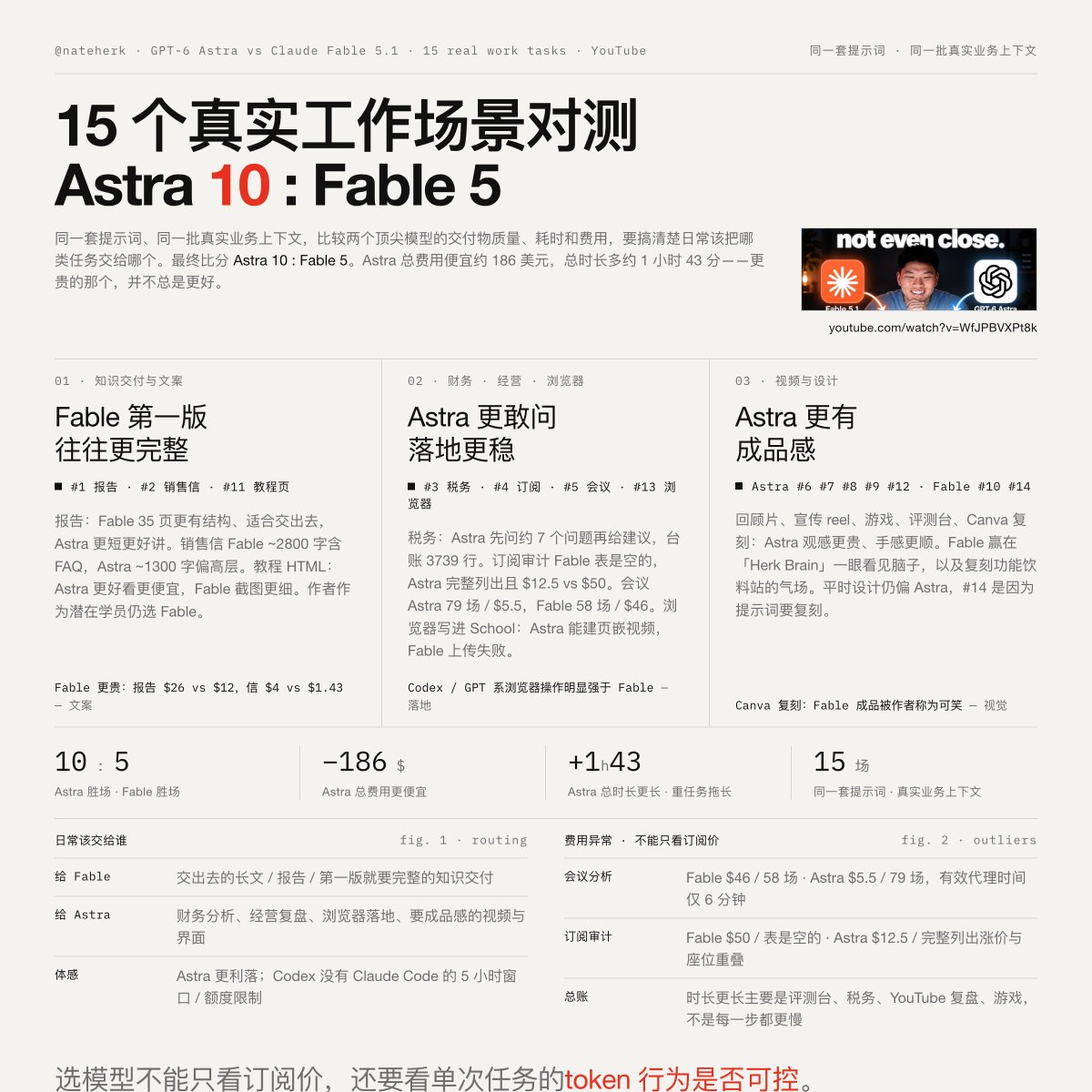
OpenAI's GPT-6 Astra launched and community benchmarks show it outperforming Anthropic's Claude Fable 5.1 in 10 out of 15 real-world work scenarios, with a final score of Astra 10 : Fable 5. The benchmark covered knowledge delivery, financial analysis, video/design, and browser tasks. Astra was cheaper overall by $186 but took 1 hour 43 minutes longer total. In specific tasks, Astra excelled in financial analysis (e.g., subscription audit, meeting analysis) and browser operations, while Fable won in some knowledge delivery tasks. A designer stated Astra is "almost unbeatable" in design, and another user replicated Figma's core editor in 30 minutes using Codex (GPT-6 Astra). Astra generated a motion graphics video in 14 minutes with only 2 revisions. Prompt examples include a bill negotiator. Computer Use demonstrated shortcuts like directly inputting URLs. Some users feel Astra has reached AGI level, citing 10 examples including human anatomy, Lego, GTA, V8 engine, and forest. NVIDIA confirmed GPT-6 Astra was trained on ~100K+ NVIDIA Grace Blackwell NVLink72 GPUs.
Key insights
GPT-6 Astra Beats Claude Fable 5.1 in 10 of 15 Real-World Tasks
A comprehensive benchmark by @nateherk compared GPT-6 Astra and Claude Fable 5.1 across 15 real work scenarios using the same prompts. Astra won 10 tasks, Fable won 5. Categories included knowledge delivery (Fable won 2, Astra won 1), financial analysis (Astra won all 4), video/design (mixed, Astra won 3, Fable won 2), and browser tasks (Astra won 1). The final score was Astra 10 : Fable 5.
Cost and Time Analysis: Astra Cheaper but Slower on Some Tasks
Overall, GPT-6 Astra was $186 cheaper than Claude Fable 5.1 but took 1 hour 43 minutes longer total. However, per-task costs varied significantly. For example, Fable's meeting analysis cost $46 for 58 meetings, while Astra cost $5.5 for 79 meetings. Astra's subscription audit cost $12.5 vs Fable's $50. In some tasks, Astra was both cheaper and faster, while in others it was slower but produced better quality.
Design Capabilities: Astra Called 'Almost Unbeatable'
A designer reported that GPT-6 Astra is 'almost unbeatable' in design, surpassing previous models like Fable 5, Opus 5, and GPT-5.6. The designer used Figma to complete BI and page design work. Another user replicated Figma's core editor using Codex (GPT-6 Astra) in about 30 minutes, creating a demo video. Astra also generated a motion graphics video in 14 minutes with only 2 revisions.
Computer Use and Automation: Smart Shortcuts and Prompt Examples
GPT-6 Astra's Computer Use feature demonstrated intelligence by taking shortcuts, such as directly inputting URLs instead of simulating clicks. A user used it to read Suno songs, collect prompts, and remix them. Prompt examples include a bill negotiator that checks bills and negotiates with providers. The model can automate complex browser-based workflows.
Community Speculation: Astra Approaching AGI
Some users feel GPT-6 Astra has reached AGI level, citing 10 'crazy' examples including human anatomy, Lego sets, GTA game, V8 engine, and forest. While not official, these demonstrations show the model's versatility across diverse domains.
Training Infrastructure: 100K+ NVIDIA Grace Blackwell GPUs
NVIDIA confirmed that GPT-6 Astra was trained on approximately 100,000+ NVIDIA Grace Blackwell NVLink72 GPUs. This highlights the massive computational resources required for state-of-the-art AI models.
Browser and Codex Tasks: Astra Stronger Than Fable
In browser-based tasks, GPT-6 Astra (Codex) consistently outperformed Claude Fable 5.1. For example, Astra successfully opened a backend, created pages, embedded videos, and saved drafts, while Fable failed to upload videos. The author noted that Codex/GPT series is clearly stronger in browser operations.