
OpenAI Internal Model Solves Navier-Stokes and 100+ Open Math Problems
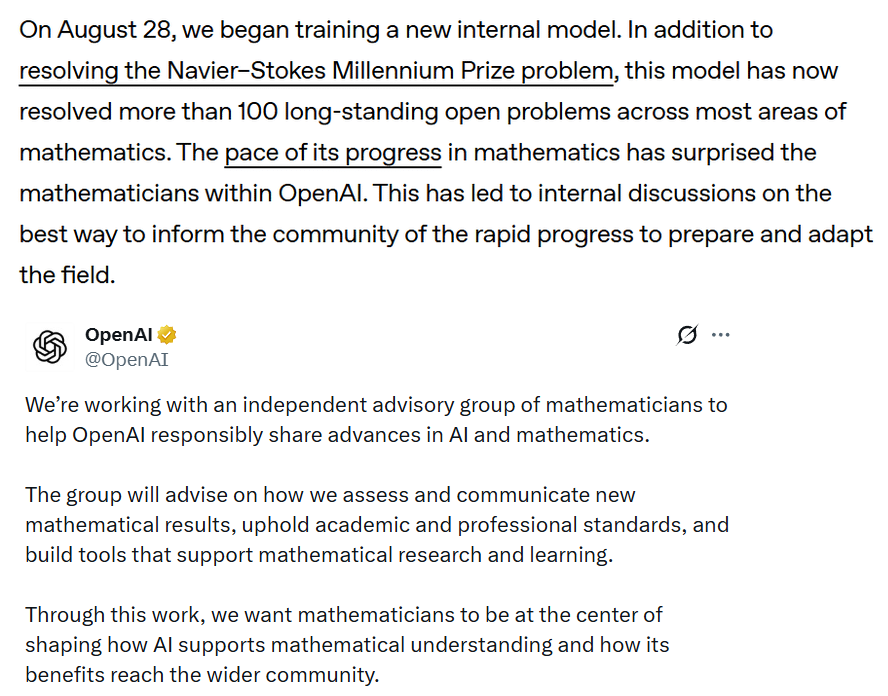
OpenAI announced an internal model trained from August 28 solved the Navier-Stokes millennium problem and over 100 open math problems. In response, 27 Fields medalists signed an open letter criticizing the approach as bypassing mathematical methodology. OpenAI formed an independent advisory group including Fields medalists to evaluate results.
Key insights
AI Achieves Major Mathematical Breakthrough
OpenAI revealed that an internal model, training started August 28, solved the Navier-Stokes existence and smoothness problem (one of seven Millennium Prize Problems) and over 100 long-standing open problems across mathematics. The speed surprised even OpenAI's own mathematicians. The model's results are being evaluated by an independent advisory group.
Fields Medalists Criticize AI's Approach to Mathematics
On September 11, 27 Fields medalists including Terence Tao, Peter Scholze, and Pierre Deligne published an open letter titled 'AI's Severe Misalignment in Mathematics'. They argued that solving problems is not just about answers but about developing new methods and understanding. They accused AI companies of treating open problems as benchmark scores, bypassing paper writing, method extraction, and citation, potentially cutting the chain of knowledge transfer.
OpenAI Forms Independent Advisory Group
In response, OpenAI established the 'Mathematics and AI Advisory Group' (AGMAI) hosted at the Institute for Advanced Study in Princeton. Members include Fields medalists Timothy Gowers and Martin Hairer, physicist Edward Witten, and nine top mathematicians from Harvard, Stanford, Berkeley. The group members do not receive payment from OpenAI, can publish opinions freely, and may criticize OpenAI's impact on mathematics. However, the group is explicitly not tasked with recommending a slowdown in AI development.