
OpenAI Launches GPT-5.6 with Three Tiers and New Features
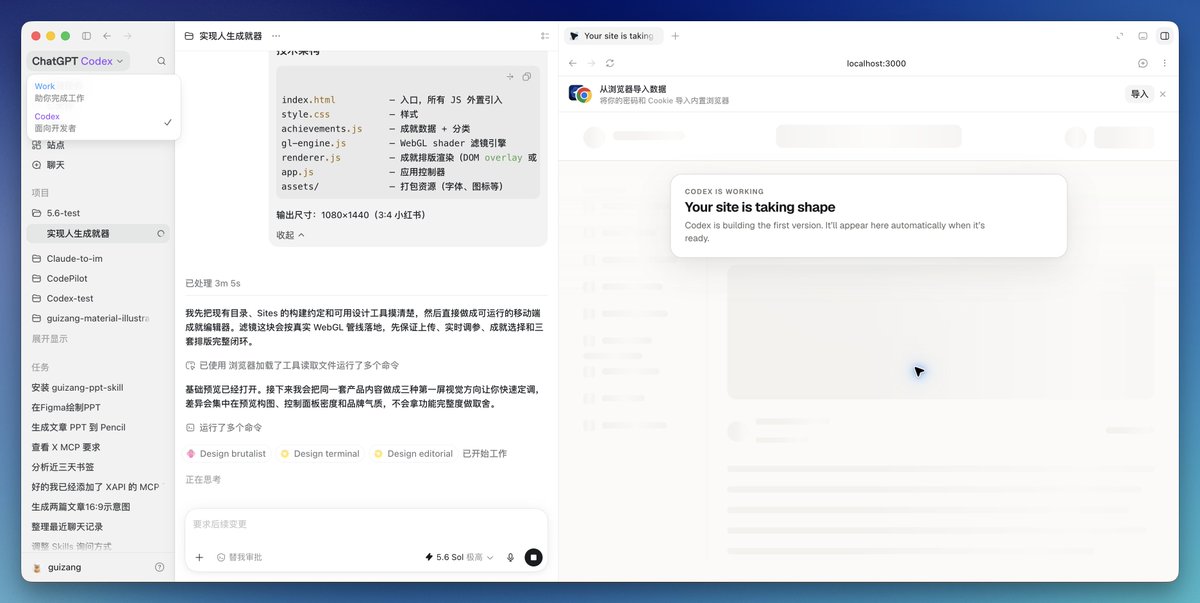
OpenAI launched GPT-5.6 with three tiers, a unified desktop app, and the ChatGPT Work agent feature. The model tiers are Sol (flagship, complex reasoning), Terra (cost-effective, half price of GPT-5.5), and Luna (lightweight, cheap). API pricing: Sol $5/M input, $30/M output; Luna $1/M input, $6/M output. Free/Go users default to Terra; Plus and above can select. Sol introduces max (deeper thinking) and ultra (multiple sub-agents) reasoning modes; ultra limited to Pro/Enterprise. ChatGPT and Codex merged into a single desktop app with Chat, Work, and Codex modes, sharing capabilities and history. Codex has 5M weekly active users; over 1M use it for non-dev tasks. ChatGPT Work: cross-application agent that connects Google Drive, Slack, email, autonomously decomposes projects, executes tasks, and can set recurring tasks. Work available on web and mobile. Sites feature: one-click shareable websites from ChatGPT visualizations. Browser upgrade supports login, multi-tab, file downloads, Chrome extension for computer use. Codex updates: in-app file editing, PR/feedback view, Ultra mode, import from Claude Code. OpenAI's super app strategy targets Google Workspace and Microsoft 365; IPO filed; enterprise contributes 40% revenue. GPT-5.4 retiring July 23, 2026. User feedback reports interface confusion: chat shrunk to small popup, Work/Code tabs seen as unnecessary, mimics Anthropic. Site plugin generates web pages with multiple templates, connects business data, and deploys to OpenAI. Mobile ChatGPT now calls Codex plugins. Browser and computer use upgraded for speed and accuracy. GPT-5.6 front-end output improved. A user tested Sol to build an online model comparison tool with good speed and results.
Key insights
GPT-5.6 introduces three distinct tiers with targeted pricing
OpenAI released GPT-5.6 with three tiers: Sol (flagship, complex reasoning, long autonomous work), Terra (cost-effective with performance near GPT-5.5 at half price), and Luna (lightweight, fast, cheap). API pricing is set at $5/M input and $30/M output for Sol, and $1/M input and $6/M output for Luna. Free and Go users default to Terra, while Plus and higher can choose any model. The tiered approach aims to serve different user segments, from budget-conscious to power users.
New reasoning modes expand model capabilities
Sol introduces two reasoning modes: 'max' allows the model to spend more time on deep thinking, and 'ultra' invokes multiple sub-agents to process tasks in parallel. The ultra mode is currently limited to Pro and Enterprise users. These modes enhance GPT-5.6's ability to handle complex, multi-step problems by simulating concurrent agents.
ChatGPT and Codex merge into a unified desktop application
OpenAI merged ChatGPT and Codex into a single desktop app with three modes: Chat, Work, and Codex. All modes share the same underlying capabilities and task history, differing only in interface presentation—Codex shows code diffs and PRs, Work hides technical details for non-developers. Codex now has 5 million weekly active users, with over 1 million using it for non-coding tasks. The unification is part of OpenAI's strategy to consolidate products and accelerate development.
ChatGPT Work transforms AI into an autonomous task agent
ChatGPT Work is a new agent feature that goes beyond answering questions. It can connect to external services like Google Drive, Slack, and email, autonomously decompose complex projects into steps, execute tasks independently, and ask for user input only when needed. It supports scheduled recurring tasks, such as summarizing Slack messages weekly. Work is also available on web and mobile, enabling users to initiate and track tasks remotely.
Sites and browser upgrades extend ChatGPT's utility
The Sites feature allows users to turn ChatGPT visualizations, dashboards, or small tools into shareable websites with one click. The browser now supports login-based website operations, multiple tabs, and file downloads, and a new Chrome extension enables ChatGPT to operate within the browser. These upgrades give the 'Computer Use' capability more practical applications, allowing ChatGPT to perform actions on behalf of the user.
User experience criticism: confusing interface and forced separation
Early users report that the new unified interface is confusing. The chat function has been reduced to a small popup in the bottom-right corner, and the mandatory separation into Work and Code tabs is seen as unnecessary and disruptive. Many users struggle to find previous conversations or understand the new layout. One user described it as 'forced merging' that mimics Anthropic's Claude desktop app, wiping out months of user familiarity with Codex.
Strategic push for IPO and enterprise lock-in
OpenAI's product updates align with its IPO ambitions. The unified app combines chat, coding, browsing, and file operations into a productivity platform directly competing with Google Workspace and Microsoft 365. With enterprise users contributing 40% of revenue, the unified platform aims to lock in enterprise customers and strengthen the IPO narrative. The retirement of GPT-5.4 on July 23 further signals the transition.