
OpenAI 'The State of Enterprise AI 2025' Report
OpenAI releases a 2025 enterprise AI report documenting expanded depth and scale of corporate AI use.
Key insights
Enterprise AI scaled from experiments to core infrastructure
OpenAI's 'The State of Enterprise AI 2025' uses usage data from over one million enterprise customers and surveys of 9,000 employees to report that AI is shifting from early experiments to core enterprise infrastructure. The report highlights massive growth in integrated use, with ChatGPT Enterprise message volume up eightfold and API token consumption up 320x in the prior year, indicating deeper system embedding.
Custom GPTs and Projects show strong workflow embedding
Custom GPTs and Projects usage grew 19x annually, demonstrating enterprises are building task‑specific AI assistants for repeatable multi‑step workflows rather than one‑off chat interactions. Heavy users saving over 10 hours weekly consume eight times the compute of average users and use advanced reasoning and multimodal features more frequently.
Measured productivity and business outcomes reported
The report quantifies benefits: employees save an average of 40–60 minutes daily. Examples include Lowe's doubling conversion via a shopping assistant and Moderna reducing planning analysis from weeks to hours, indicating AI impacts both efficiency and strategic business metrics.
Sector and geographic adoption patterns identified
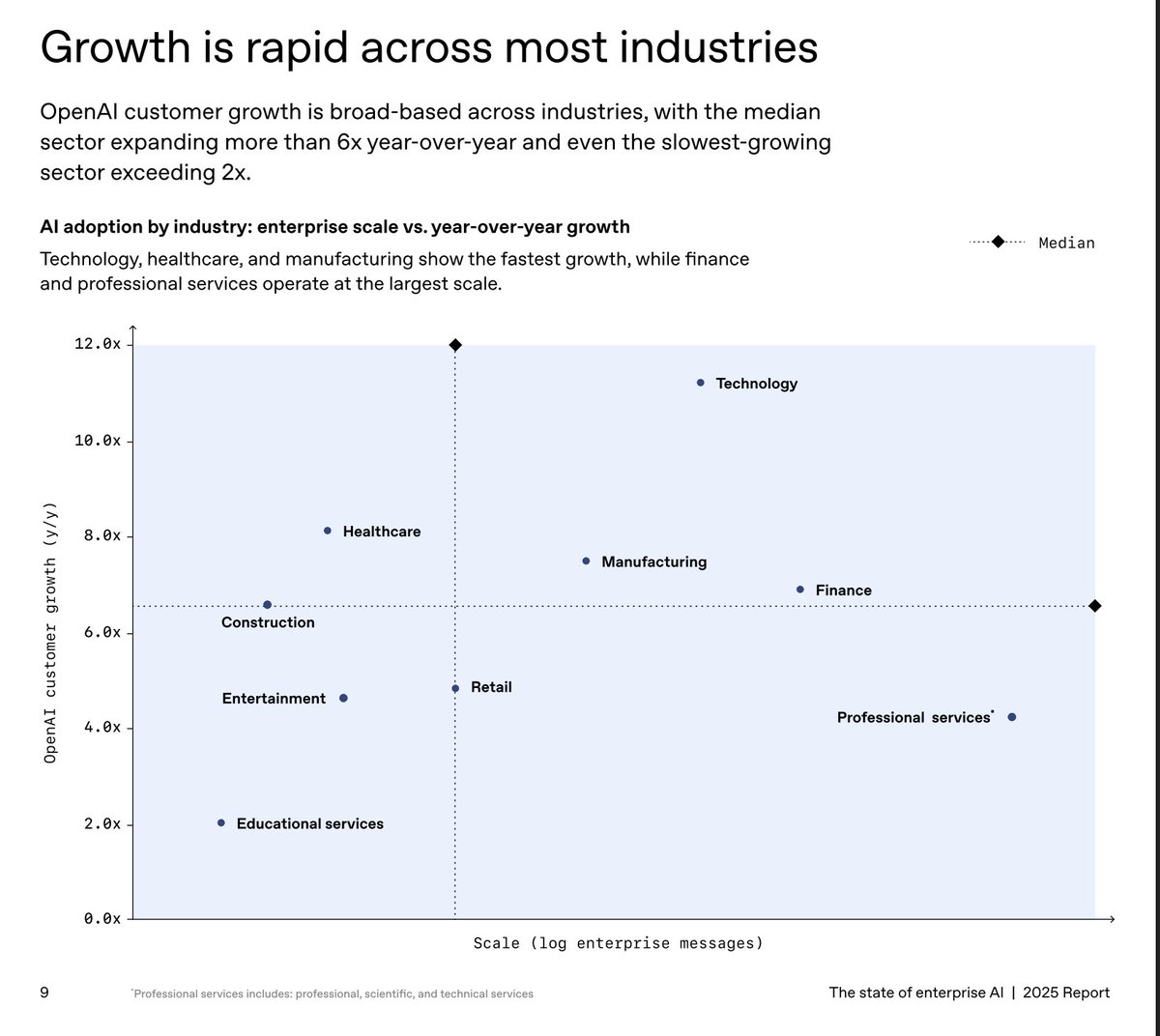
Technology, healthcare, and manufacturing are fastest‑growing sectors; professional services and finance remain the largest users. Rapid adoption growth is noted in Australia, Brazil, the Netherlands, and France (>143%). The report flags a widening maturity gap between frontier users and median users at both individual and corporate levels.
Best practices for enterprise AI adoption enumerated
OpenAI lists five actions observed in leading adopters: deep systems integration enabling secure data/tool access; workflow standardization and sharing of Custom GPTs; explicit executive support; data readiness and machine‑readable pipelines; and decentralized change management via an 'AI advocate' network.