
Organizational Change & Tech Diffusion (Ivan Zhao / Diffusion Theory)
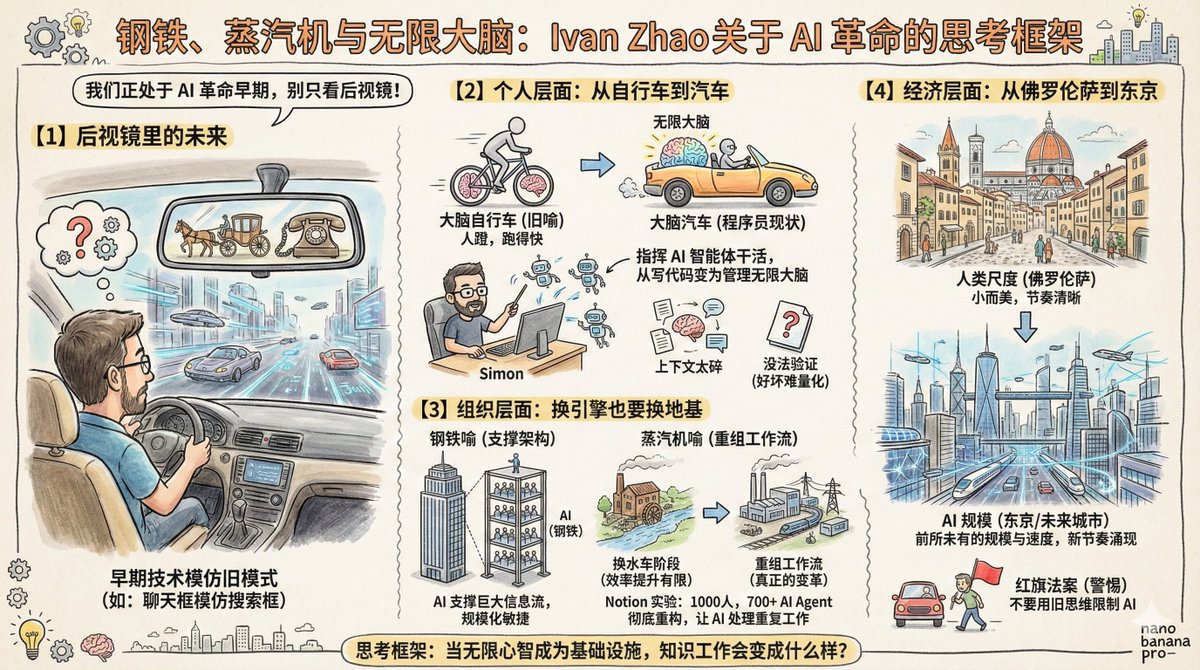
Ivan Zhao compared AI’s adoption to historical infrastructure shifts (steel, steam), arguing AI will reshape individual roles, organizational design and urban-scale economic structures. • Early adopters misinterpret new tech through legacy frames; AI is currently viewed through 'search/chat' metaphors. • Personal productivity shift: programmers moved from 'bicycle' (assistive) to 'car' (agent orchestration); some engineers no longer type code, they manage AI agents. • Two constraints for broader diffusion: consolidating context (scattered info) and verifiable outcomes (hard-to-quantify tasks). • Organizational analogies: AI acts as 'steel' for information structures and like 'steam' enabling re-placement of work patterns; full benefit requires redesigning workflows not just swapping tools. • Diffusion S-curve accelerates: GenAI adoption timelines are shorter (3 years) compared to prior technologies; cross-company pressures and capital incentives will accelerate deployment. • Advice: focus on durable learning skills, structural re-design, and recording decision rationale for AI to learn business knowhow.
Key insights
AI is a foundational infrastructure shift requiring workflow redesign
Ivan Zhao argued AI is analogous to industrial infrastructure (steel and steam): incremental tool swaps are insufficient. Organizations must redesign processes, information flows and measurement systems (context graphs, decision recording) to realize AI’s full potential rather than simply adding chat interfaces to existing workflows.
Personal productivity transforms role definitions; programmers lead early
Zhao described a transition where programmers evolve from individual coders to supervisors of 'infinite brains'—orchestrators of multiple AI agents. He noted the broader diffusion to other roles requires improving context capture and verifiable outcome measures for non-code tasks.
Diffusion theory: the adoption 'chasm' and rapid GenAI S-curve
The diffusion framework (S-curve and adopter categories) was applied to GenAI. Zhao and commentators pointed out that GenAI adoption is occurring faster than prior technologies (3-year mainstream penetration) and that crossing the early-adopter-to-early-majority chasm requires concrete ROI and workflow fit.