
Prompt engineering and book-specific companion prompts
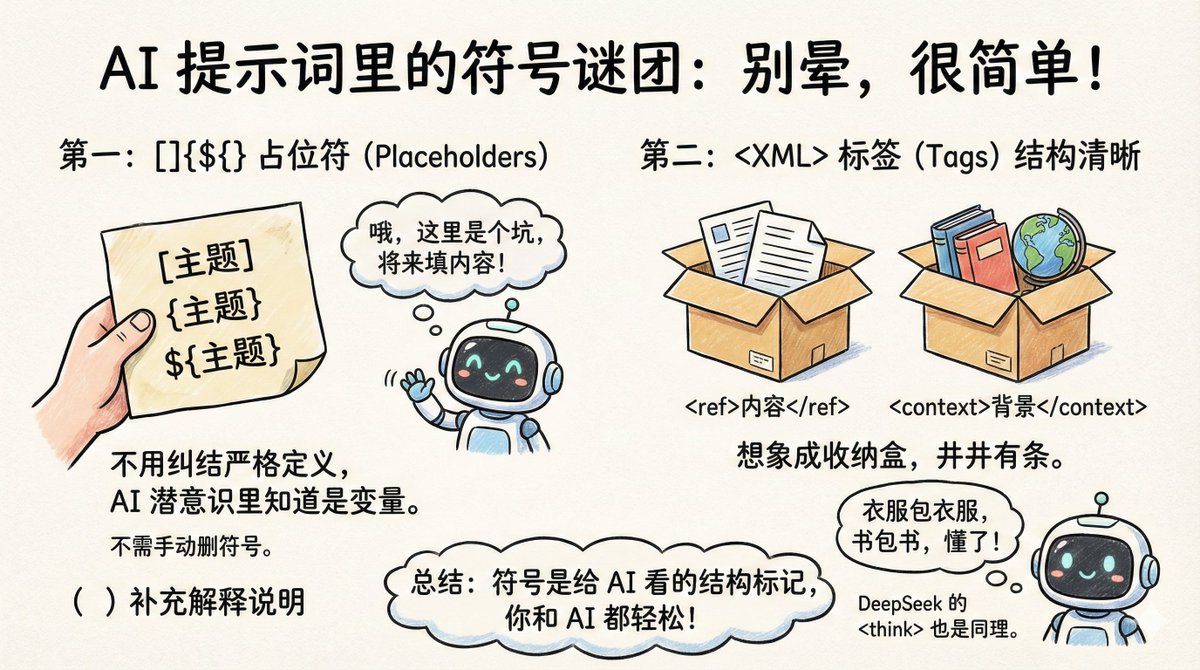
Prompt engineering explains placeholder use. - Brackets like [] {} and ${} are commonly used as placeholders. - These bracket forms are not strictly defined for prompts. - Large language models trained on code recognize brackets as variables/parameters. - AI infers intent from context; exact bracket type is not critical. - Parentheses () are used for explanatory background or notes. - XML-style tags (e.g., <ref>, <context>) structure prompt sections. - DeepSeek uses <think>…</think> to box internal reasoning. - Tags act as containers to organize content for AI and humans. - Practice: create a dedicated companion prompt per book and feed passages or sentences to that prompt while reading.
Key insights
Brackets and placeholders are flexible and AI-understood
Brackets such as square [], curly {}, and templated ${} are used as placeholders in prompts and do not have strict, distinct definitions; large language models trained on code recognize these symbols as variables or parameters and infer the intended fill-in from context. Prompt authors do not need to memorize rigid rules or manually remove such markers before providing content, and parentheses () are often reserved for supplying explanatory background within prompts. (Source: instructional post explaining bracket usage.)
Use XML-like tags to structure prompts
XML-style tags (for example <ref>...</ref> or <context>...</context>) are recommended to make prompt structure explicit; these tags act as containers that separate and organize different semantic parts of a prompt for both AI processing and human readability. An implementation example cited is DeepSeek, which wraps reasoning in a <think>...</think> block. Structured tags help keep complex prompts modular and clearer, which facilitates more orderly model behavior.
Create a custom companion prompt per book
A practical method is to design a single, dedicated companion prompt for each book one is reading and use that tailored prompt as the active 'reading companion.' During reading, readers should send specific passages, paragraphs, or sentences to that book-specific prompt to deepen engagement and analysis. This approach centralizes commentary and interpretation for each book under a consistent prompt persona or behavior.