
Prompt Libraries and Generative Image Workflows
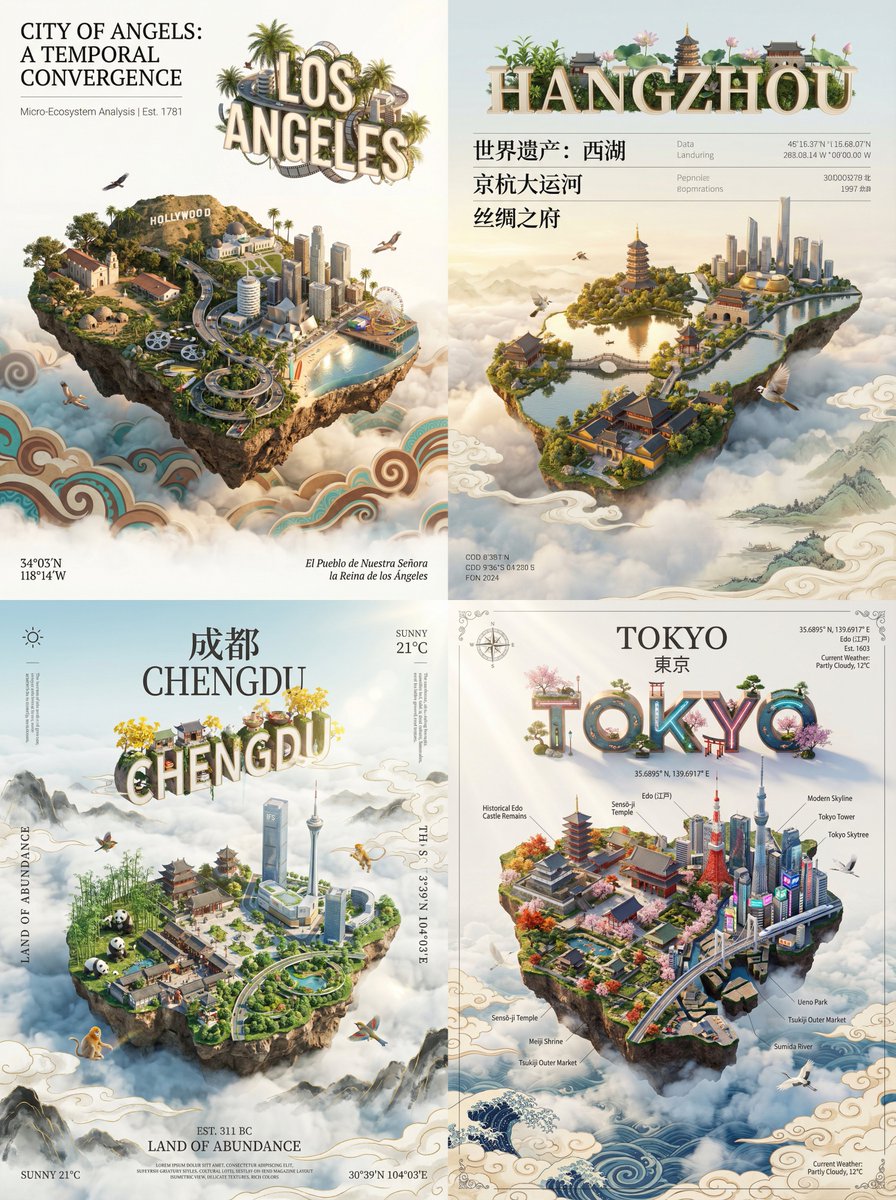
Prompt libraries and generative-image workflows advance with new tools and detailed prompts. - Nano Banana Pro offers a city-poster prompt that auto-adjusts elements by chosen city. - The poster prompt specifies island-shaped city micro-island, landmarks, fauna, timelines, and typographic museum-style layout. - Style directives include Octane Render, C4D, isometric city, 8k resolution, DreamWorks-like 3D modeling. - A prompt-tool for programmers combines a pattern library and a command-line interface for composing prompts, likened to functional programming. - Some generated images now reach commercial composition quality. - Text rendering in images remains weak compared to other elements. - An author described an iterative avatar-creation process: define intent, generate many versions, pick closest, then fine-tune and crop for small sizes.
Key insights
Nano Banana Pro city-poster prompt detailed specification
Nano Banana Pro provides a high-detail prompt pattern for generating a city-specific digital art poster: the prompt instructs an island shaped like the chosen city, integrating landmarks, natural features, local fauna, geographic coordinates, founding dates, and nicknames. It mandates a museum-quality typographic information panel, restrained layout with serif and minimalist sans-serif fonts, and visual style directions such as Octane Render, C4D, isometric micro-world, 8k resolution, and DreamWorks-style 3D modeling. The post frames the prompt as adaptable so all elements auto-adjust to the selected city.
Prompt library plus CLI enables composable prompt engineering
A recommended prompt tool targeted at programmers includes two parts: a prompt-pattern library aggregating community prompt patterns and a command-line utility that helps combine those patterns into composed prompts. The tool is described as analogous to functional programming for prompts, enabling modular composition and reuse of prompt elements. The post highlights the tool's utility for developers by streamlining prompt combination and making complex prompt assembly more reproducible.
Generative images reaching commercial composition but text rendering lags
Multiple examples show that overall image composition and commercial viability have improved; a user commented that compositions are commercially usable. However, the same commenter noted that text rendering remains imperfect, citing specific cases where typographic details were insufficient. The post contrasted acceptable environmental and detail rendering with weaker text outcomes, indicating a gap between visual composition quality and embedded textual accuracy.
Iterative avatar creation process emphasizes intent and small-size readability
An author described an iterative process for generating a new avatar: define expressive intent (curiosity), choose theme (boy looking at the Milky Way), select stylistic constraints (black-and-white silhouette for small-size clarity), generate multiple variants, pick the closest result, then refine attributes like age, galaxy angle, horizon treatment, and framing for avatar crop. The author explained rejecting color variants because color details blurred at avatar size and reduced recognizability, preferring monochrome for contrast and consistent identification.