
Prompting and Chain-of-Thought: Practices to Enhance Model Output Quality
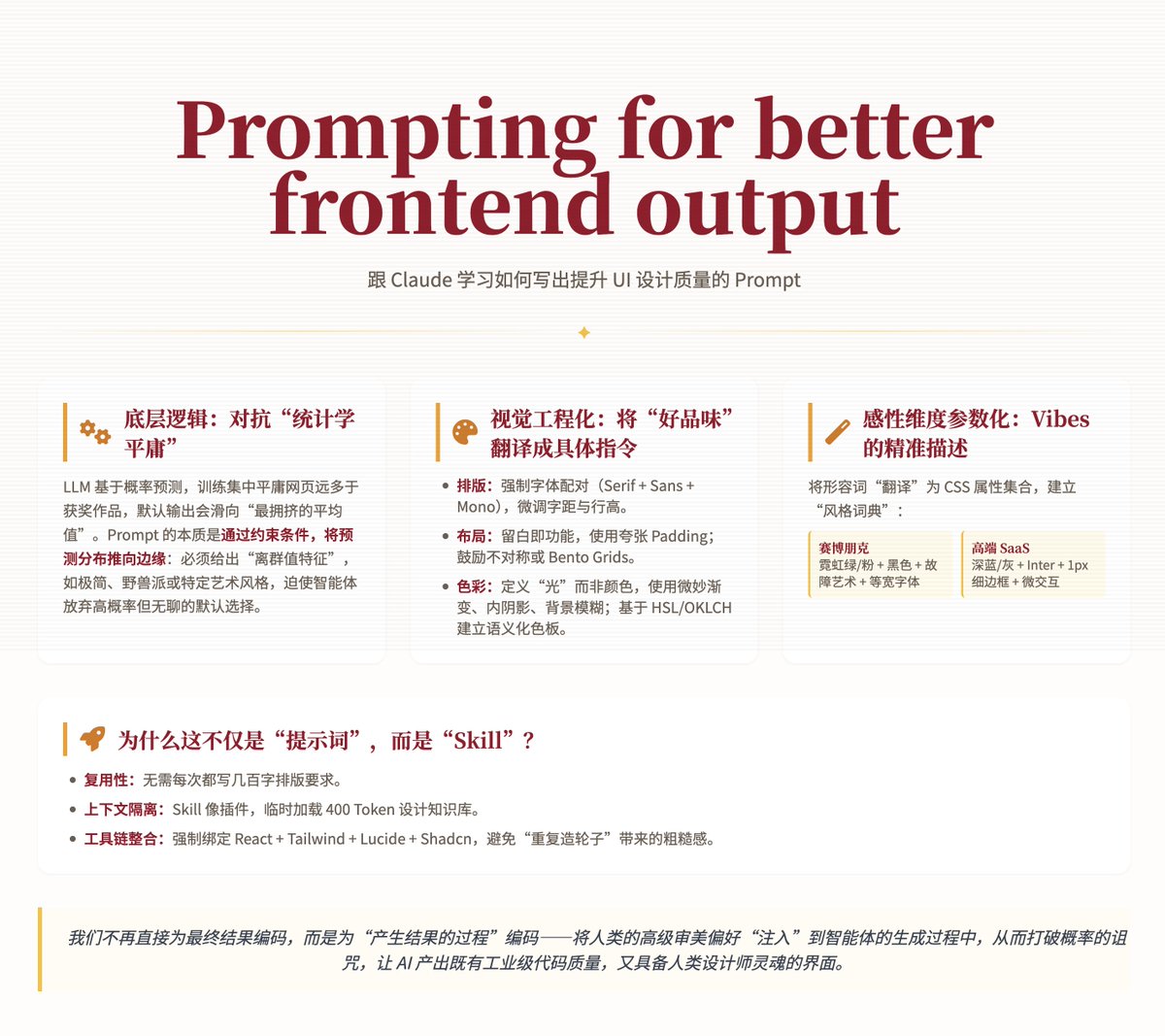
Two articles focus on improving model output quality through Prompt/Skill and the language limitations of Gemini CoT. Claude's blog suggests using Skills to counteract the 'statistical mediocrity' of model outputs. The essence of Prompting is to constrain the model's predictive distribution to produce outlier features. Visual engineering strategies include a set of specific instructions across three dimensions: typography, layout, and color scheme. Typography strategies involve font pairing and controlling letter spacing/line height. Layout strategies emphasize white space, exaggerated inner margins, and asymmetric grids. Color scheme strategies require physical texture, gradients, inner shadows, and semantic color palettes. The 'Vibe' is parameterized into executable CSS/design instructions (examples include cyberpunk and high-end SaaS). Prompts are encapsulated as Skills for reuse, context isolation, and toolchain binding (example: React + Tailwind). Gemini's CoT (thinking steps) currently outputs only in English during user attempts, and cannot be forced into Chinese through custom instructions (user inquiries and discussions).
Key insights
Claude Proposes Using Skills to Counteract 'Statistical Mediocrity'
Claude's blog suggests that LLMs tend to produce 'safe outputs' that lean towards 'average' when generating design-related content, which is a statistical result based on the next token probability prediction. The solution is not simply to demand 'aesthetically pleasing' outputs, but to push the model's predictive distribution towards the edges by imposing strict constraints (e.g., specifying outlier features like minimalism or brutalism), thereby generating more personalized and professional UI design outputs. This viewpoint emphasizes that Prompts need to provide specific, engineerable constraints to alter generation tendencies.
Translating Aesthetics into Concrete Engineering Instructions (Typography/Layout/Color)
The article details the practice of parameterizing 'good taste' into executable instructions: on the typography level, it requires clear font pairing (serif for headings, sans-serif for body text, monospace for code) and controlling letter spacing and line height; on the layout level, it emphasizes treating white space as a design element and using exaggerated inner margins and asymmetric grids; on the color scheme level, it requires defining a semantic color palette based on HSL/OKLCH and using gradients, inner shadows, and background blur to simulate physical texture. The article uses cyberpunk and high-end SaaS as examples to demonstrate how to translate 'vibe' into specific CSS/design constraints.
Encapsulating Prompts as Skills for Reuse and Toolchain Integration
The article points out that high-quality Prompts should be encapsulated as Skills, providing reusability and context isolation, and allowing binding to specific tech stacks (example: React + Tailwind + Lucide Icons + Shadcn UI). By turning Prompts into Skills, agents can automatically load specific style dictionaries and component libraries during generation, thus avoiding repetitive explanations and enhancing output consistency and engineering operability. This method encodes 'the process of generating results' as a reusable asset.
User Report: Gemini's CoT (Thinking Steps) Outputs Only in English
Users in discussions pointed out that while some reasoning models' CoT can output in Chinese, attempts to change the thinking steps (CoT) to Chinese in Gemini were ineffective: regardless of setting the application to Chinese or specifying in custom instructions, Gemini's CoT still outputs in English. Users believe that the language of CoT is a model-level setting that cannot be modified through user-defined instructions and inquired if there are solutions or official adjustments from the community.