
Qwen-Image-2.1 Open-Source Image Model and Local Deployment
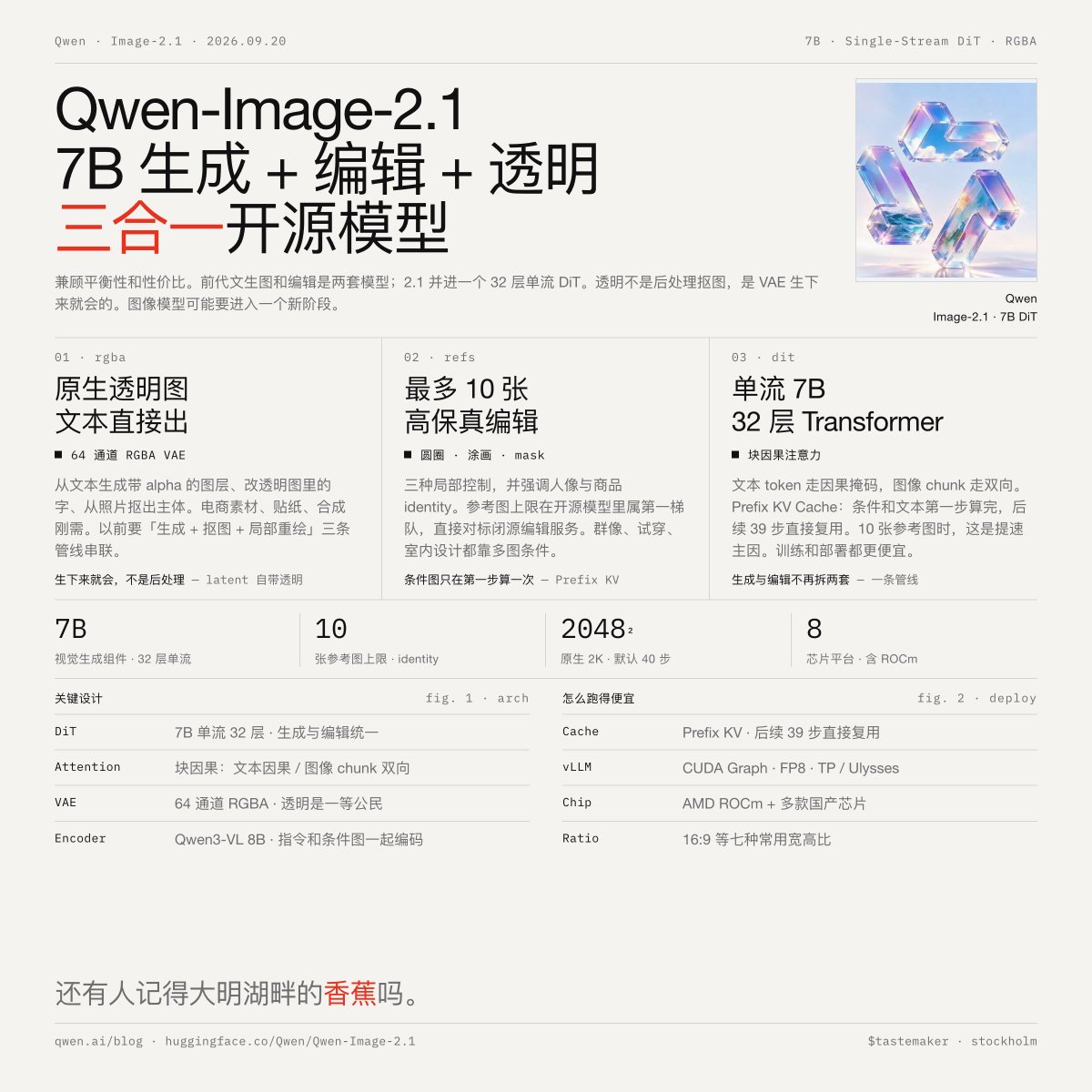
Alibaba released Qwen-Image-2.1, an open-source 7B parameter DiT model that unifies text-to-image generation, editing, and transparent image output. It supports up to 10 reference images for editing, native RGBA output, and 2K resolution. The model is optimized for deployment with vLLM and supports 8 chip platforms, with local deployment possible via Unsloth GGUF quantization down to 12GB VRAM.
Key insights
Unified Architecture and Capabilities
Qwen-Image-2.1 uses a single-stream DiT with 32 layers, replacing the previous separate models for generation and editing. It features block-causal attention: causal mask for text tokens, bidirectional mask for image chunks. The model natively generates RGBA images with a 64-channel VAE that carries the alpha channel in latent space, eliminating the need for separate matting pipelines.
Editing with Multiple Reference Images
The model supports up to 10 reference images for high-fidelity editing, with three local control methods: circle annotation, scribble marking, and independent masks. It emphasizes identity preservation for portraits and products. The prefix KV cache allows conditional images and text to be computed once for the first denoising step and reused for the remaining 39 steps, significantly speeding up multi-image editing.
Text Rendering and Quality Improvements
Qwen-Image-2.1 shows qualitative improvements in text rendering, portrait lighting, and realistic textures. Chinese text rendering is a particular strength inherited from the Qwen-Image series. The model uses Qwen3-VL 8B as the text encoder, which unifies encoding of text instructions and condition images, improving complex instruction following.
Deployment and Hardware Support
The model supports vLLM deployment options including CUDA Graph, FP8 quantization, and TP/Ulysses parallelism. It is compatible with 8 chip platforms including AMD ROCm and multiple domestic chips. Default inference uses 40 steps, native 2K resolution (2048²), and supports seven common aspect ratios including 16:9.
Local Deployment via Unsloth Quantization
UnslothAI released GGUF quantized versions of Qwen-Image-2.1, enabling local deployment on consumer GPUs. For 12-16GB VRAM (e.g., RTX 4070), Q4_K_M quantization runs at 1024x1024. For 6GB VRAM, dynamic FP8 with offloading offers higher precision but slower speed. On 24GB VRAM, INT8 achieves best quality (LPIPS 0.064 vs FP8 0.112). CPU and Apple Silicon also supported with 12-16GB memory.
Comparison to Previous Models
Qwen-Image-2.1 unifies the previously separate Qwen-Image (generation) and Qwen-Image-Edit (editing) models into a single 7B DiT. This reduces training and deployment costs. The native transparent image capability is a fundamental difference from competitors that require post-processing matting. The model's ability to handle up to 10 reference images is among the highest in open-source models, directly competing with closed-source editing services like GPT-Image.