
RAG / Agent → AI Memory and Tool Stack (Analysis and Tool-Related Dynamics)
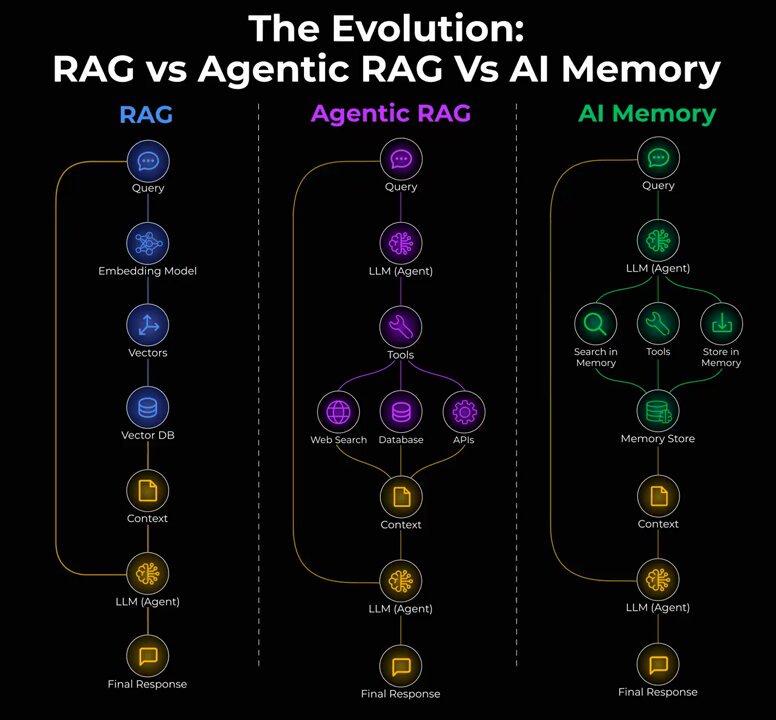
A lengthy post distinguishes RAG, Agentic RAG, and AI memory into three stages: RAG (2020-2023) is a one-time, read-only retrieval; Agentic RAG allows the Agent to decide whether to retrieve, select data sources, and verify results, but remains read-only; AI memory enables read-write access to external knowledge, learns from conversations, and remembers user preferences, achieving personalization and continuous learning, while also introducing challenges such as memory degradation, forgetting strategies, and management of various memory types. The post recommends the open-source framework Graphiti for real-time knowledge graph construction. Additionally, two related updates are noted: one individual achieved 100 sales, claiming to acquire a combination of NotebookLM + 11 Labs + Gemini for $10 and established a VVIP group; another retweet shows the hiring of six new employees and lists tool responsibilities (Nano Banana Pro, Lovart, Gemini3 Pro, Claude Code, Feishu Multidimensional Tables, Lightning Talk).
Key insights
RAG is a Read-Only, One-Time Retrieval Model Stage
The lengthy post defines RAG (2020-2023) as a mechanism for single-instance information retrieval and response generation, emphasizing that RAG lacks decision-making capabilities, merely extracting and answering, and often retrieves irrelevant information. This stage is described as read-only and one-time, unable to accumulate knowledge from interactions.
Agentic RAG is More Proactive in Retrieval Decisions but Remains Read-Only
The author points out that the Agent in Agentic RAG decides whether retrieval is necessary, selects data sources, and verifies results, introducing a decision-making process into retrieval. However, the core limitation remains that the system is read-only, unable to write back or remember new information through interactions, thus failing to achieve continuous learning.
AI Memory Achieves Read-Write Capabilities, Supporting Personalization and Continuous Learning
The post explains that AI memory allows reading and writing of external knowledge, learns from past conversations, and remembers user preferences and historical context, thereby achieving true personalization and continuous improvement. The author views memory as a bridge between static models and adaptive AI systems, emphasizing that memory enables the Agent to gradually improve without retraining.
Memory Introduces New Engineering and Management Challenges
The post outlines the issues brought by memory: memory degradation, decisions on what to forget, and management of various memory types (procedural, episodic, semantic), noting that addressing these problems from scratch is challenging and requires specialized tools and frameworks.
Market and Team Dynamics Reflect Trends Towards Tool Combination and Commercialization
Other two posts report: one individual announced achieving 100 sales, claiming that for $10, they could obtain a combination of NotebookLM + 11 Labs + Gemini and established a VVIP group (15388); another retweet shows the hiring of six new employees and lists tool responsibilities, including Nano Banana Pro, Lovart, Gemini3 Pro, Claude Code, Feishu Multidimensional Tables, and Lightning Talk, reflecting the team's practical adoption of a multi-tool stack and commercial activities (15407).