
Real-time agent & developer tooling (TEN, Cursor, agent docs)
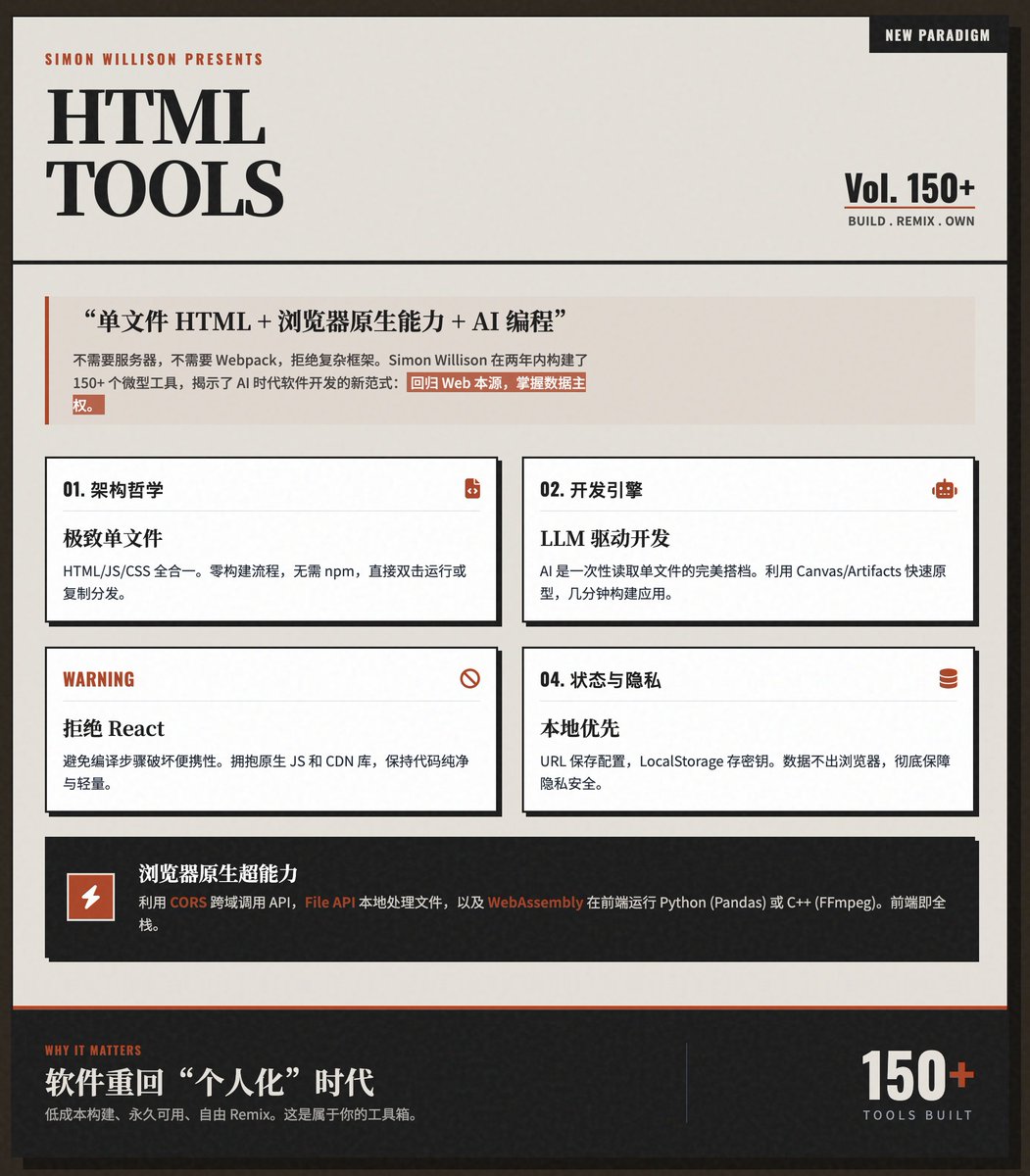
Multiple developer tooling updates and patterns highlight faster agent and real-time assistant development. - HTML Tools: single-file HTML/JS/CSS micro-app pattern for portable, serverless tools and privacy. - TEN Framework: open-source runtime for real-time multimodal agents (audio/video) with visual graph, polyglot runtime, edge-cloud split. - Agent docs: proposal for machine-readable project docs to help AI programming agents build and test projects. - Cursor 2.2: adds Debug Mode, Plan Mode upgrades, multi-agent judging and pinned chats. - Tutorials: open-source guides for building agents from basics to multi-agent systems. - Skywork 5.0: mobile app demonstrates multi-agent pipelines (speech-to-text, PPT, social posts) and voice-note automation.
Key insights
HTML Tools offer a lightweight, privacy-preserving pattern for AI-driven micro-apps
Simon Willison’s HTML Tools pattern advocates single-file micro-apps (HTML+JS+CSS) that run in the browser without a backend, enabling portable, low-complexity tools that maintain data sovereignty. The approach favors native JS, CDN libraries, URL/localStorage state, and WebAssembly for heavier compute, reducing dependency and deployment friction for LLM-assisted utilities.
TEN Framework standardizes real-time multimodal agent orchestration
TEN Framework targets real-time audio/video + AI agent orchestration, providing a visual TEN Graph editor, a polyglot runtime (C++ for media, Python for LLM logic, Go for network), and edge-cloud integration to run light components at the edge and heavy reasoning in cloud. TEN addresses glue-code, latency and multi-language integration pain points for interactive assistants.
Machine-readable 'agent docs' improve AI coding reliability
An open-source project recommends adding machine-oriented README-like files to project roots that explicitly state build, test and run commands for AI coding agents. This separation of human-facing docs and machine instructions aims to reduce AI confusion about project structure and to improve generated code validity across tooling like Cursor and Windsurf.
Cursor 2.2 expands from code generation to full debugging, planning and multi-agent evaluation
Cursor 2.2 introduces Debug Mode to reproduce and fix bugs via runtime logs, Plan Mode improvements including visual flowcharts and manual task assignment, and a multi-agent judging mechanism that evaluates parallel agent outputs and recommends the best solution with explanatory rationale. It also adds pinned chats for long-lived contexts.
Practical apps showcase multi-agent pipelines on mobile
Skywork 5.0 mobile app demonstrates practical multi-agent pipelines: speech-to-text transcription, automatic formatting into todos, slide generation, social posts and simultaneous multi-output generation, illustrating agent composability in consumer-facing products.