
Real-time multimodal frameworks and video models
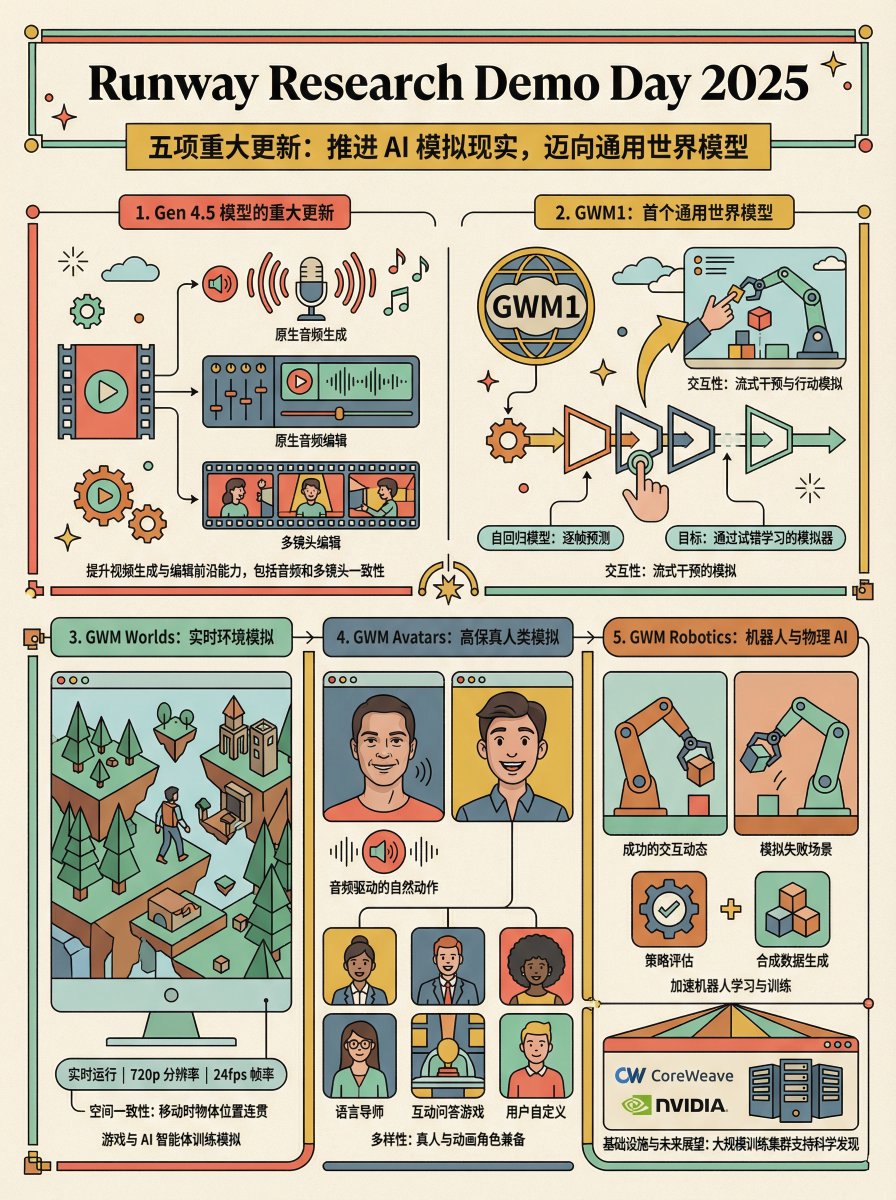
Runway released new video models and world models; TEN Framework provides a real-time multimodal agent stack. - Runway launched Gen 4.5 with original audio generation and editing. - ALF supports multi-shot, variable-length video editing with consistent characters and lighting. - GWM1 world model supports autoregressive frame prediction and stream-time intervention. - GWM Avatars enable audio-driven realtime video generation with micro-expressions. - GWM Robotics models simulate successful and failed interactions for robot training. - TEN Framework is an open-source runtime for real-time audio/video + LLM agents. - TEN provides a visual graph editor, polyglot runtime, and edge-cloud integration for performance/latency. - TEN addresses glue-code, latency, and cross-language complexity in building real-time assistants.
Key insights
Runway extends video generation with audio-native editing and world models
Runway announced Gen 4.5 video models that generate and edit original audio, an ALF model for consistent multi-shot editing, and GWM1, a self-regressive world model enabling frame-by-frame prediction with live user intervention. They also introduced GWM Avatars for audio-driven real-time video with realistic motion and micro-expressions, and GWM Robotics to simulate both successful and failure scenarios for robotics training.
TEN Framework targets the integration gap for real-time multimodal agents
TEN Framework provides an industrial open-source stack for real-time multimodal agents, combining a visual graph editor (TEN Designer), a polyglot runtime to mix C++, Python, and Go, and edge-cloud orchestration. TEN addresses glue-code complexity, latency accumulation across STT/LLM/TTS chains, and cross-language runtime issues to enable interruptible, low-latency audio/video assistants.