
Retrieval and Memory Systems Optimized for Intelligent Agents (Index / Memori / Redis for AI)
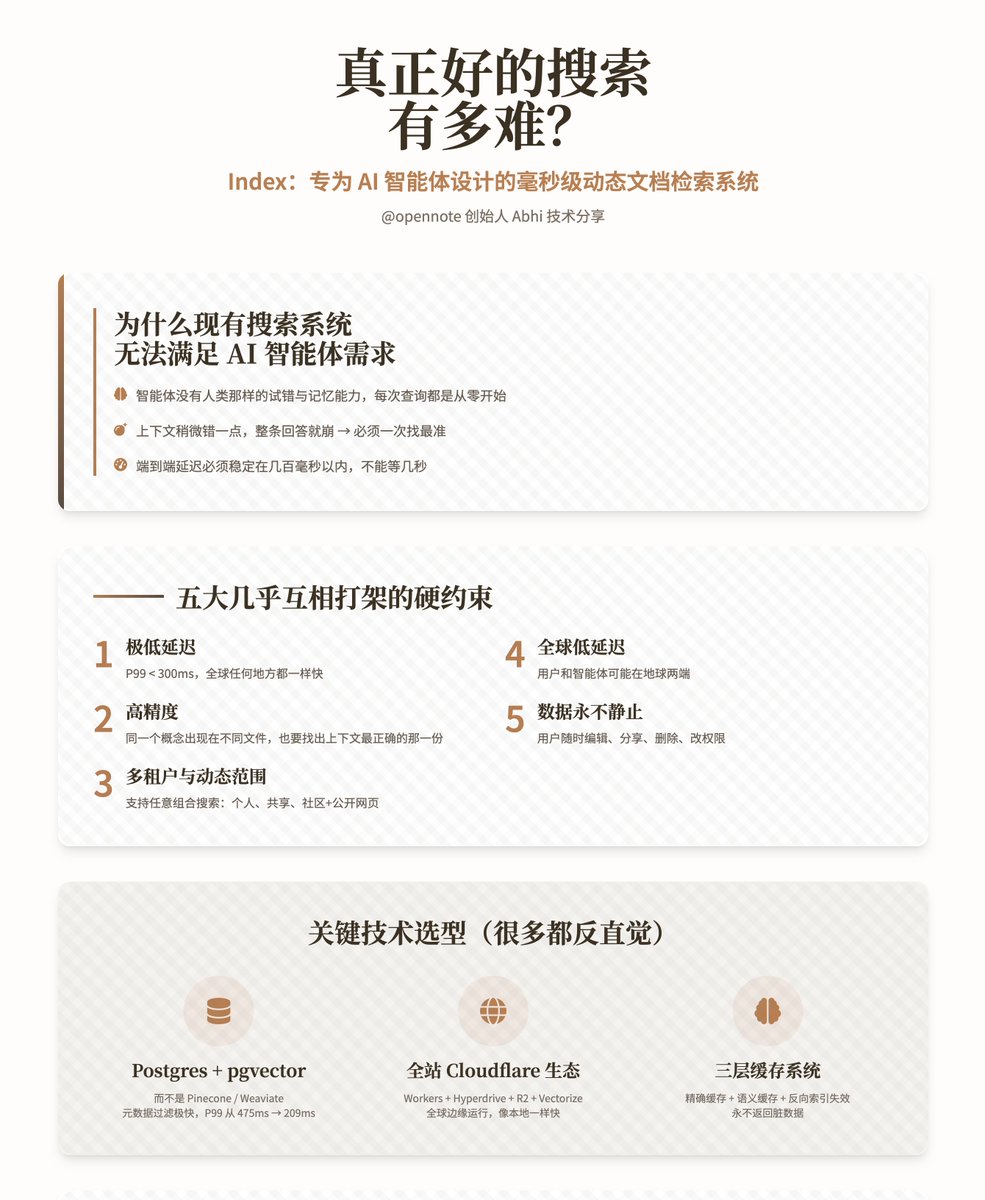
Multiple engineering and open-source projects showcase retrieval and memory solutions aimed at intelligent agents, targeting low latency, high accuracy, and persistent memory. - Index (Opennote): A millisecond-level hybrid retrieval system built for personal knowledge bases of intelligent agents, utilizing Postgres+pgvector, global Cloudflare edge operations, and a complex cache invalidation mechanism, achieving P99 <300ms and performing equally or slightly better than Chroma on various metrics (13530). - Memori: An open-source SQL-native memory engine that integrates with a single line, supporting multiple memory modes (Conscious/Auto/Combined), injecting memory through interceptors and periodically refining it with a background awareness agent (13406). - Redis for AI: A new Redis accelerator providing high-speed vector storage, long-term/short-term memory, semantic caching, and routing, suitable for real-time and multi-agent scenarios (13308). - Semantic caching and retrieval significantly impact the cost and response time for intelligent agents (13530/13308/13406).
Key insights
Retrieval Optimized for Intelligent Agents Must Meet Low Latency and High Accuracy
Opennote's Index system emphasizes P99 latency <300ms, precise segment retrieval, and dynamic multi-tenant filtering. The implementation path includes hybrid retrieval on Postgres (vector + full-text), global Cloudflare edge operations, a three-layer cache (exact/semantic/reverse index invalidation), and incremental embedding, recalculating only changed chunks to ensure latency and accuracy in real production environments (13530).
SQL Native Memory Engine Simplifies Persistent Memory and Auditability
Memori provides a line-enabled memory engine for LLMs and intelligent agents, storing memory in a standard SQL database while supporting entity extraction, patterned classification, and various memory modes. The system injects short-term memory through pre-calls and records new information post-response, with a background awareness agent periodically refining long-term memory to enhance contextual continuity between sessions and ensure data auditability (13406).
Redis for AI Offers Semantic Caching and Real-Time Vector Services to Reduce Inference Costs
Redis for AI combines high-performance vector storage, long-term/short-term memory, semantic caching, and routing, adapting to multimodal and large-scale real-time scenarios, providing industry-leading latency and scalability. It supports integration with ecosystems like LangChain and reduces redundant LLM calls through semantic caching to save costs (13308).
Hybrid Retrieval and Caching Strategies Are Core Engineering Challenges for Intelligent Agent Retrieval Systems
Multiple engineering practices show that metadata filtering should precede at the database level, vector retrieval and full-text retrieval should run in parallel, and query results must be deduplicated and optionally lightly reordered within the DB to ensure accuracy in limited context and multi-tenant scenarios. Caching must incorporate exact, semantic, and reverse invalidation mechanisms to avoid returning outdated information (13530/13308).