
Retrieval, RAG and Memory Infrastructure for Production AI
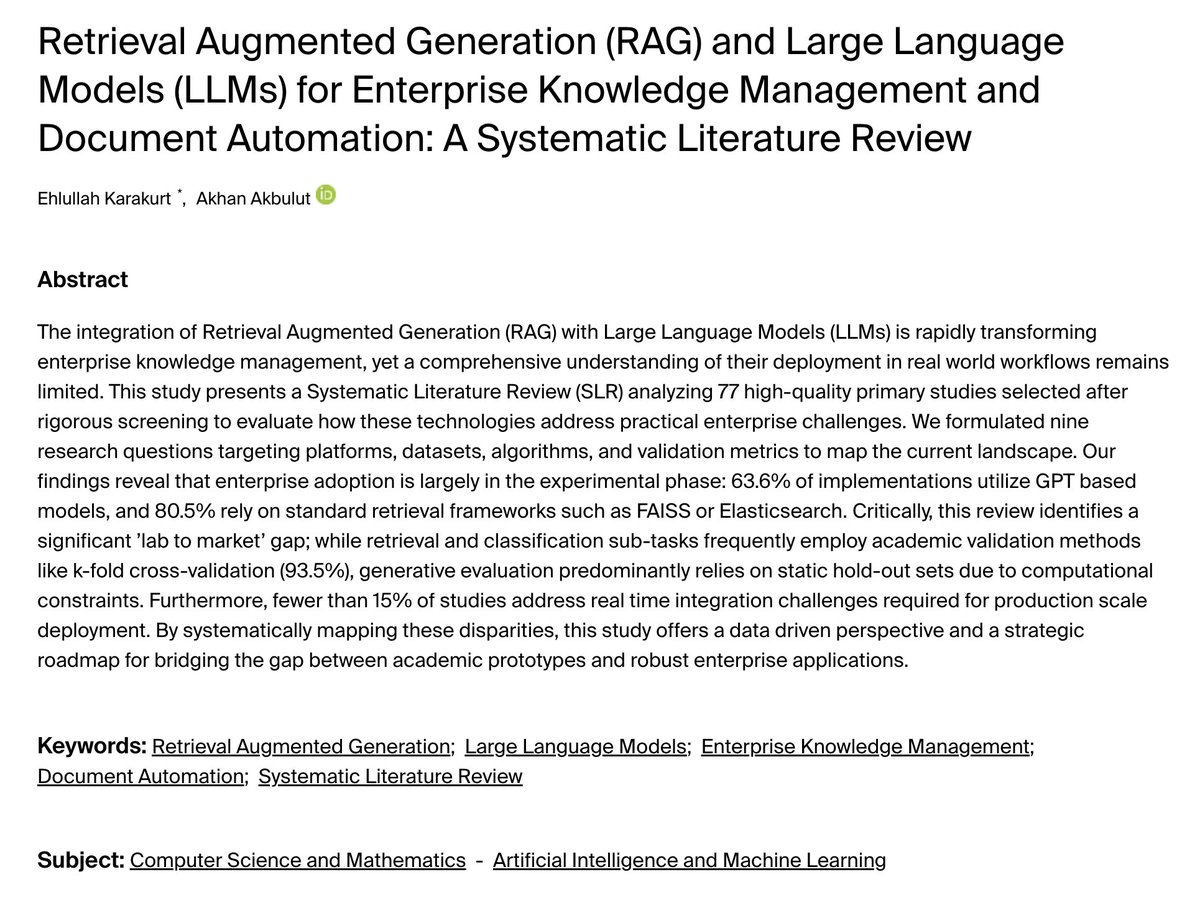
Retrieval, RAG and memory systems show production gaps and new engineering patterns. - Systematic review of 77 RAG studies finds 63.6% use GPT models and 80.5% use FAISS/Elastic - Only 13% of RAG research reached enterprise deployment; key challenges: hallucinations, privacy, latency, domain adaptation - Mixed retrieval (vectors + knowledge graphs) improves explainability and accuracy in some studies - Industry data from OpenRouter/a16z shows agentic, multi‑step usage and middle‑sized open models gaining share - Index is a production search system optimized for agent precision: Postgres + pgvector, edge Workers, three‑layer caching - Index achieves sub‑300ms P99 and supports dynamic, multi‑tenant filters with efficient ingestion/upserts - Anthropic advanced tool use introduces tool search, programmatic calls and examples to reduce token bloat and improve accuracy
Key insights
RAG research has limited enterprise deployments and recurring operational challenges
A literature review of 77 RAG studies shows that most prototypes rely on GPT-style models and established retrieval libs (FAISS/Elasticsearch), but only 13% advanced to enterprise deployment. Recurring obstacles include hallucination control, data privacy, latency and domain adaptation; business impact remains hard to quantify in many studies.
Hybrid retrieval improves factuality and interpretability
Studies report that combining dense vector retrieval with structured knowledge graphs or metadata improves precision and provenance, raising explainability and reducing hallucination risk versus pure vector retrieval in enterprise contexts.
Index demonstrates production search architecture for agent use cases
Index, built for millisecond agent retrieval, uses Postgres (pgvector + pg_trgm + tsvector), Cloudflare Workers global edge runtime, a three‑tier cache system and chunk‑level ingestion to maintain sub‑300ms P99 latency and accurate mixed retrieval. The design emphasizes dynamic filters, multi‑tenant isolation and incremental embedding updates to avoid reprocessing.
Advanced tool use patterns reduce token costs and scale tool catalogs
Anthropic's advanced tool use—deferred tool loading via a tool search meta‑tool, programmatic (code) orchestration of multi‑tool sequences and explicit usage examples—reduces token consumption and improves tool selection accuracy when agents must access hundreds or thousands of tools.
OpenRouter data shows agentic workflows and medium‑sized models rising
OpenRouter and a16z analysis of real interaction data indicate agentic multi‑step reasoning grew substantially, and 'mid‑sized' open models (15B–70B) gained adoption for cost‑effective developer workflows, while tool invocation and longer prompts increased average user prompt length.