
s3 Multi-Agent RL Method Lets Swarms Learn Their Own Coordination
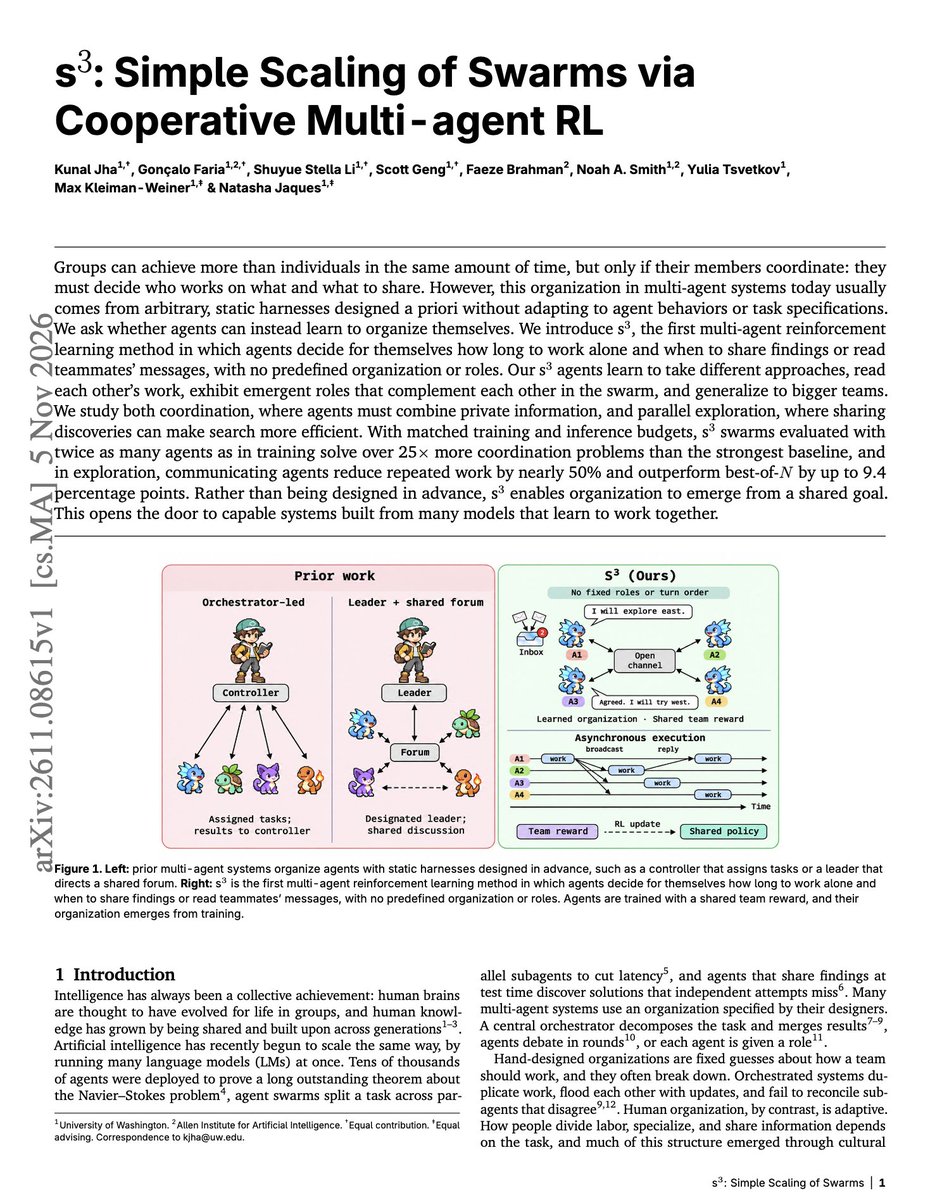
Researchers introduced s3, a cooperative multi-agent reinforcement learning method in which agents decide for themselves when to work alone, share findings, or read teammates' messages, with no predefined roles or communication schedule. With matched training and inference budgets, swarms evaluated at twice their training size solved over 25 times more coordination problems than the strongest baseline, and communicating agents in parallel exploration reduced repeated work by nearly 50% and outperformed best-of-N by up to 9.4 percentage points.
Event version 1.
Key insights
Organization learned rather than designed
Multi-agent systems typically follow static harnesses written in advance that decide which agent does what and when agents message each other. s3 instead has agents learn that organization through cooperative reinforcement learning, with no predefined roles or communication schedule.
Coordination gains at larger scale
With matched training and inference budgets, s3 swarms evaluated with twice as many agents as in training solved over 25 times more coordination problems than the strongest baseline.
Efficiency in parallel exploration
In parallel exploration, communicating agents reduced repeated work by nearly 50% and outperformed best-of-N by up to 9.4 percentage points.
Emergent complementary roles
s3 agents learn to take different approaches, read each other's work, and exhibit emergent roles that complement each other in the swarm. These roles generalize to bigger teams.