
Societal, philosophical and managerial implications of AI automation
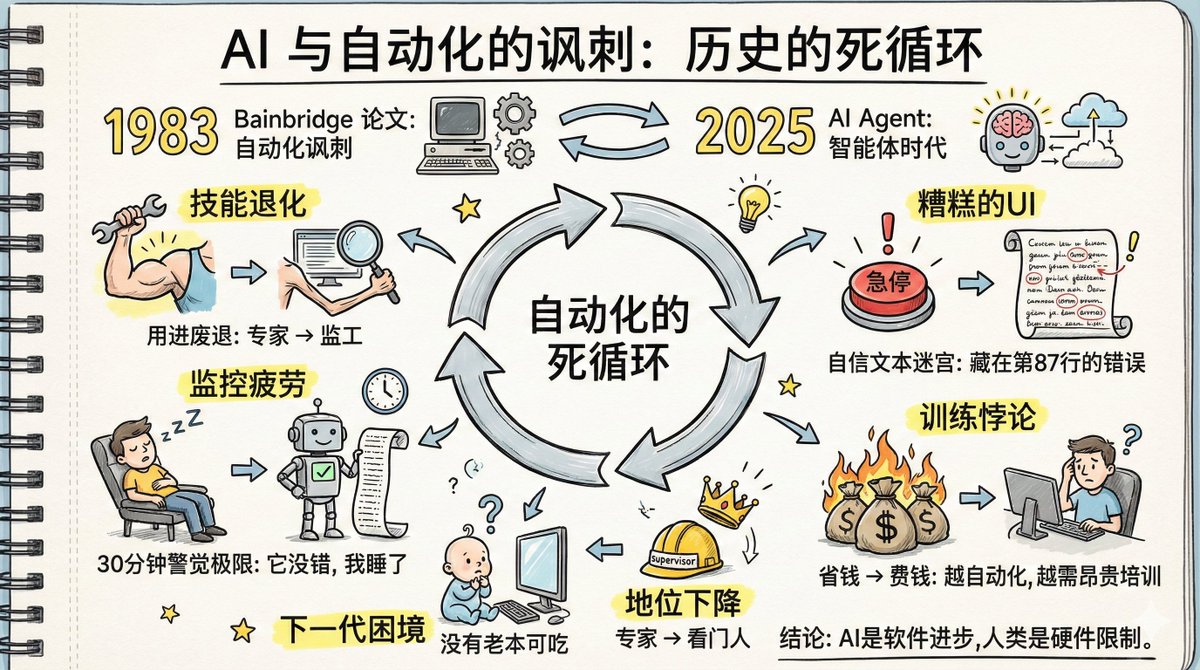
Classical automation critiques apply to today's AI agent supervision and societal risks. - 'Ironies of Automation' parallels modern AI agent oversight. - Skill degradation occurs when experts become supervisors. - Memory retrieval for seldom-used skills slows over time. - Training without real practice fails to prepare for novel failures. - Human monitoring fatigue undermines rare-error detection. - Poor UI design compounds hidden failure modes in agent outputs. - Successful automation raises training costs to maintain human readiness. - Separate posts discuss post-human elites and philosophical reframing of value.
Key insights
Automation’s ironies apply to AI agent supervision and skill decay
The 'Ironies of Automation' framework maps directly onto AI-agent environments: when AI performs tasks and humans supervise, operator skill degrades due to lack of practice, making humans less able to intervene on novel failures. Periodic retraining is costly and simulations cannot cover unforeseen faults, creating a tension between automation efficiency and human preparedness.
Human monitoring fatigue and UI deficiencies increase operational risk
Human attention declines when systems rarely fail; combined with text-heavy AI explanations and poor monitoring interfaces, supervisors are unlikely to spot rare, subtle errors. Alarm and monitoring systems shift the oversight burden but themselves require supervision, creating layered failure risks.
Political and ethical concerns about post-human divergence
One post frames a darker scenario where an elite group uses human enhancement (BCIs, gene editing, uploads) to diverge cognitively from the rest of humanity; the author warns such divergence could eliminate mutual empathy and create new social hierarchies.
Philosophical critique: challenging utility-based human value in automation era
A post argues the prevailing 'instrumental' framework values people for usefulness; it proposes an existential alternative—value rooted in existence not utility—and asks whether such philosophical ideas can be translated into political realities to protect human dignity in an automated future.