
State of AI 2025 & Model Ecosystem Trends (OpenRouter / DeepSeek)
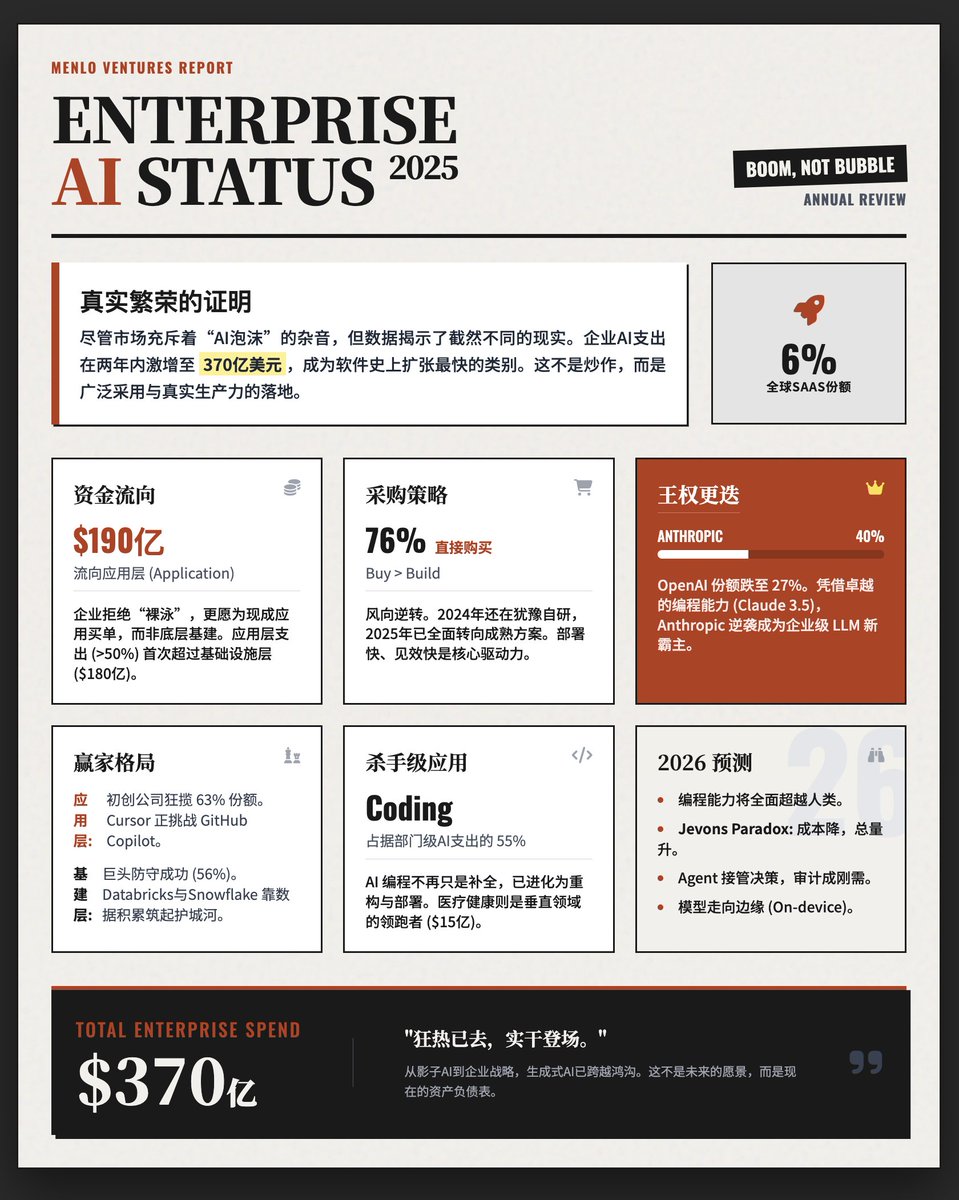
Multiple industry reports and datasets characterize 2025 as the year agentic AI and mid-sized open models matured for production. - Menlo Ventures found enterprise AI spend rose from $1.7B (2023) to $37B (2025), with applications taking majority spend. - Enterprises prefer buying solutions (76%) over building (24%). - OpenRouter/OpenRouter data: open-source usage rose rapidly; role-playing dominates >50% of open model calls while programming accounts ~20%. - OpenRouter: 'Cinderella Glass Slipper' effect—first model solving a pain point locks users in. - OpenRouter and a16z report: push toward multi-step reasoning; push-time 'thinking' models now >50% of usage. - DeepSeek-V3.2 claims architecture and training advances (sparse attention, expert distillation) achieve parity with closed models at lower compute. - OpenRouter data shows medium-size models (15B–70B) are favored for cost/performance tradeoffs. - Predictions: AI programming surpasses human baseline for routine tasks; models move to edge for privacy; benchmarks lose predictive value for deployed utility.
Key insights
Enterprise adoption accelerates: buy > build and applications dominate spend
Menlo Ventures' survey reports enterprise generative AI spending jumped to $37 billion in 2025, with more than half directed to application-layer solutions (≈$19B) versus infrastructure. The majority of enterprise use-cases are satisfied by purchasing off-the-shelf solutions (76%), with only 24% self-built. Programmatic coding, IT ops and customer workflows drive departmental AI budgets; startups captured most application-level share while incumbents retain infrastructure dominance. These findings indicate enterprises are prioritizing time-to-value via commercial applications rather than vertically integrating base model development. (supporting_posts: [17429])
Open-source models and mid-sized parameter regimes lead the ecosystem reshaping
OpenRouter and a16z analyses show a rapid rise in open-source model usage and a preference for mid-sized models (≈15B–70B parameters) that balance latency, cost and capability. OpenRouter data also reveals usage patterns: role-playing/creative scenarios dominate open model calls (>50%), while coding comprises ≈20%. DeepSeek-V3.2 technical reports claim architectural innovations (sparse attention DSA, expert distillation, simulated task curricula) achieve closed-model parity in reasoning benchmarks at lower compute cost. These trends underpin a multi-vendor, multi-model landscape where 'first-fit' model experiences lock users into long-term usage. (supporting_posts: [17418, 17429, 17277, 17112])
Agentic usage and reasoning models grew to a majority of interactions
OpenRouter and a16z report the rise of inference/push-time reasoning models: what was near-zero in early 2024 became >50% of usage by end of 2025. Users feed longer contexts (average prompt lengths grew 4x) and expect models to plan, call tools and execute multi-step tasks. This shift increases token consumption per task dramatically and pressures cost models and infrastructure, making agent orchestration, tool invocation mechanics and memory systems central engineering priorities. (supporting_posts: [17418, 17429, 17112])
Cinderella effect: first model to solve a pain point captures durable users
OpenRouter analysis describes a 'Cinderella Glass Slipper' effect where the first model to satisfy a specific high-value user pain point creates deep lock-in. Users form habitual and contextual attachments to a model's interaction style, latency and tool conventions, making later technically superior models difficult to displace. This suggests that early market entrants that match vertical needs can secure 'foundational cohorts' and lasting ecosystems despite subsequent improvements from competitors. (supporting_posts: [17112, 17418])