
State of AI 2025 & OpenRouter industry reports
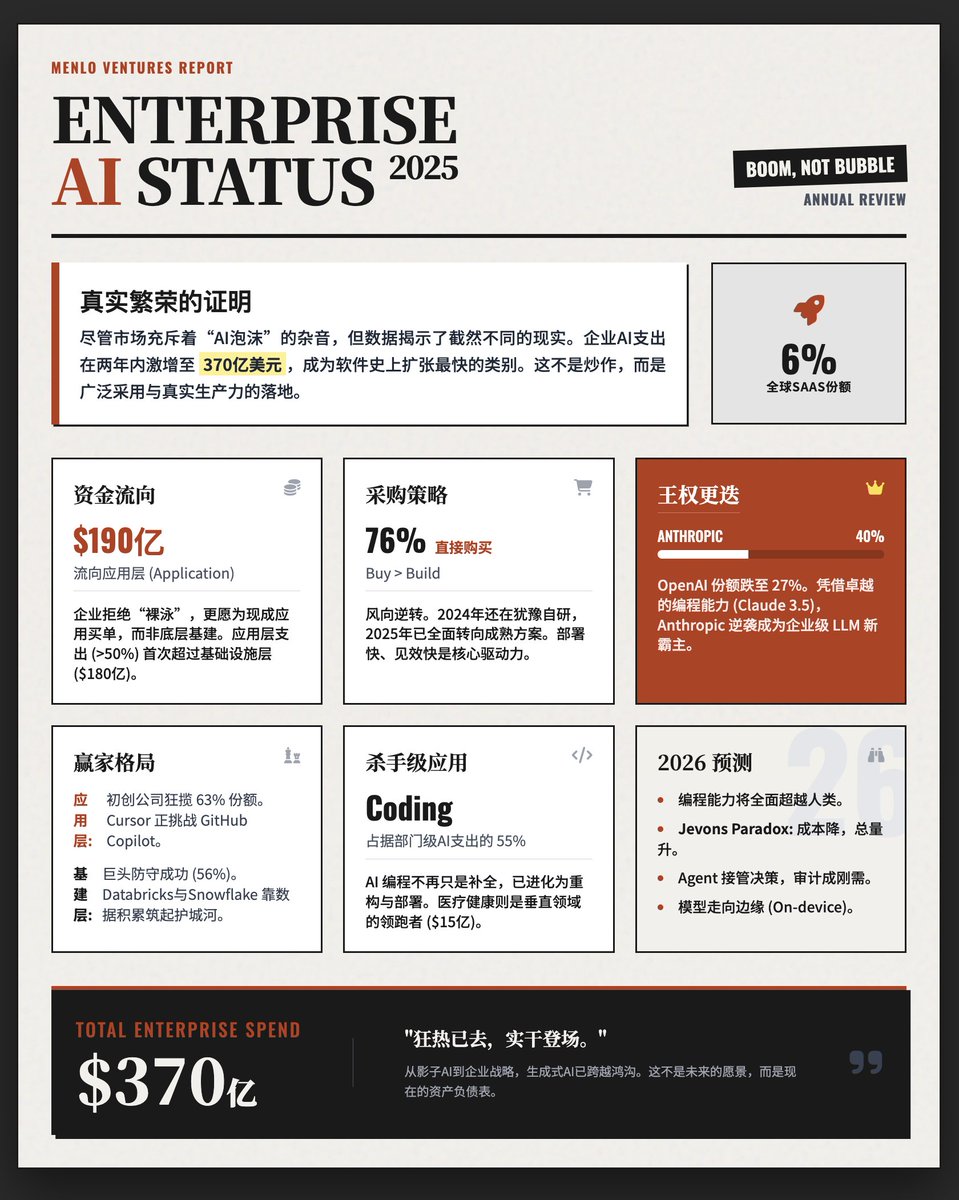
MenloVentures released a State of Generative AI in the Enterprise 2025 report and OpenRouter/a16z published State of AI 2025 analyses. - Report estimates enterprise AI spend rose from $1.7B in 2023 to $370B in 2025 - Enterprise generative AI now ~6% of global SaaS - Majority of spend split: Apps $19B and Infrastructure $18B (approx equal) - 76% of enterprise AI use cases now buy off-the-shelf solutions; 24% are custom-built - 27-40% of AI adoption driven bottom-up by product users and shadow IT - Startups capture 63% of application-layer market; cloud and infra incumbents retain 56% in infrastructure - OpenRouter data: token-level telemetry shows role of medium-sized models, Asia growth, and 'Cinderella Glass Slipper' lock-in effect - OpenRouter finds open-source use dominated by roleplay (~50%) and programming (~20%) and mid-sized models (15B–70B) rising - Reports predict push toward agentic AI, model-edge deployment, governance and measurement of business impact
Key insights
Enterprise generative AI spending surge to $370B in 2025
The MenloVentures 'State of Generative AI in the Enterprise 2025' report estimates enterprise AI spending rose from $1.7 billion in 2023 to $370 billion in 2025 and that generative AI accounts for roughly 6% of global SaaS. The report breaks spending roughly evenly between application-layer purchases and infrastructure, and finds buying off-the-shelf solutions now dominates over custom builds (76% vs. 24%). The study is based on ~500 US enterprise decision-maker surveys and market modeling.
OpenRouter/a16z data shows shift to agentic, multi-step reasoning workloads
OpenRouter and a16z analysis found that usage has moved from one-shot generation toward multi-step reasoning and agentic workflows, with reasoning-model usage exceeding 50% of traffic. The analysis also documents growing prompt lengths, wider tool calling, and the rise of mid-sized open models (15B–70B) that balance cost and capability. OpenRouter notes the 'Cinderella Glass Slipper Effect' where early models that solve a user’s pain point create durable lock-in.
Market split: startups win apps; incumbents keep infra
Reports indicate startups capture the majority of application-layer value (63%), while incumbents like Databricks and Snowflake retain a majority of infrastructure revenue (56%). The sectoral analysis shows programming and copilot-style tools dominate departmental spend, and vertical applications (healthcare/legal) lead in industry adoption.
OpenRouter telemetry highlights regional and modality shifts
OpenRouter telemetry cited in the reports shows Asia usage share rose substantially (13% to 31%), open-source roleplay remained large (~50%), and programming queries dominate open-source model usage. The data also shows medium-sized models increasingly popular due to latency, cost and performance trade-offs.