
State of Enterprise Generative AI — 2025 Reports & RAG Deployments
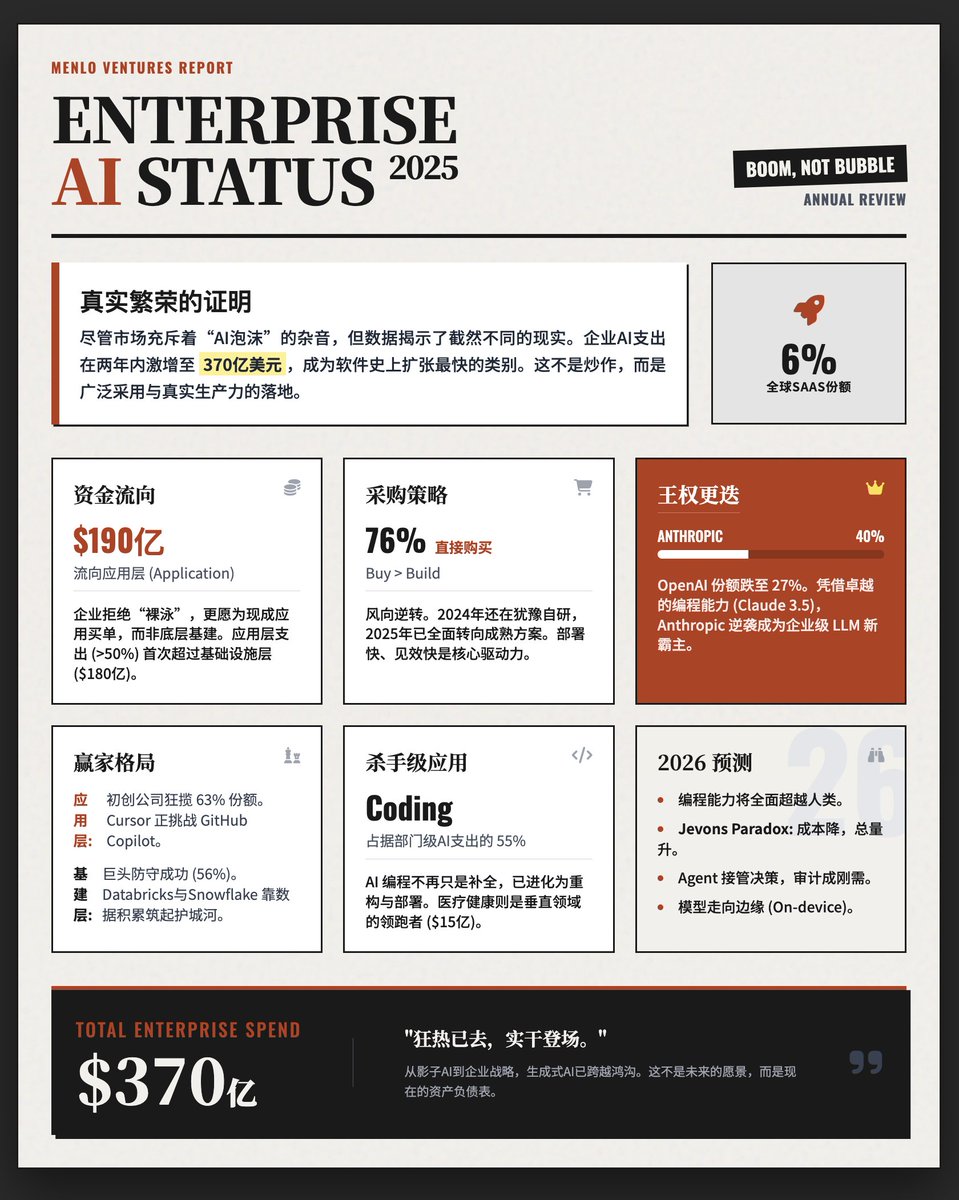
Menlo Ventures data shows enterprise generative AI spending grew to $37 billion in 2025, split roughly evenly between applications ($19B) and infrastructure ($18B). Enterprises favor buying solutions (76%), with significant bottom‑up adoption (27%). Startups lead application share (63%), while incumbents hold infrastructure share. A systematic RAG review of 77 papers highlights production challenges—hallucination control, privacy, latency, domain adaptation—and notes only 13% of prototypes reached enterprise deployment. a16z/OpenRouter finds agentic, multi‑step reasoning is now mainstream usage and mid‑sized open models are developer favorites.
Key insights
Enterprise spend and application adoption accelerated in 2025
The Menlo report documents a large increase in enterprise generative AI expenditure to $37B in 2025, with over half spent on application layer solutions ($19B) and the remainder on infrastructure. The report shows a strong preference for buying mature solutions (76%) and significant bottom‑up adoption driven by individual users (27%).
RAG systems face production gaps despite research progress
A systematic review of 77 RAG+LLM studies reports prevalent production challenges: hallucination control (48.1%), data privacy (37.7%), latency/scalability (31.2%), domain adaptation (23.4%), and difficulty measuring business impact (15.6%). Only 13% of evaluated systems were deployed in enterprise settings.
Agentic workflows and multi‑step reasoning are mainstreaming
a16z/OpenRouter analysis shows a shift from single‑step generation to multi‑step, agentic workflows. OpenRouter traffic indicates reasoning models and tool usage now account for over half of usage, with users supplying longer prompts and orchestration becoming common.
Open and mid‑sized models gain developer preference
OpenRouter and industry signals note that 15B–70B parameter 'mid‑sized' open models now balance cost and capability and are the preferred choice for many developers; Chinese open models play a significant role in the ecosystem shift.
Startups dominate application layer while incumbents own infrastructure
The Menlo report shows startups capture 63% of application market share, while legacy vendors maintain 56% share at the infrastructure layer due to trust and data advantages.