
Study Links Chain-of-Thought Controllability to Entropy Collapse in First Tokens
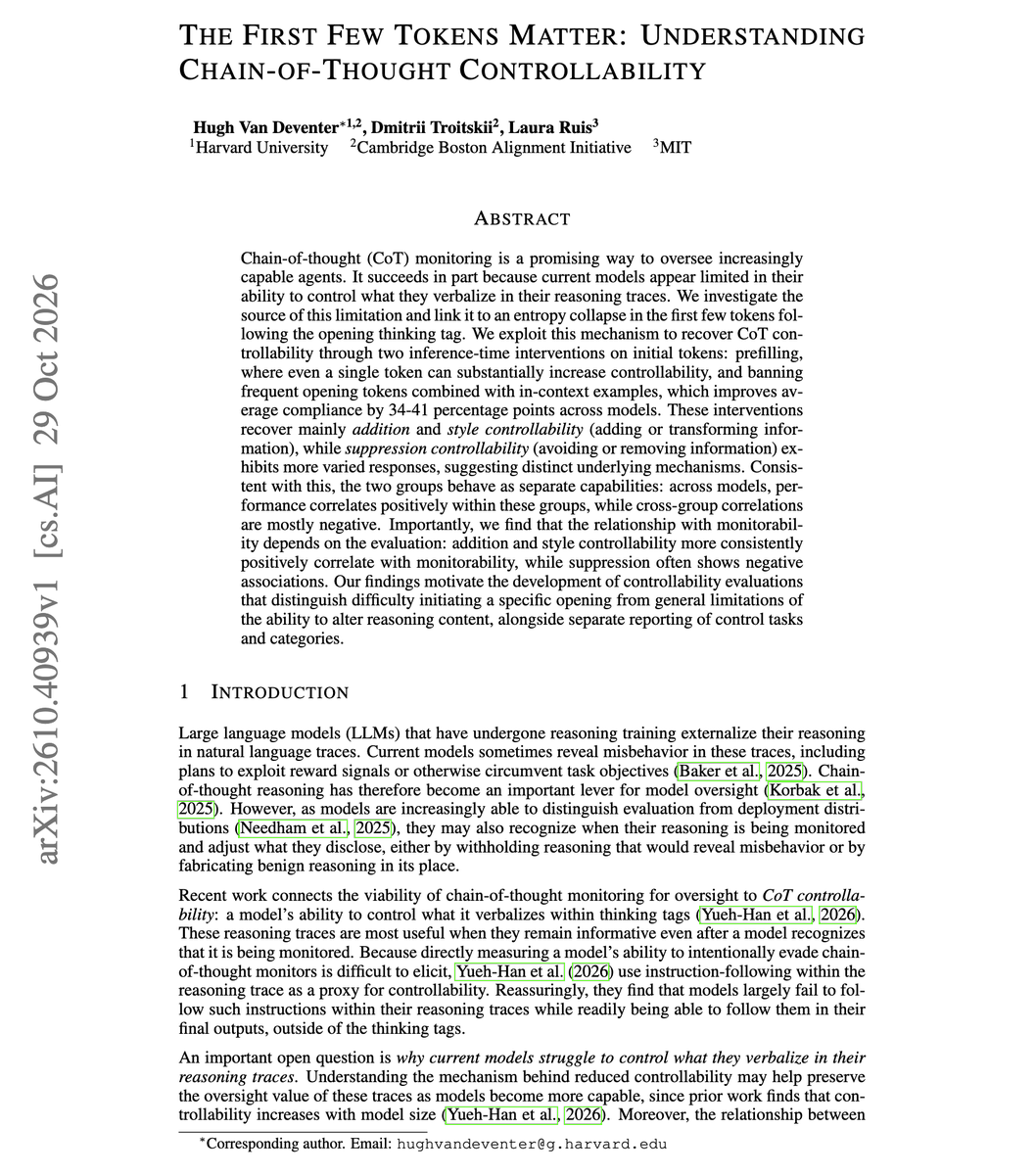
Researchers Hugh Van Deventer, Dmitrii Troitskii and Laura Ruis published a study linking models' limited control over chain-of-thought reasoning to entropy collapse in the first few tokens after the opening thinking tag. Prefilling a single token and banning frequent opening tokens with in-context examples raised average compliance by 34 to 41 percentage points across models, mainly for addition and style controllability, while suppression controllability responded inconsistently.
Event version 1.
Key insights
Entropy collapse mechanism
Low entropy in the first reasoning tokens following the opening thinking tag explains much of why models fail to follow instructions about what to verbalize in their reasoning traces.
Interventions raise compliance
Prefilling even a single token substantially increases controllability. Banning frequent opening tokens combined with in-context examples improves average compliance by 34 to 41 percentage points across models.
Two separate capabilities
The interventions recover mainly addition and style controllability, while suppression controllability shows more varied responses. Across models, scores correlate positively within each group and mostly negatively between groups.
Monitorability depends on evaluation
Addition and style controllability more consistently correlate positively with monitorability, while suppression controllability often shows negative associations, motivating separate reporting of control tasks and categories.