
Tencent WeChat Vision Team Open-Sources WeVisOne-VL 2B/4B Vision-Language Model
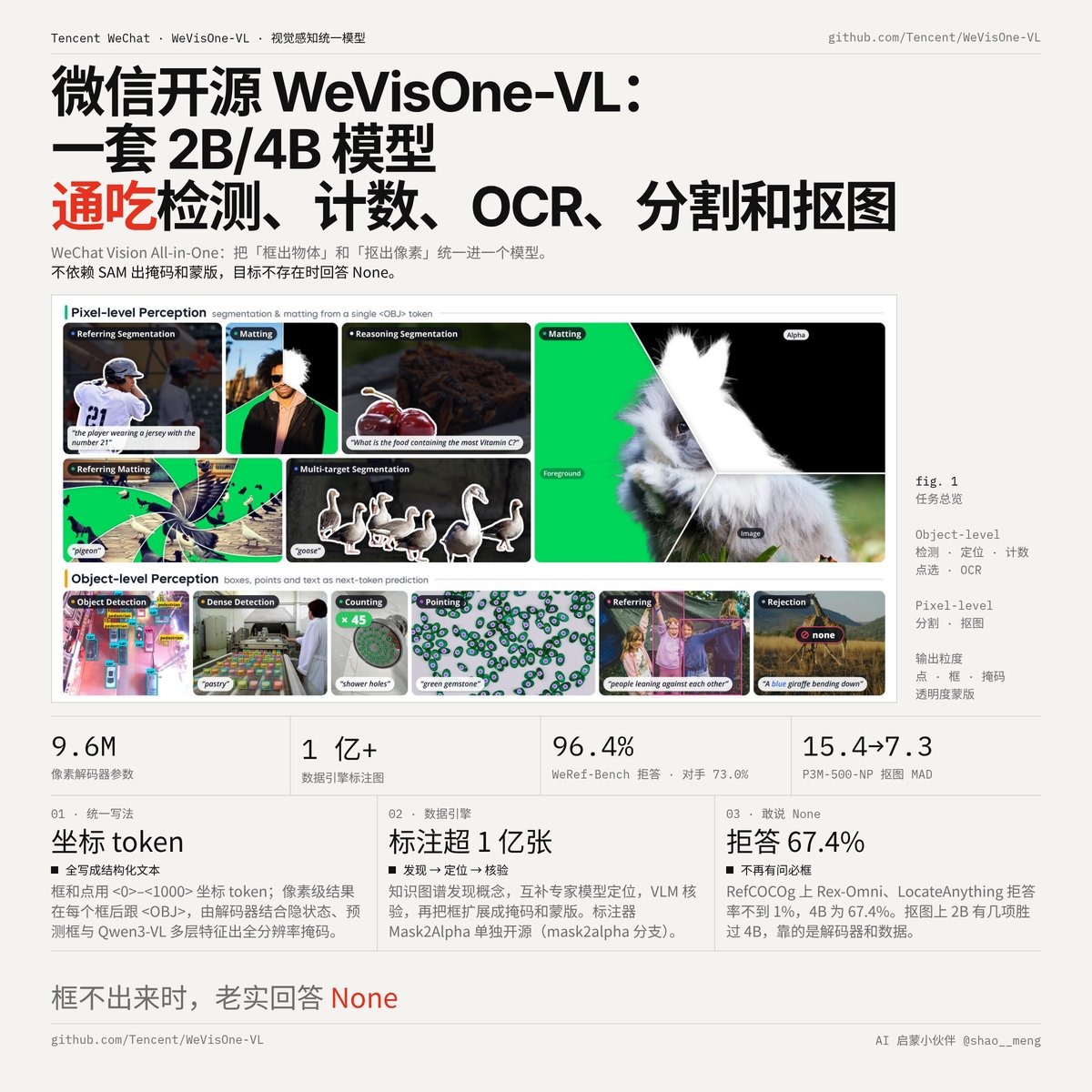
Tencent's WeChat Vision team released WeVisOne-VL, an open-source 2B/4B vision-language model that unifies object-level detection, counting, pointing and OCR with pixel-level segmentation and alpha matting. A 9.6M-parameter pixel decoder produces masks and alpha mattes without SAM, and the model outputs None for absent targets. The 4B version improved LVIS F1 from 50.7 to 55.3 and raised rejection rate on WeRef-Bench to 96.4%.
Event version 1.
Key insights
Unified object- and pixel-level perception
WeVisOne-VL covers open-vocabulary detection, referring localization, counting, pointing and OCR at the object level, plus referring segmentation and promptable alpha matting at the pixel level. Users select output granularity from a point or box to a binary mask or continuous alpha matte.
Lightweight decoder replaces SAM
A 9.6M-parameter pixel decoder combines each OBJ token's hidden state, predicted box and multi-layer Qwen3-VL visual encoder features to predict full-resolution masks or mattes. No separate SAM model is required.
Benchmark gains over open-source rivals
The 4B version raised LVIS F1 from 50.7 to 55.3, Dense200 from 58.7 to 71.3, RefCOCOg test from 77.6 to 81.8 and PixMo-Count accuracy from 82.8 to 89.6. On SROIE OCR it scored 68.1, above PP-OCRv5's 58.6.
Matting error roughly halved
Box-prompted matting MAD on P3M-500-NP dropped from 15.4 to 7.3, and text-prompted matting on WeRefMat referring tasks dropped from 22.4 to 9.8. Referring segmentation gIoU on ReasonSeg val rose from 65.0 to 71.2.
Strong rejection of absent targets
On the team-built WeRef-Bench, rejection rate rose from the strongest competitor's 73.0% to 96.4%. On RefCOCOg, WeVisOne-VL-4B reached a 67.4% rejection rate while Rex-Omni and LocateAnything stayed below 1%.