
Tencent WeKnora and T-Mem: Enterprise Knowledge Platforms and Memory Systems
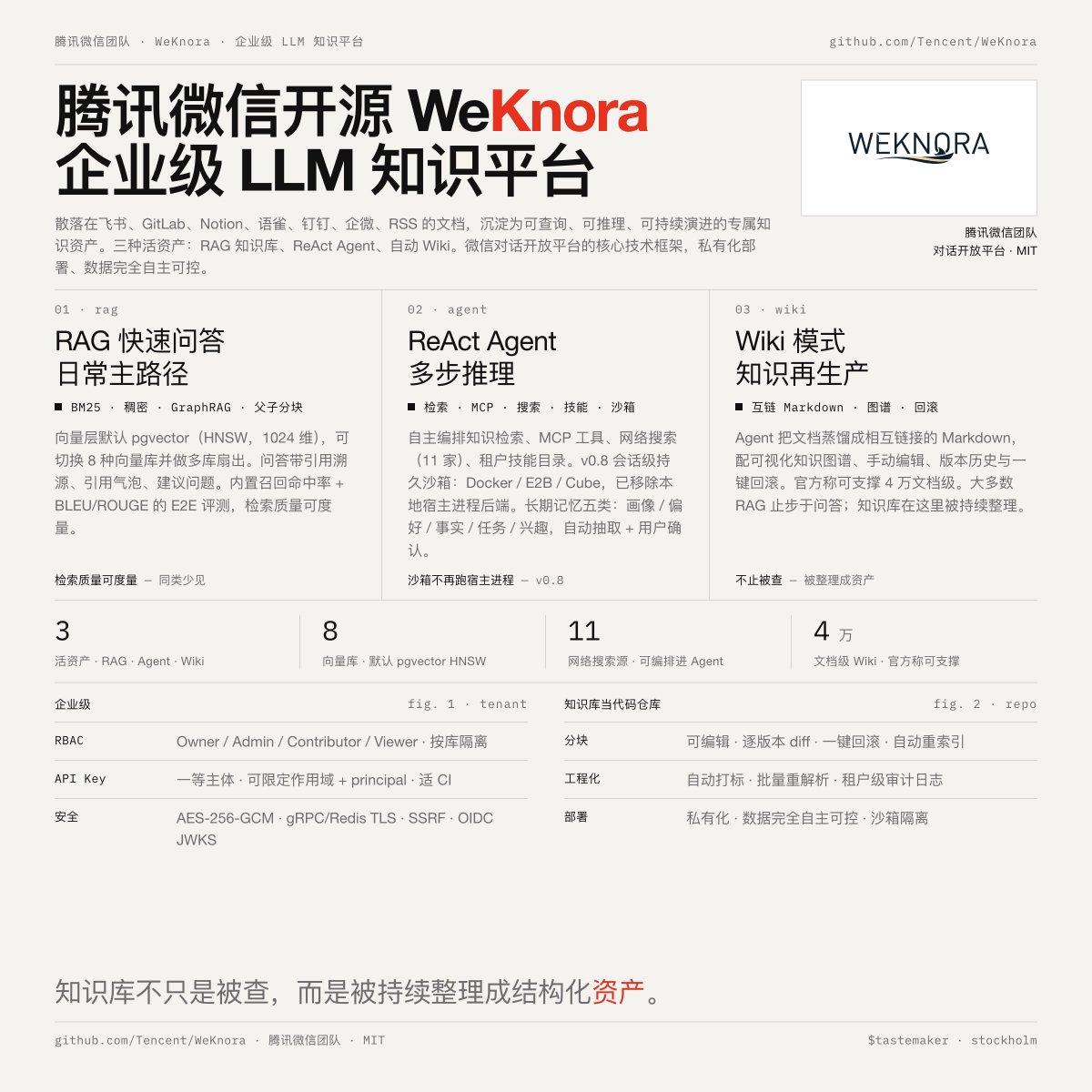
Tencent open-sourced WeKnora, an enterprise LLM knowledge platform that converts documents into RAG knowledge bases, ReAct agents, and auto-generated wikis. Separately, Tencent released T-Mem, a memory system that introduces 'triggers' for associative recall, solving the problem of retrieving memories with no lexical overlap. T-Mem achieves 80.26% accuracy on LoCoMo, outperforming baselines.
Key insights
WeKnora: Enterprise Knowledge Platform
WeKnora ingests documents from various sources (Feishu, GitLab, Notion, etc.) and produces three assets: RAG knowledge bases for Q&A, ReAct agents for complex reasoning, and auto-generated wikis. It supports BM25, dense vectors, GraphRAG, and multi-strategy retrieval. Features include multi-tenancy with RBAC, API key management, AES-256-GCM encryption, and sandbox isolation. The wiki mode automatically distills documents into linked Markdown with version history.
T-Mem: Associative Memory with Triggers
T-Mem addresses the limitation of existing memory systems that rely solely on similarity search. It introduces 'triggers' generated during memory writing that predict future contexts where the memory will be relevant. Four trigger families cover the design space: Entity (factual), Bridge (associative fact-to-scene), Scene (descriptive), and Horizon (associative scene-to-future). This enables recall even when query and memory have zero lexical overlap.
T-Mem Performance: Outperforming Baselines on Associative Recall
On LoCoMo, T-Mem achieves 80.26% accuracy, 3.25 points above HyperMem. On the Cognitive subset of LoCoMo-Plus (designed to test pure associative recall), T-Mem scores 74.81%, far ahead of HyperMem (48.63%) and GPT-4o zero-shot (21.05%). Ablation studies show that removing associative triggers causes a 22.19 point drop on LoCoMo-Plus, while descriptive components have minimal impact. This confirms the structural blind spot of similarity-based retrieval.
T-Mem Architecture: TypeGraph and Offline Pipeline
Memory is organized as a typed graph with five object types: scene (conversation segments), item (atomic facts), topic (for filtering only), trigger (for retrieval only), and persona. The construction pipeline segments by event closure, groups by topic, extracts items, and generates triggers. Retrieval is a three-level cascade (topic→scene→item) with RRF fusion. Triggers bypass topic pre-filtering to avoid similarity bias. The system runs on CPU without GPU.