
The Paradox of Senior Engineers and Intelligent Agent Development / Expert User Value
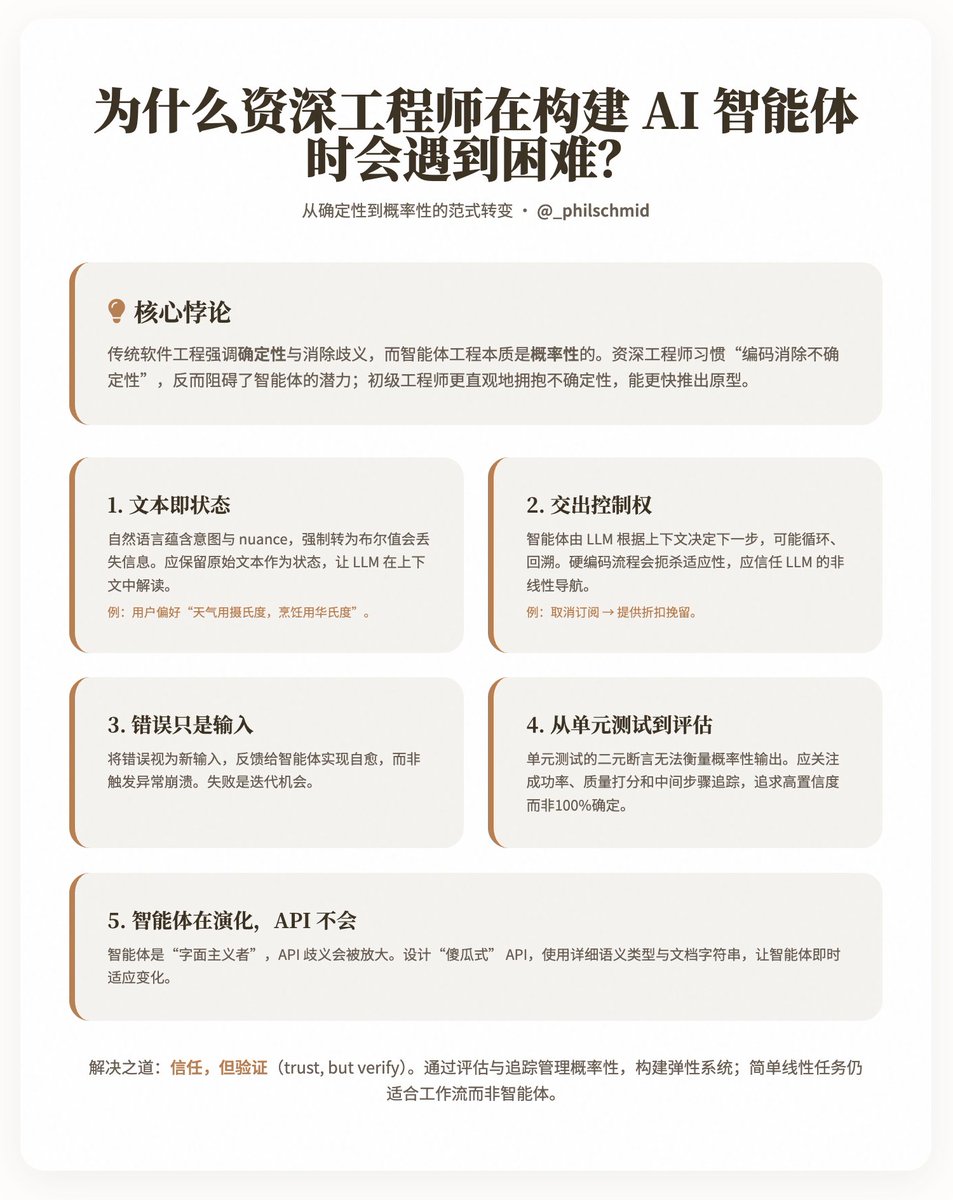
Multiple posts discuss the challenges faced by senior engineers in building AI intelligent agents, the differences between expert user value and engineering practices. • Senior engineers are accustomed to pursuing certainty, while intelligent agent engineering is inherently probabilistic, requiring trust in LLMs to handle nonlinear processes (14612). • Five major challenges: text as state; relinquishing control; treating errors as input; shifting from unit testing to evaluation (evals); agents evolve while APIs remain unchanged (14612). • Text should be preserved as state to retain subtle intent examples (such as preferences, local indications) (14612). • It is suggested to allow LLMs to manage processes and self-heal errors, while tracking intermediate steps and success rates through evaluations (14612). • Another post notes that senior engineers are more willing to directly adopt agent outputs, due to clearer prompt signals, proficiency in breaking down tasks, and stronger correctness priors (14466). • Expert users are identified as key dissemination nodes, providing optimal use cases, often serving as early adopters and incubators for KOLs, while targeting the general C-end may lead to early entry bottlenecks (14559). • Technical tip: Adding SESSION_ID to the system prompt can enhance cache hit rates (14467).
Key insights
Senior Engineers Face a Shift from Certainty to Probability
The author points out that traditional software engineering emphasizes certainty (fixed inputs, certain outputs, exception isolation), while intelligent agent engineering relies on the probabilistic outputs of LLMs and multi-turn interactions. Senior engineers tend to eliminate uncertainty, which becomes a resistance in building agents; the solution is to accept textual states, treat errors as feedback, and design resilient control flows and evaluation systems to manage probabilistic behavior.
Five Specific Challenges Define the Differentiated Practice of Intelligent Agent Engineering
The five challenges include: text as state (preserving original text to maintain subtle differences), relinquishing control (trusting LLMs to determine processes), treating errors as input (looping failures back to LLM for recovery), shifting from unit testing to evaluation (using success rates and quality scores instead of binary testing), and agents evolving while APIs remain unchanged (requiring more clearly defined semantics in APIs). Each challenge is accompanied by examples and practical suggestions to help engineers adapt to the new paradigm.
Senior Engineers Excel in Adopting and Reviewing Agent Outputs
Observations show that senior engineers are more willing and daring to directly adopt agent outputs, due to their clearer prompt writing, proficiency in breaking work into manageable tasks for agents, stronger priors on correctness, and ability to validate outputs more quickly and accurately; this indicates that programming-oriented agents amplify existing engineering capabilities rather than replace engineers themselves.
Expert Users are Key Groups for Product Dissemination and Use Case Discovery
The viewpoint lists five values of expert users: providing wisdom for AI, serving as dissemination nodes, often being early adopters, offering optimal use cases, and being incubators for KOLs; it warns that directly targeting the general C-end may encounter growth bottlenecks earlier, suggesting that early emphasis should be placed on the expert user pathway.
Cache Strategy Details Affect System Hit Rates and Performance
Practical tips indicate that a globally consistent system prompt may reduce hit rates due to cache request overflow under large user volumes; adding {{SESSION_ID}} at the beginning to achieve session consistency can enhance hit rates, or it is suggested to support similar mechanisms at the header level to improve cache effectiveness.