
Thinking Machines Inkling Open Source Model Debut
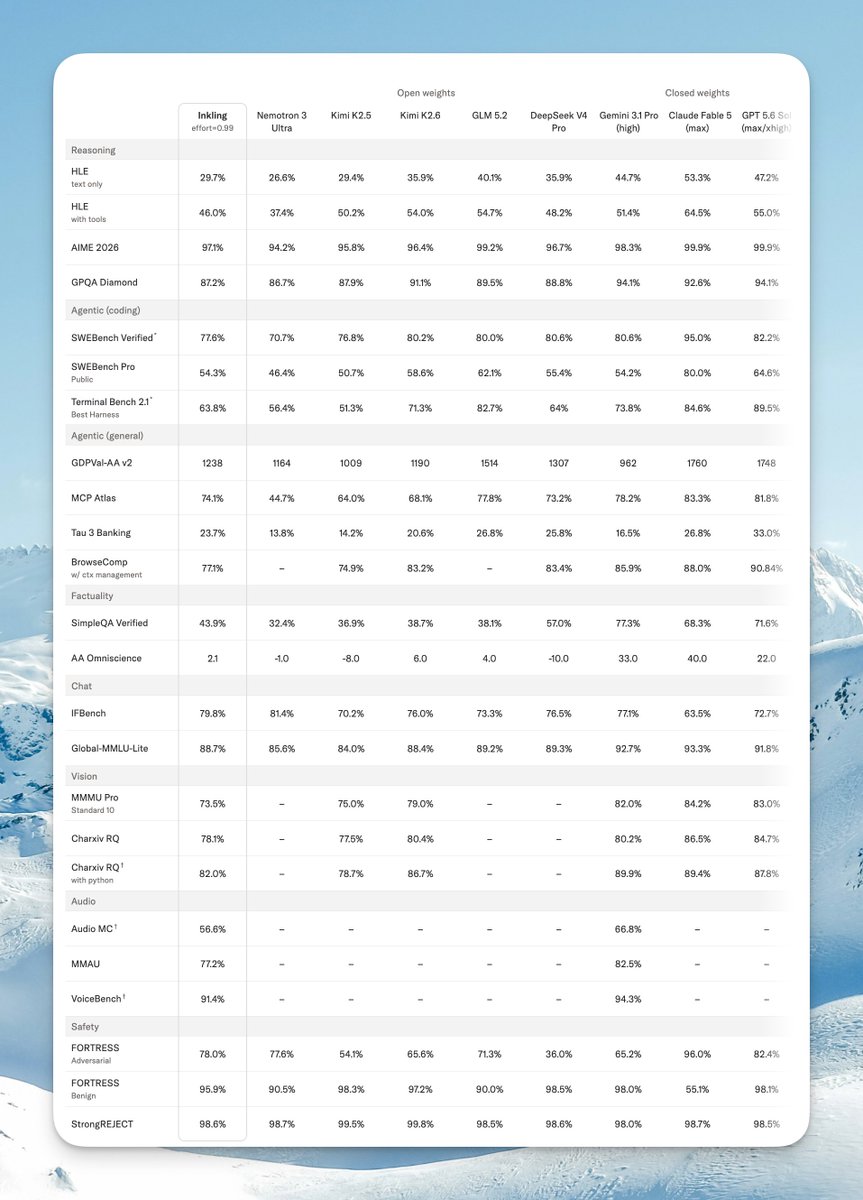
Thinking Machines, founded by former OpenAI CTO Mira Murati, released Inkling, a 975B-parameter Mixture-of-Experts model with 41B active parameters and 1M context window. It was trained on 45T tokens and natively supports text, image, and audio. A smaller 12B-active-parameter preview was also announced. The model is open-source, with post-training data distilled from models such as Kimi 2.5. Benchmark positioning vs. other open models: • Outperforms Nemotron 3 Ultra and Kimi K2.5. • Trades blows with Kimi K2.6 and DeepSeek V4 Pro (leading on IFBench, SWEBench Verified; trailing on HLE, SimpleQA, Terminal Bench). • Slightly behind GLM 5.2, which is the current open-source leader across most benchmarks. Compared to closed-source frontier: • Claude Fable 5 and GPT-5.6 Sol lead significantly in agentic coding (SWEBench Verified 95% vs 77.6%) and factuality (SimpleQA 71.6% vs 43.9%). • Inkling excels in instruction-following (IFBench 79.8% vs Claude 63.5%) and low refusal on benign prompts (FORTRESS Benign 95.9% vs Claude 55.1%).
Key insights
Inkling's Release Adds a New Major Player to Open-Source AI
With 975B parameters and a Mixture-of-Experts design, Inkling enters the open-source field near the top, surpassing several established models. Backed by Mira Murati's team, it signals that ex-OpenAI leadership sees open models as a viable path to influence AI development and potentially counter closed-source consolidation.
Inkling Demonstrates a Usability-Safety Trade-Off That Favors Instruction Following
While trailing closed models in agentic coding and knowledge reasoning, Inkling outperforms Claude in instruction following and has far lower refusal rates on benign requests. This suggests active design choices to prioritize helpfulness and adherence to user intent over cautious safety refusals, a different philosophy than some safety-focused providers.
Distillation from Open Models Highlights Open-Source Network Effects
Inkling's post-training distillation from Kimi 2.5 and other open models shows how open-source releases can accelerate successive model development. This creates a positive feedback loop where each new model raises the baseline for the next, but also questions the originality of the training pipeline.