
Token-efficient CLI agents outperform MCP
A technical comparison argues that while MCP offers improvements like deferred tools and structured schemas, CLI-based agents remain superior for many scenarios including locally known commands, token efficiency, and CI/CD automation. MCP's advantages appear in multi-user environments, OAuth integration, discovery, and regulated industries.
Key insights
Deferred tools narrow but don't eliminate MCP-CLI gap
MCP's deferred tool loading reduces tool definition context by ~85% in large toolset scenarios per Anthropic data. However, CLI commands like gh pr list require no schema injection because models have already learned them in training. For unfamiliar commands, CLI has --help and skills fallback, making it difficult to argue MCP exceeds CLI in token efficiency.
Model tool-calling gains benefit both, but differently
Stronger models improve both CLI command construction and MCP structured schema handling. CLI benefits from already-learned commands as prior knowledge, which matters less as tool-calling improves. MCP benefits more from multi-step tool call chain reliability with structured schemas, potentially closing the gap in complex orchestration scenarios.
CLI preferred for local execution, pipes, and CI/CD
CLIs excel when models already know the commands, running locally, composing with pipes, minimizing token usage, and CI/CD automation with known tools and fixed commands. Debugging and quick verification favor command-line invocation. These scenarios cover common development workflows.
MCP's strength in auth, discovery, and compliance
MCP suits environments without terminal access (browsers, mobile), multi-user authorization with OAuth integration, tools not in model training data, and regulated industries requiring audit trails. Standardized tools/list endpoints enable agent-side tool discovery for evolving toolkits. MCP gateway benefits from Mcp-Method and Mcp-Name headers for routing without request body parsing.
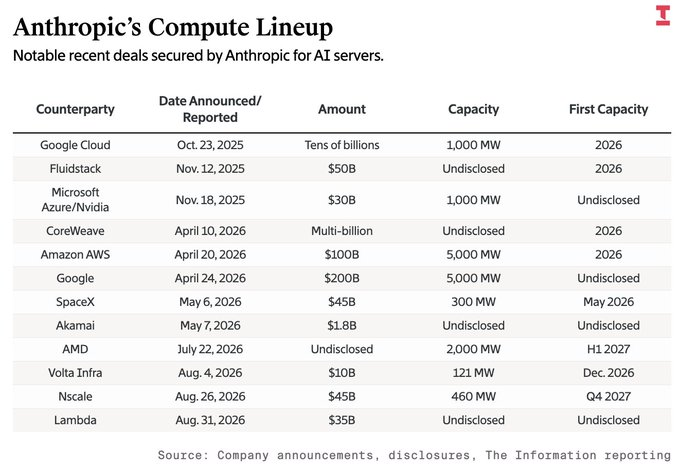
Anthropic commits up to $517B in compute agreements
Anthropic's ten-year compute commitments may total $517 billion covering cloud services, chips, and data centers, per The Information. Since October 2025, Anthropic signed at least 14.8GW of compute capacity with Amazon and Google accounting for 11GW and costs exceeding $300 billion. Demand is driven by Claude Code and Cowork.