
TypeSafe AI launches Jev, a decision-making System One model
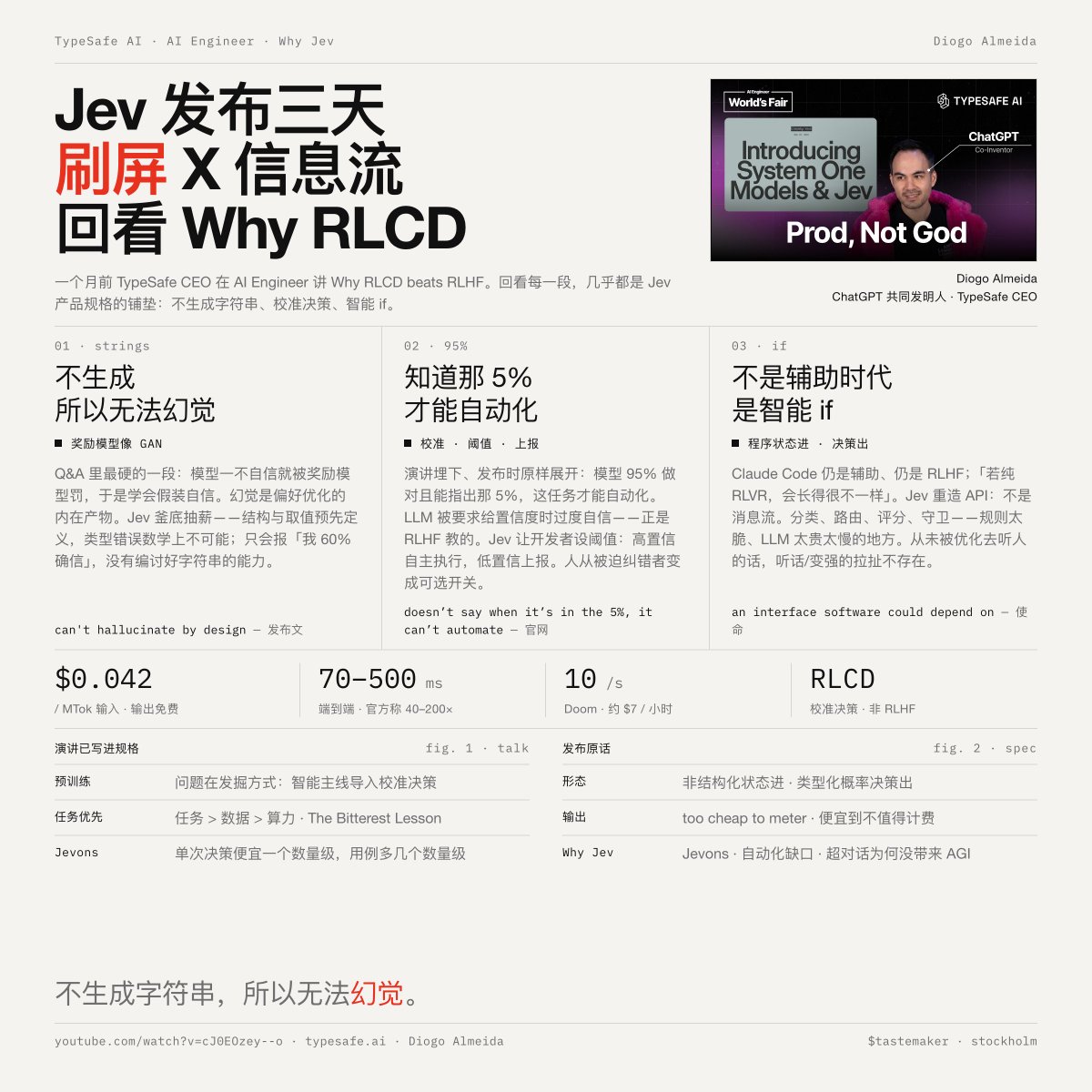
TypeSafe AI, founded by former OpenAI researcher Diogo Almeida, released Jev on September 16, 2026. It is a System One model that outputs only type-safe structured decisions with calibrated probabilities, not free text. Response times range from 70 to 500 milliseconds, 20-200x faster than frontier LLMs, at $0.042 per million input tokens with free output tokens. Jev targets classification, routing, scoring, and extraction tasks.
Key insights
RLCD training addresses LLM hallucination and calibration issues
TypeSafe AI's Diogo Almeida argued that RLHF inherently incentivizes models to feign confidence and discard uncertain patterns, producing hallucination. Jev uses RLCD (Reinforcement Learning for Calibrated Decisions), which trains the model to provide epistemically honest probabilities. Since Jev cannot generate free text, 'hallucination is mathematically impossible.' Each output includes a confidence score, and developers can set thresholds for autonomous execution vs. human escalation.
Performance benchmarks against frontier LLMs
On TypeSafe's Workflow Evals, Jev achieved response times of 70-500 ms compared to 3-329 seconds for frontier models like GPT-6 Astra and Fable 5.1. TypeSafe claims Jev is 20-200x faster and 40-400x cheaper at equivalent intelligence levels. The company acknowledges extreme speedups (193x, 444x) represent best-case scenarios. Jev's speed comes from parallel sampling (all outputs computed at once) rather than the serial token generation of LLMs.
Practical demonstrations: DOOM AI and Wikiracing
TypeSafe showed Jev powering a DOOM game AI bot making about 10 calls per second at roughly $7 per hour. In Wikipedia racing (navigating from one article to another via hyperlinks), Jev outperformed non-thinking LLM modes in both steps and speed. These demos illustrate Jev's suitability for real-time, latency-sensitive decision tasks that require repeated calls.
Target use cases: 'smart if statements' for software
TypeSafe positions Jev for scenarios where a decision in code needs AI judgment but not human-readable text. Key use cases include intelligent branching in workflows (routing tickets, assessing urgency), large-scale data processing (classification, tagging, extraction over millions of records), real-time applications (recommendations, dynamic pricing, game AI), and as a guardrail for LLM outputs (checking safety, format, and jailbreak attempts at low cost and latency).
Pricing strategy and the Jevons Paradox
Jev charges $0.042 per million input tokens ($42 per billion), with output tokens free. TypeSafe states it is already profitable and plans further price cuts. The name 'Jev' references the Jevons Paradox, where increased efficiency leads to higher total consumption. The company bets that making AI decisions cheap enough will cause usage to explode. This contrasts with LLM providers who charge per output token, which can be a significant cost factor.