
TypeSafe AI launches Jev, a fast calibrated decision model
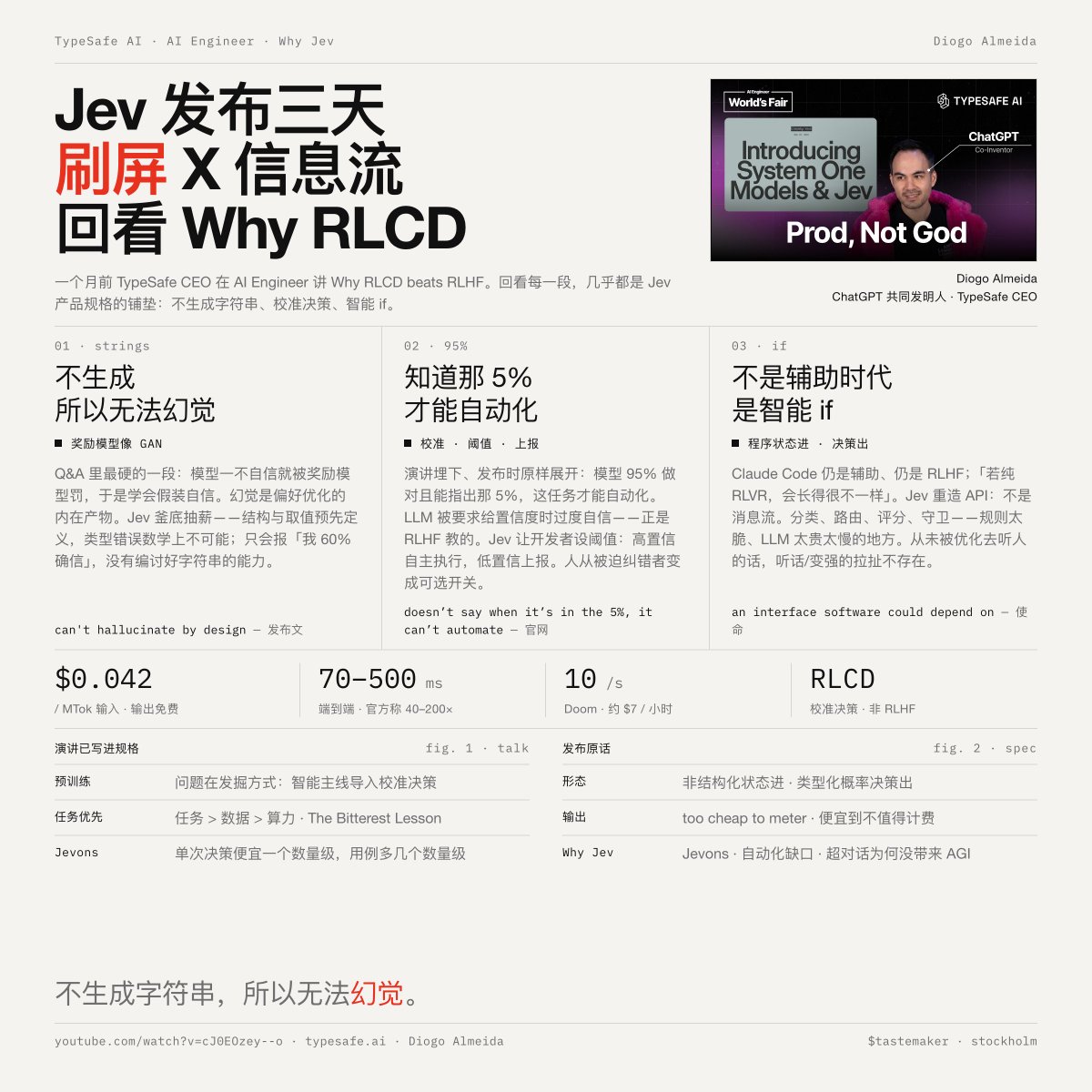
TypeSafe AI released Jev, a new 'System One' model for structured decisions, achieving 70-500ms response time and free output tokens. It outputs type-safe results with calibrated probabilities, avoiding hallucinations by not generating free text. Applications include routing, classification, and guardrails.
Key insights
Novel Architecture: Parallel Sampling, No Token Generation
Jev differs from LLMs by using parallel sampling instead of autoregressive text generation. All outputs are computed at once, providing fast and scalable decisions. It does not generate free text, only pre-defined structured output with confidence scores. Type error rate is mathematically zero.
Performance: 70-500ms, 20-200x Faster than Frontier LLMs
Jev's response time is 70-500ms compared to 3-329s for frontier LLMs for similar decision tasks. Input token price $0.042 per million tokens, output tokens free. TypeSafe claims it is 20-200x faster and 40-400x cheaper than equally intelligent LLMs. These numbers are from workflow evals using GPT-6 Astra and Fable 5.1 as reference.
Use Cases: Intelligent If-Statements, Guardrails, Decision Nodes
Jev is designed for tasks where developers need an AI judgment but not a human-readable text: classification, routing, risk gating, extraction, scoring. It can serve as a guardrail to check LLM outputs for safety and format compliance. Its type-safety makes it reliable for production systems.
Economic Model: Jevons Paradox – Cheap Decisions Drive More Usage
The name Jev references Jevons paradox: increased efficiency leads to increased total consumption. TypeSafe bets that making AI decisions cheap and fast will explode usage. They charge only for input tokens and plan to continue lowering prices.
Open-Source Alternative Kev Released by Cognition Team
Within days of Jev's release, Cognition's Jared Palmer open-sourced Kev, a similar decision model based on Qwen3 with LoRa adapters and pointer head. Kev comes in 0.6B, 4B, 8B sizes. Kev-8B achieved 79.6% accuracy on out-of-distribution data vs Jev's 85.7%. Kev is API-compatible with Jev.
New Three-Layer Architecture for AI Applications
A recommended architecture includes: LLM layer for open-ended work, Jev layer for fuzzy but bounded semantic decisions (routing, risk gating, completion determination), and deterministic code layer for hard constraints (file permissions, spending caps). This separates concerns effectively.
Manus team used Jev to control a browser in a 3D rendering game. Another demo shows Jev powering semantic Ctrl+F in web pages, and a PostgreSQL extension for semantic queries like 'find people who can work remotely'. Also used to analyze user operation logs to identify bugs and generate PRs.