
TypeSafe AI Launches Jev: A Non-Text Decision Model
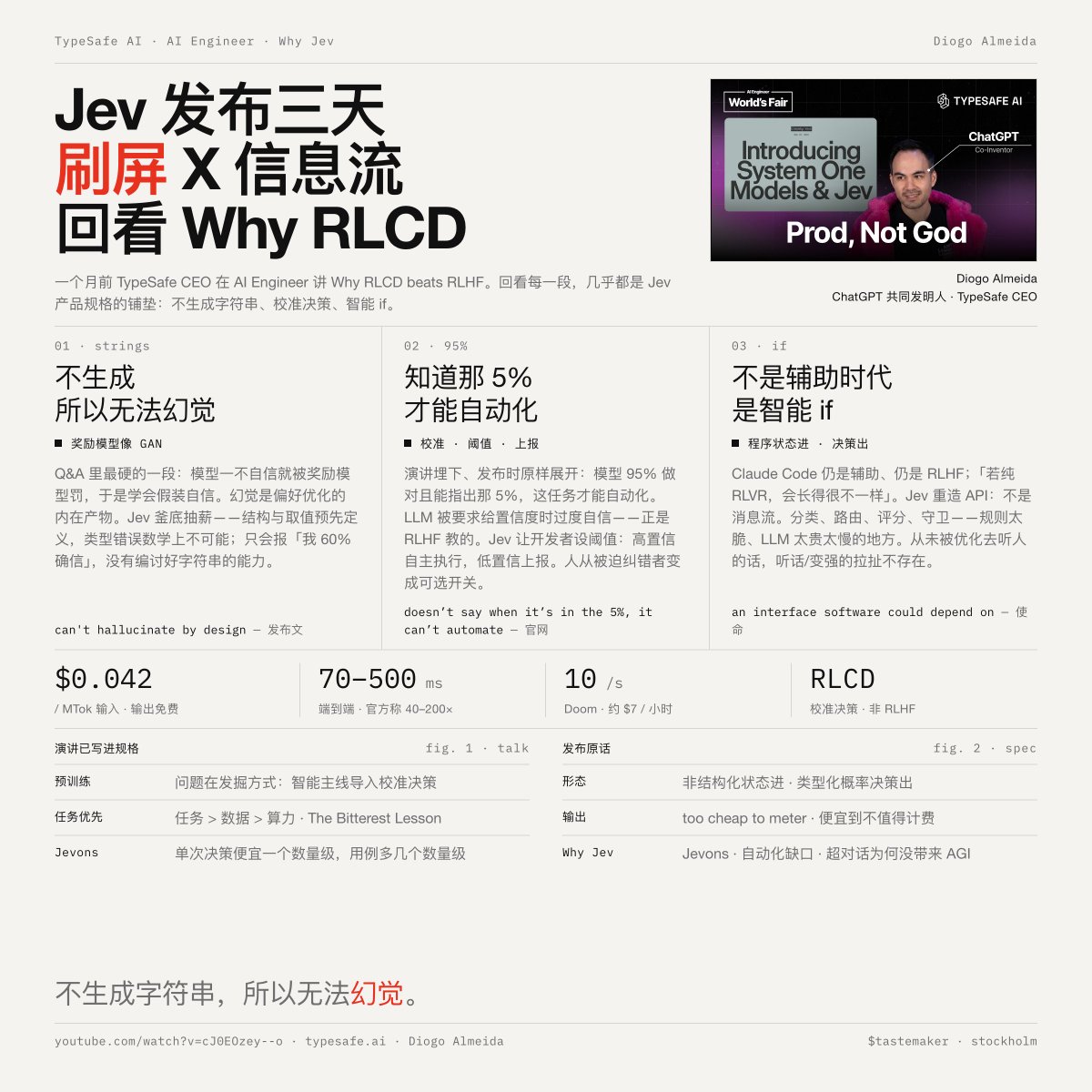
TypeSafe AI, co-founded by ChatGPT inventor Diogo Almeida, launched Jev, a System One decision model that does not generate text. Jev responds in 70-500ms, costs $0.042 per million input tokens (output free), and is designed for classification, routing, and extraction. It uses RLCD training to eliminate hallucination and provides calibrated probabilities.
Key insights
Jev's Key Specifications and Performance
Jev delivers response times of 70-500ms, compared to 3-329 seconds for frontier LLMs. Input token price is $0.042 per million tokens, output is free. TypeSafe claims it is 20-200x faster and 40-400x cheaper than equivalently intelligent LLMs, based on workflow evals using GPT-6 Astra and Fable 5.1 as reference. It uses parallel sampling instead of sequential token generation, enabling the speed advantage.
Technical Foundation: RLCD and No Hallucination
Jev is trained with RLCD (Reinforcement Learning for Calibrated Decisions), a method that avoids the hallucination-inducing incentives of RLHF. The model cannot generate free text; its output structure is pre-defined, making type errors mathematically impossible. Each output includes an epistemically honest probability score. This architecture directly addresses the problem of overconfidence and hallucination in standard LLMs.
Use Cases: Intelligent If-Statements for Software
Jev targets scenarios where a code component needs a smart judgment but not text generation: classification, scoring, routing, extraction, guardrails. Examples include customer service ticket routing, large-scale document processing (at $42 per billion tokens for input), real-time applications like game AI (DOOM demo running ~10 calls/sec at ~$7/hour), and as a guardrail to check LLM outputs for safety and format compliance. It is explicitly not a replacement for chat models.
Founder's Vision and the Jevons Paradox
The name Jev references the Jevons Paradox: as efficiency improves, total consumption increases. TypeSafe CEO Diogo Almeida argues that reducing AI decision cost to near zero will cause usage to explode. He positions Jev as the successor to the 'agent era' where RLHF-based models struggle with reliability. The company is already profitable and plans to continue lowering prices, betting on volume growth.
Availability and Integration
Jev is currently in early access; developers can join a waitlist. The API is not based on message streams but structured program state to typed decisions. It is intended to be embedded as a component in system architectures, acting as an 'intelligent if statement' for fuzzy criteria that rule engines cannot handle well.