
TypeSafe AI Launches Jev, a Non-Text Decision Model
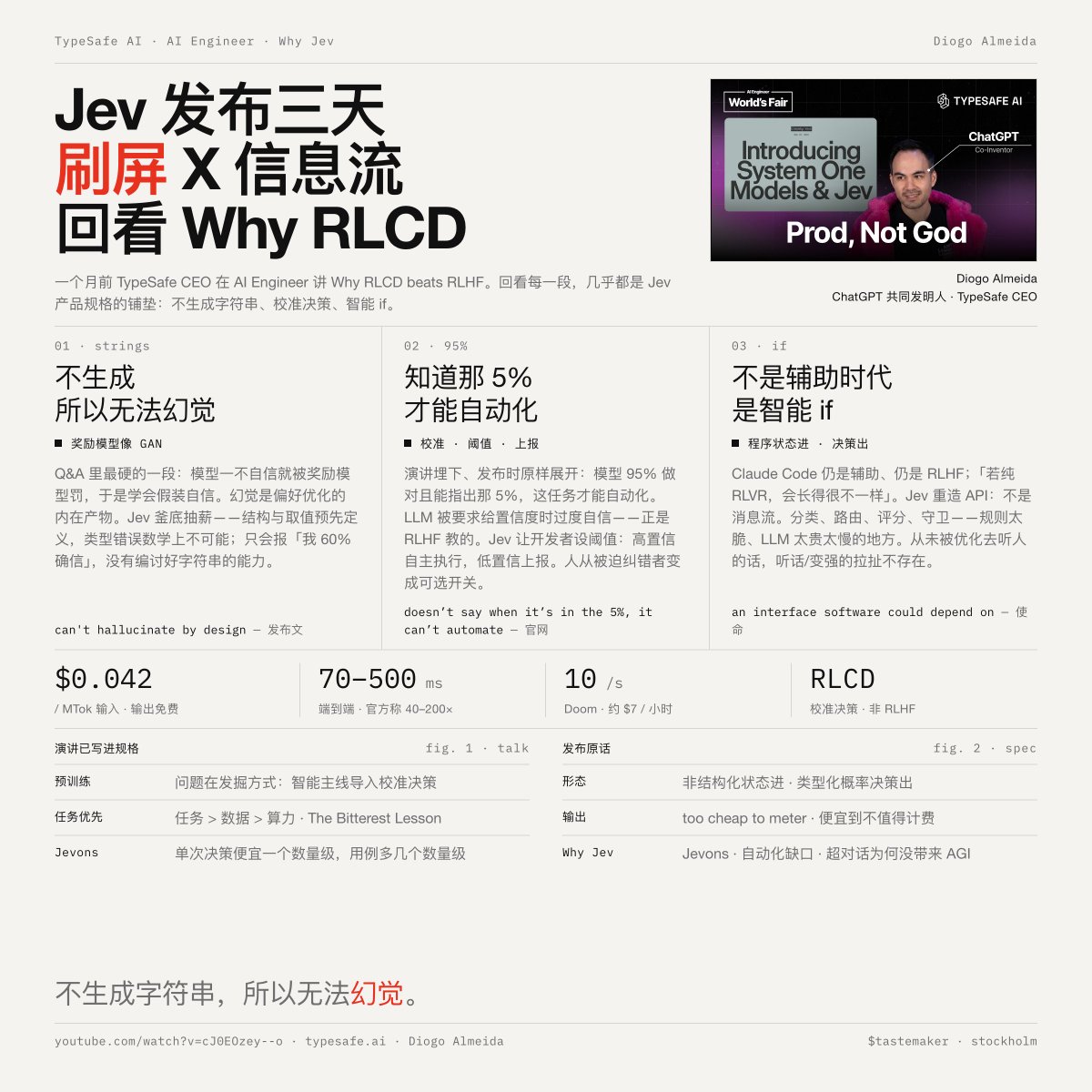
ChatGPT co-inventor Diogo Almeida's TypeSafe AI launched Jev, a text-free model returning type-safe decisions with calibrated confidence. Jev answers in 70-500 ms at $0.042 per million input tokens, targeting routing, classification, and guardrails where LLMs are too slow.
Key insights
Jev debuts as first 'System One' model for software-internal decisions
TypeSafe AI, founded by Diogo Almeida — who worked on InstructGPT and RLHF at OpenAI and co-authored the ChatGPT and GPT-4 papers — launched a new model category it calls 'System One models,' named after Kahneman's fast, automatic cognition, with Jev as the first model. Jev abandons text generation entirely: unstructured data in, type-safe structured results out, each carrying a calibrated confidence score. It is positioned as an 'intelligent if statement' for classification, scoring, routing, extraction, branching, and guards — tasks where hand-written rules are too brittle and LLMs too slow, expensive, or unreliable. Jev is available through an early-access waitlist.
Speed and price claims come with self-acknowledged benchmark caveats
Jev responds in 70-500 ms versus 3-329 seconds for frontier LLMs, and TypeSafe claims it is 20-200x faster and 40-400x cheaper than big models of comparable intelligence. Input tokens cost $0.042 per million — about $42 per billion — and output tokens are free. The numbers come from TypeSafe's own 'Workflow Evals,' which use the average of GPT-6 Astra and Anthropic's Fable 5.1 as reference answers. The company concedes this method itself favors OpenAI and Anthropic models and may understate Jev's relative performance, and that extreme multipliers such as 193x and 444x are best-case results that do not represent every scenario.
Parallel-sampling architecture removes hallucination by construction
The speed is architectural: LLMs generate tokens one after another, while Jev uses parallel sampling so all outputs are computed at once — the same parallel-over-serial logic that let Transformers replace RNNs. The price is that Jev cannot generate text at all. It outputs only pre-defined decision structures, each answer tagged with a confidence score like '60% confident.' Because the output structure is constrained at the architecture level, type errors are mathematically impossible, and the company states hallucination therefore does not exist: Jev lacks the ability to fabricate a pleasing string and can only state its confidence.
RLCD thesis: pleasing humans is the root of hallucination
At his 'Jev Creator: Why RLCD beats RLHF' keynote a month before launch, Almeida argued reward models have a GAN-like asymmetry: a model's lack of confidence is easily detected and punished, so models learn to drop uncertain patterns and fake confidence, making hallucination an inherent product of preference optimization. Jev's answer is RLCD — Reinforcement Learning for Calibrated Decisions — and never generating free text. The keynote's core product logic: 'If a model is right 95% of the time and can tell you when it's in that 5%, this task can be automated.' Developers set thresholds so high-confidence decisions execute autonomously and low-confidence ones escalate, turning human-in-the-loop from forced error correction into an optional switch.
API redesigned around structured program state, not message streams
The keynote explicitly positioned Jev against the current coding-assistant era, arguing Claude Code still belongs to an assistance age built on RLHF and that a purely RLVR system would look very different. Jev goes further by rebuilding the API form itself: structured program state goes in and typed decisions come out, replacing message streams. The talk also identified the optimization tug-of-war in which agents become less obedient as they grow more capable and weaker when made obedient; in Jev's framework that tension does not exist because it was never optimized to follow human instructions.
Pricing and naming bet on a Jevons-paradox demand explosion
Jev is named for William Stanley Jevons: when steam-engine efficiency rose, total coal consumption grew rather than shrank. TypeSafe applies the same economics to intelligence — every order-of-magnitude drop in per-decision cost expands the population of use cases that consume it, matching the keynote line that these tasks are simple enough to run repeatedly at near-zero cost. The company revises Sutton's bitter lesson to 'the choice of task matters more than data or compute,' echoes it in the blog 'The Bitterest Lesson,' prices output tokens free because they are 'too cheap to bill,' claims profitability, and states its mission as 'AI needs an interface software could depend on.'
Demos and four use-case families target latency-critical judgment
Launch materials demonstrated Jev controlling a DOOM bot at roughly 10 queries per second for about $7 per hour, and winning a Wikiracing task — jumping from one article to a target via links — ahead of LLM non-reasoning modes in both steps and speed. The posts group applications into four families: intelligent workflow branching, such as support-ticket triage by team, urgency, and sentiment in tens of milliseconds; bulk document classification, tagging, and extraction priced for hundreds of millions of records; real-time uses including recommendations, dynamic pricing, and game AI at 100 ms latency; and LLM guardrails that check outputs for safety, format, and jailbreaks, exploiting Jev's speed and non-hallucinating design.