
TypeSafe AI launches Jev, a 'System One' decision model
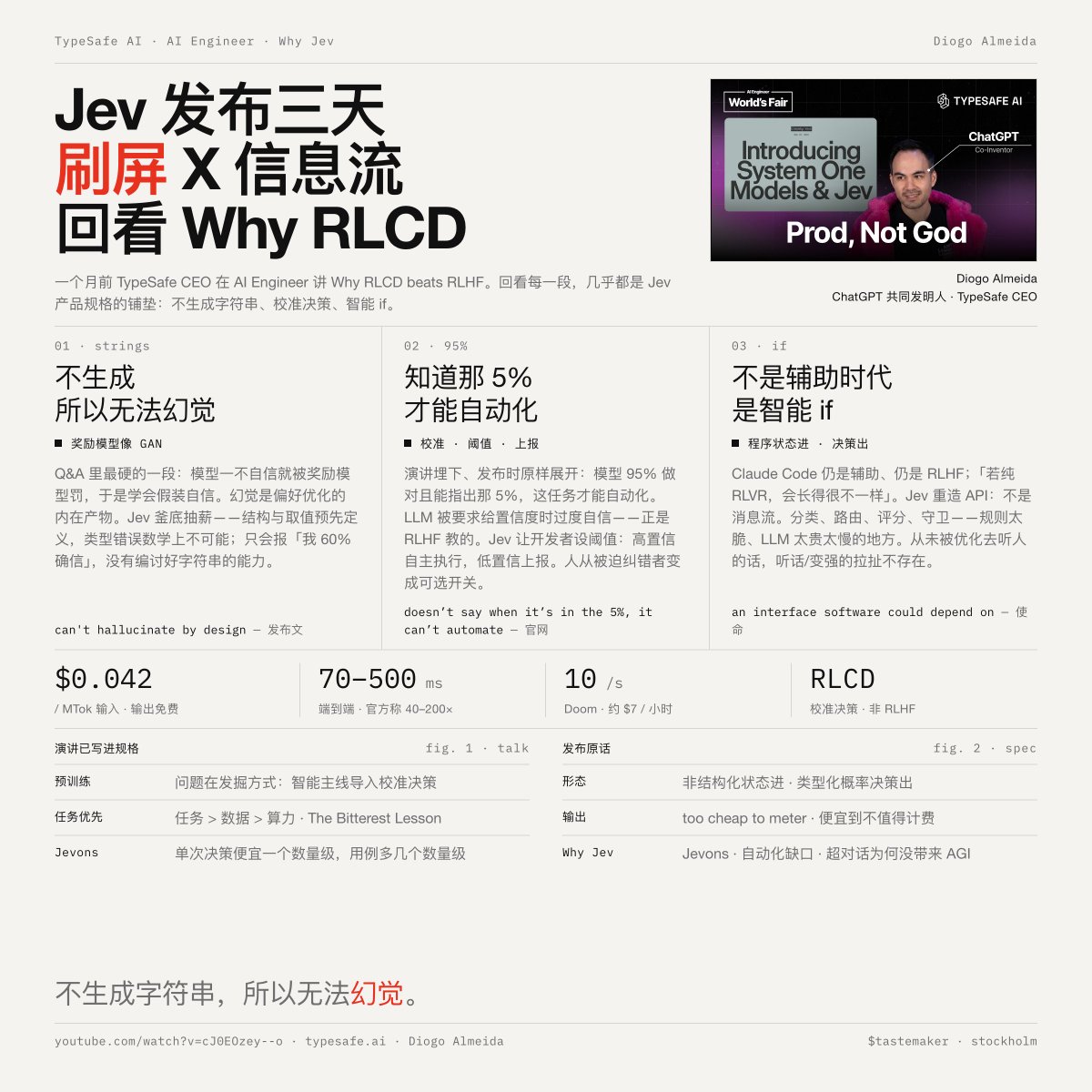
TypeSafe AI, co-founded by a ChatGPT co-author, launched Jev, a System One decision model that does not generate text but outputs structured decisions with calibrated probabilities. It is 20-200x faster and 40-400x cheaper than frontier LLMs for classification, routing, and extraction tasks.
Key insights
Jev's technical architecture differs fundamentally from LLMs
Jev uses parallel sampling instead of autoregressive token generation, enabling response times of 70-500ms. It outputs predefined structured results with attached confidence scores, making type errors mathematically impossible and eliminating hallucinations. The model is trained with RLCD (Reinforcement Learning for Calibrated Decisions), a new method developed by TypeSafe AI.
Jev targets specific automation use cases, not general conversation
Jev is designed for 'intelligent if statements' in software workflows: classification, scoring, routing, extraction, and guardrails. It excels in real-time applications like game AI (Doom demo at 10 calls/second), large-scale data processing, and as a quality checker for LLM outputs. It does not replace ChatGPT or Claude but fills a gap for fast, reliable decision-making in code.
Open-source System 1 models emerge quickly after Jev's release
Within seven days of Jev's launch, open-source System 1 models appeared on GitHub and Hugging Face. One such model gained 15,000 GitHub stars and reached number one on Hugging Face trending. This rapid replication shows strong developer interest and the feasibility of the approach.
Jev's pricing and business model aim for massive adoption
TypeSafe AI charges $0.042 per million input tokens and offers free output tokens. The company claims it is already profitable and plans to lower prices further. The name 'Jev' references the Jevons paradox, betting that drastically lower decision costs will lead to explosive growth in usage.