
TypeSafe AI Launches Jev, a 'System One' Decision Model by ChatGPT Co-Inventor
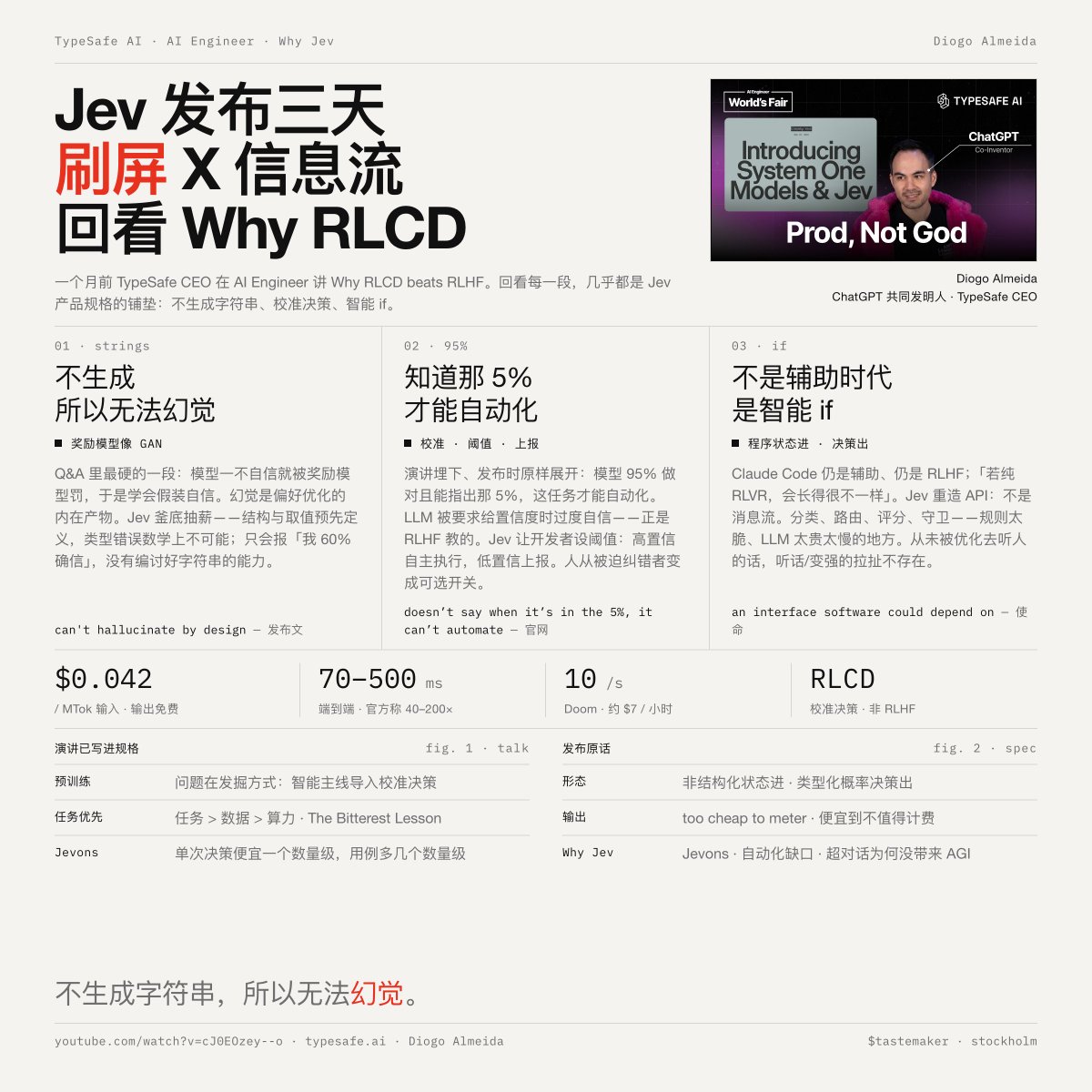
TypeSafe AI, founded by ChatGPT co-inventor Diogo Almeida, released Jev, a 'System One' model for fast structured decisions without text generation. Jev is 20-200x faster and 40-400x cheaper than frontier LLMs for classification, routing, and scoring tasks. It outputs type-safe results with calibrated probabilities and no hallucination risk.
Key insights
Jev's Design: RLCD Over RLHF
Diogo Almeida, co-inventor of ChatGPT, left OpenAI to build Jev using Reinforcement Learning for Calibrated Decisions (RLCD). He argued that RLHF trains models to please humans, causing hallucinations and overconfidence. Jev does not generate free text; it outputs predefined structured results with epistemically honest probabilities. This eliminates hallucination and type errors by design.
Performance and Cost Benchmarks
Jev responds in 70-500 milliseconds, compared to 3-329 seconds for frontier LLMs. Input token price is $0.042 per million tokens ($42 per billion), output is free. TypeSafe claims 20-200x faster and 40-400x cheaper than equivalent intelligence. These numbers come from Workflow Evals using GPT-6 Astra and Fable 5.1 as references. Extreme speedups (193x, 444x) represent best-case scenarios.
Architecture: Parallel Sampling Eliminates Token Generation
Jev uses parallel sampling instead of autoregressive token generation. All outputs are computed at once, similar to how Transformer replaced RNN. This enables much faster inference. The trade-off is that Jev cannot generate text; it only outputs predefined structured decisions with confidence scores. Type error rate is mathematically zero.
Use Cases: Smart If-Statements for Software
Jev is designed for embedding AI judgment into code: classification, routing, scoring, extraction, branching, guardrails. It acts as an 'intelligent if-statement' where rule engines are too brittle and LLMs are too slow/expensive. Example applications include customer service ticket routing, large-scale data processing, real-time recommendations, and LLM output validation. TypeSafe demonstrated Jev controlling DOOM AI at 10 calls/second ($7/hour) and playing Wikiracing.
Pricing and Business Logic: Jevons Paradox
The name 'Jev' references William Stanley Jevons and the Jevons Paradox: as efficiency increases, total consumption rises. TypeSafe bets that making AI decisions extremely cheap will explode usage. Output tokens are free ('too cheap to meter'). The company claims profitability and plans further price cuts. They focus on task selection over data/compute scaling.
Not a Replacement for Chat Models
Jev is not for end users; it is a component for developers to embed in system architectures. It solves the problem of needing AI judgment without AI expression. It complements ChatGPT/Claude by handling tasks that require millisecond response, structured output, and no hallucination. TypeSafe calls this category 'System One' models, after Kahneman's fast thinking system.