
TypeSafe AI Launches Jev: A System One Model for Fast, Calibrated Decisions
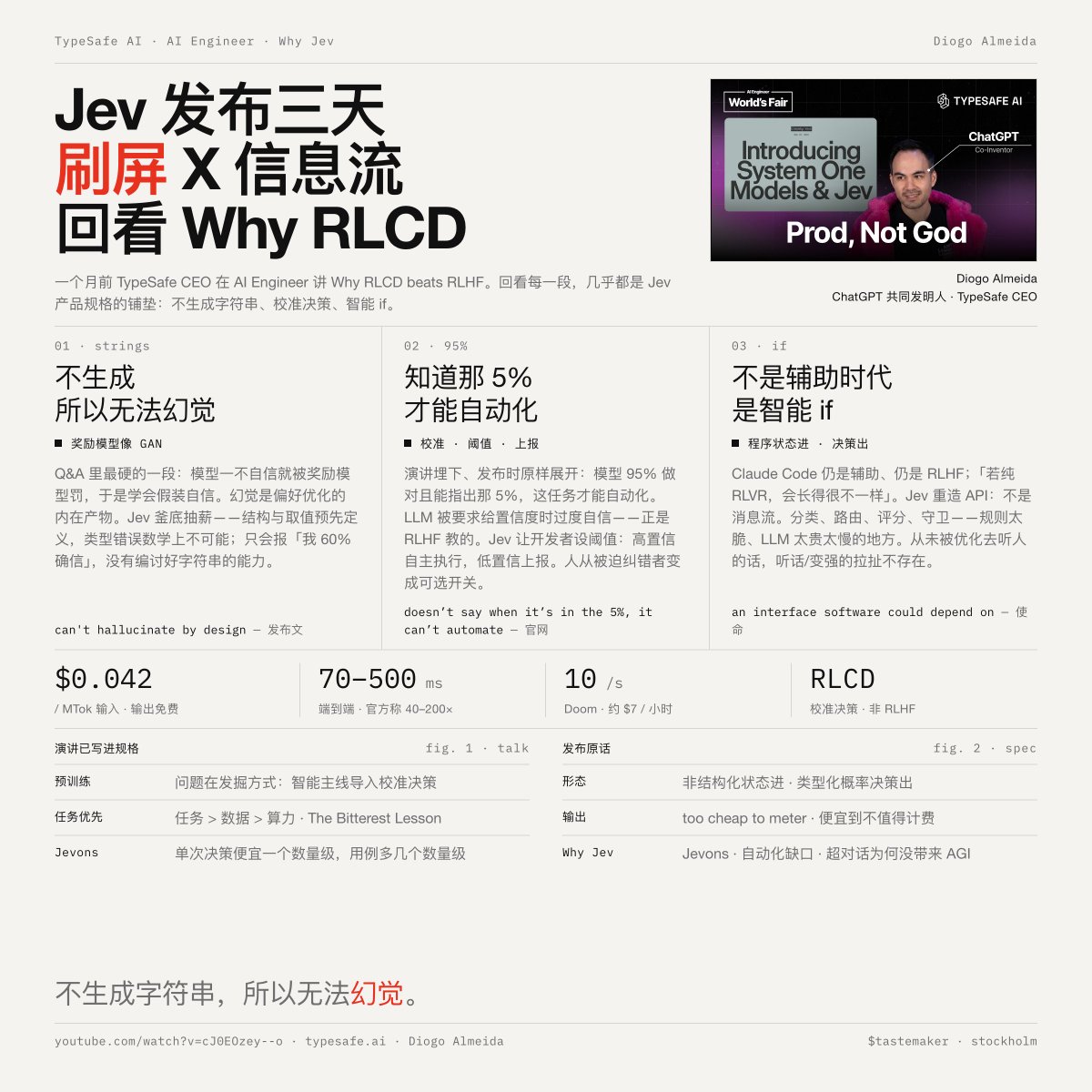
TypeSafe AI, founded by ChatGPT co-inventor Diogo Almeida, released Jev, a 'System One' model that outputs structured decisions with calibrated probabilities instead of generating text. Jev responds in 70-500ms, costs $0.042 per million input tokens with free output, and is designed for tasks like classification, routing, and scoring in software systems.
Key insights
Jev's Core Differentiator: No Text Generation, Calibrated Confidence
Jev does not generate free text; it outputs predefined structured results with 'epistemically honest' probabilities. This eliminates hallucination because the model cannot fabricate strings. Each output includes a confidence score, allowing developers to set thresholds for autonomous execution or human escalation. The architecture uses parallel sampling instead of autoregressive token generation, enabling 70-500ms response times.
Speed and Cost Advantages Over Frontier LLMs
Jev is 20-200x faster and 40-400x cheaper than equivalently intelligent LLMs, according to TypeSafe's workflow evals using GPT-6 Astra and Fable 5.1 as references. Input token price is $0.042 per million tokens, output is free. The speed comes from parallel sampling: all outputs are computed at once, unlike autoregressive models. The cost advantage is amplified by the Jevons Paradox: cheaper decisions lead to more usage.
RLCD Training vs RLHF: Addressing Reward Model Asymmetry
TypeSafe CEO Diogo Almeida explained that RLHF creates a GAN-like asymmetry where model uncertainty is penalized, forcing models to feign confidence and hallucinate. Jev uses a new training method called RLCD (Reinforcement Learning for Calibrated Decisions) that avoids this by not optimizing to please humans. The model is trained to output calibrated probabilities, not to generate pleasing text.
Use Cases: Smart If-Statements in Software
Jev is positioned as an 'intelligent if statement' for software: classification, routing, scoring, extraction, branching, and guardrails. Examples include real-time DOOM AI (10 queries/second, ~$7/hour), Wikipedia racing, and LLM output safety checks. It is not for end users but for developers embedding AI decisions in system architecture, replacing brittle rule engines or expensive LLM calls.
CEO's Critique of KV Cache and Agent Design
In a separate analysis, Diogo Almeida argued that many standard agent features are patches to work around KV cache limitations and per-token pricing. He proposed a 'TypeSafe-centric' design with explicit state and dynamic context reconstruction per query, enabling cost-aware routing, sub-agents, and conditional skills. This philosophy underpins Jev's architecture: no KV cache, no autoregressive generation.