
TypeSafe AI Launches Jev: A System One Model for Fast Decisions
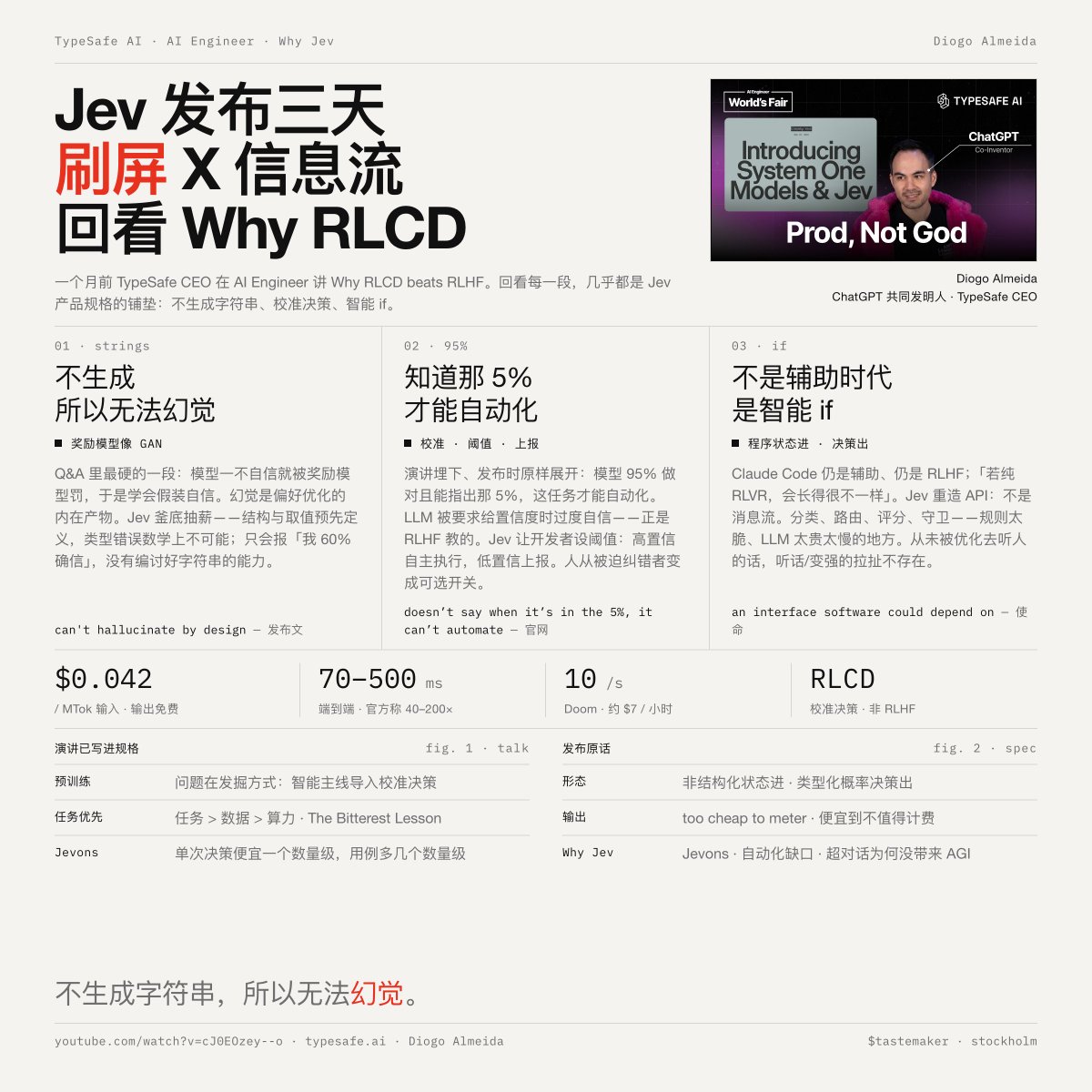
TypeSafe AI, founded by a ChatGPT co-author, launched Jev, a System One model designed for fast, structured decisions. Jev does not generate text but outputs typed results with calibrated probabilities, achieving 70-500ms response times and costing 40-400 times less than leading LLMs.
Key insights
Jev's Unique Architecture
Jev is a new category of AI model called 'System One' that completely abandons text generation. Instead, it outputs structured, type-safe results with calibrated probabilities. The model uses parallel sampling instead of autoregressive token generation, allowing all outputs to be computed at once. Type errors are mathematically impossible because the output structure is constrained at the architecture level. Hallucination is eliminated as the model cannot generate free text.
Performance and Cost Advantages
Jev achieves response times of 70 to 500 milliseconds, compared to 3 to 329 seconds for leading frontier LLMs. Input token price is $0.042 per million tokens ($42 per billion tokens), and output tokens are free. TypeSafe claims Jev is 20 to 200 times faster and 40 to 400 times cheaper than models of equivalent intelligence. These figures come from internal Workflow Evals using GPT-6 Astra and Fable 5.1 as references; extreme speedups (193x, 444x) represent best-case scenarios.
RLCD Training Method
Jev was trained using a novel method called RLCD (Reinforcement Learning for Calibrated Decisions), developed by TypeSafe CEO Diogo Almeida, a former OpenAI researcher who contributed to InstructGPT and RLHF. Almeida argued that RLHF inherently produces overconfidence and inconsistency because models learn to discard uncertain patterns to please the reward model. RLCD instead trains the model to provide epistemically honest probabilities, enabling developers to set confidence thresholds for autonomous execution versus human escalation.
Practical Use Cases
Jev is designed for 'intelligent if-statements' in software workflows. Use cases include smart routing in customer service (classifying tickets, assessing urgency, detecting sentiment), large-scale data processing (classifying millions of documents, extracting structured fields), real-time applications (recommendations, dynamic pricing, game AI), and guardrails for LLM outputs (checking safety, format compliance, jailbreak attempts). Jev is not a replacement for conversational models but a component for embedding AI decisions in code.
Demos and Real-World Applications
TypeSafe demonstrated Jev with two notable demos. In DOOM, Jev controlled an AI bot in real-time, making approximately 10 calls per second at a cost of about $7 per hour. In Wikipedia racing, Jev navigated from one article to another by selecting among hundreds of links, outperforming LLMs in non-reasoning mode in both steps and speed. These demos illustrate Jev's ability to handle high-frequency, low-latency decision tasks.
Philosophical and Economic Rationale
The name 'Jev' references the Jevons paradox, where increased efficiency of a resource leads to greater total consumption. TypeSafe bets that drastically lowering AI decision costs will cause usage to explode. The company is already profitable and plans to continue lowering prices. The 'System One' concept is drawn from Daniel Kahneman's 'Thinking, Fast and Slow', representing fast, intuitive, automated thinking. TypeSafe's mission is to make AI an interface that software can depend on, contrasting with RLHF-based models that are optimized to please humans.
Developer Insights on Agent Design
TypeSafe CEO Diogo Almeida shared his perspective on coding agents, arguing that many standard features are workarounds for KV cache and per-token pricing limitations. He advocates for explicit state management and dynamic context reconstruction per query, which he calls 'meta-attention'. This approach enables cost-aware routing, efficient sub-agents, and scalable tool integration. He suggests that the biggest efficiency gain lies in replacing sub-agent searches with structured retrieval, as reading and searching account for 56.2% of tool calls in one analysis.