
TypeSafe AI Launches Jev: Sistema One Model for Fast Decisions
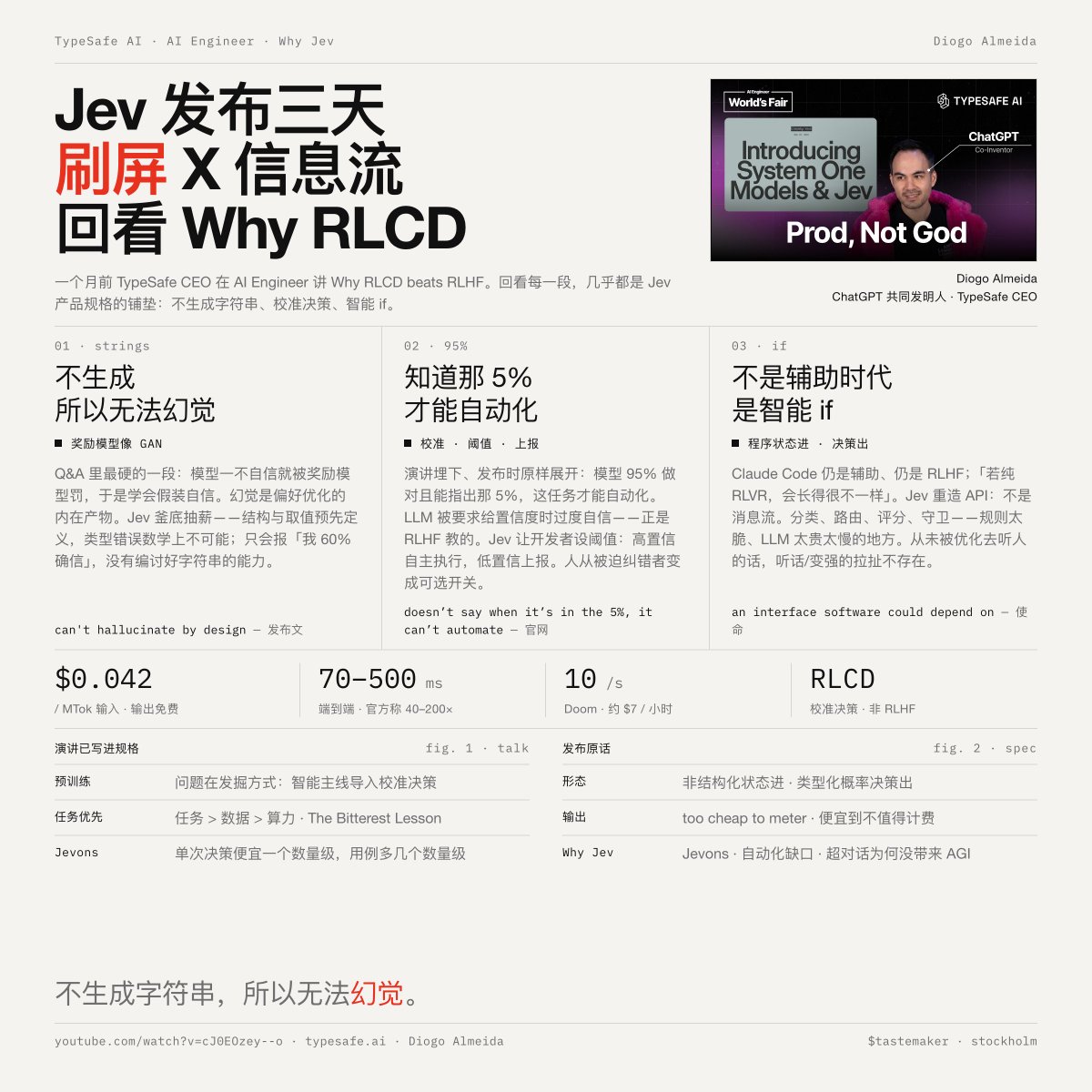
TypeSafe AI, founded by ChatGPT co-author Diogo Almeida, released Jev, a new AI model class for rapid decision-making. Jev outputs structured results with calibrated probabilities, 20-200x faster and 40-400x cheaper than LLMs. It cannot generate free text, eliminating hallucinations, and targets developers needing 'smart if statements' in code.
Key insights
Product overview and key specifications
Jev is a 'System One' model designed for fast, structured decisions rather than text generation. It outputs predefined structured results with calibrated confidence scores. Response time is 70-500ms, compared to 3-329 seconds for frontier LLMs. Input token price is $0.042 per million tokens ($42 per billion), output tokens are free. TypeSafe claims Jev is 20-200x faster and 40-400x cheaper than equivalently intelligent LLMs.
Architecture: parallel sampling eliminates token-by-token generation
Jev uses parallel sampling where all outputs are computed at once, unlike LLMs that generate tokens sequentially. This architectural difference is analogous to Transformer replacing RNN. The trade-off is that Jev cannot generate free text; it only outputs type-safe structured results. Type errors are mathematically impossible due to architecture-level constraints, and hallucinations are eliminated because the model cannot produce arbitrary strings.
Training method: RLCD instead of RLHF
Jev is trained using RLCD (Reinforcement Learning for Calibrated Decisions), a method developed by TypeSafe CEO Diogo Almeida. He argues that RLHF causes models to learn to please humans, leading to overconfidence and hallucination. RLCD produces models that output 'epistemically honest' probabilities. The model can say 'I am 60% confident' rather than fabricating a pleasing string. This makes Jev suitable for automation where reliability is critical.
Target use cases: smart if statements in code
Jev is designed for developers to embed AI decision nodes in code: classification, routing, scoring, extraction, branching, guardrails. It is not a replacement for ChatGPT or Claude but fills the gap where LLMs are too slow, expensive, or unreliable. Example applications include intelligent routing in customer service, large-scale data classification, real-time recommendations, and acting as a guardrail to check LLM outputs for safety and format.
Demonstrations: DOOM AI and Wikipedia racing
TypeSafe demonstrated Jev controlling a DOOM game AI with ~10 calls per second at ~$7/hour. Another demo showed Wikipedia racing (navigating from one article to another via links), where Jev outperformed LLMs in non-reasoning mode in both steps and speed. These demos illustrate Jev's ability to make fast, repeated decisions in real-time environments.
Pricing philosophy: Jevons Paradox
The name 'Jev' references William Stanley Jevons and the Jevons Paradox: as efficiency of a resource increases, total consumption rises. TypeSafe bets that making AI decisions extremely cheap will lead to explosive growth in usage. Output tokens are free because they are 'too cheap to meter'. The company claims to be profitable and plans further price reductions, focusing on expanding the task space rather than competing on per-unit intelligence.