
TypeSafe AI Launches Jev: System One Decision Model
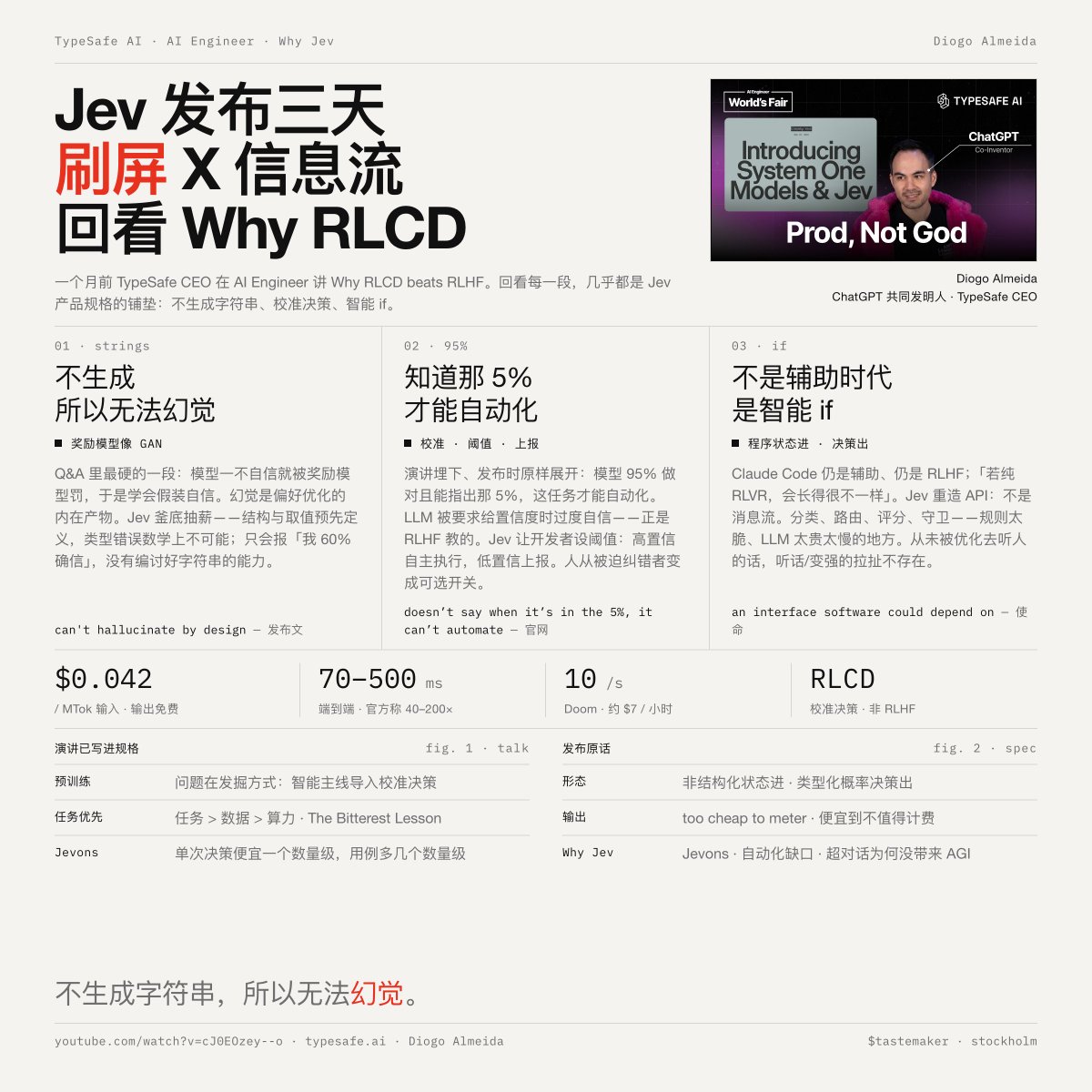
TypeSafe AI launched Jev, a System One decision model that outputs structured, calibrated results instead of text. It is 20-200x faster and 40-400x cheaper than frontier LLMs, with 70-500ms response times. Jev uses RLCD training to eliminate hallucination and type errors, targeting use cases like classification, routing, and scoring in software pipelines.
Key insights
Jev: A New Category of AI Model for Decisions
TypeSafe AI launched Jev, the first System One model, designed for fast, structured decision-making rather than text generation. It inputs unstructured data and outputs type-safe structured results with calibrated probabilities. Jev cannot generate free text, eliminating hallucination and type errors by design. It uses parallel sampling instead of autoregressive token generation, enabling response times of 70-500 milliseconds.
Performance and Cost Advantages Over Frontier LLMs
Jev is 20-200 times faster and 40-400 times cheaper than frontier LLMs for decision tasks, according to TypeSafe's Workflow Evals using GPT-6 Astra and Anthropic Fable 5.1 as references. Input token price is $0.042 per million tokens ($42 per billion), and output tokens are free. The speed advantage comes from parallel sampling, while the cost advantage is due to the absence of text generation. The company claims to be profitable and plans further price reductions.
RLCD Training Method Addresses RLHF Limitations
Jev is trained using RLCD (Reinforcement Learning for Calibrated Decisions), a method developed by founder Diogo Almeida, who co-authored InstructGPT and RLHF. He argued that RLHF causes models to be overconfident and hallucinate because they learn to please humans. RLCD trains models to output calibrated probabilities and to be 'epistemically honest' about uncertainty. This allows Jev to tell developers when it is confident and when to escalate to humans.
Use Cases: Intelligent If Statements and Beyond
Jev is designed for scenarios where a software system needs a quick, reliable decision: classification, routing, scoring, extraction, branching, and guardrails. It acts as an 'intelligent if statement' that can replace brittle rule engines or expensive LLM calls. Specific applications include customer service ticket routing, large-scale data labeling, real-time recommendations, game AI, and as a guardrail to check LLM outputs for safety and format compliance.
Demonstrations Show Real-Time Capabilities
TypeSafe demonstrated Jev in two real-time scenarios. In DOOM, Jev controlled an AI bot with about 10 calls per second, costing roughly $7 per hour. In Wikiracing (navigating from one Wikipedia article to another via links), Jev outperformed non-reasoning LLMs in both steps and speed. These demos illustrate Jev's ability to make rapid, repeated decisions in interactive environments.
Economic Model Based on Jevons Paradox
The name 'Jev' references the Jevons paradox, where increased efficiency leads to greater total consumption. TypeSafe bets that by drastically lowering the cost per decision, the total number of AI decisions will explode. The company's pricing strategy (output free, input cheap) reflects this philosophy. Founder Diogo Almeida stated that the key is task selection, not just data or compute, and that Jev targets tasks that are simple enough to be repeated nearly cost-free.
Complementary to LLMs, Not a Replacement
Jev is not intended to replace conversational AI like ChatGPT or Claude. Instead, it fills a gap: providing fast, reliable, structured decisions within software systems. It is best suited for 'System One' tasks (fast, intuitive) as opposed to 'System Two' tasks that require reasoning and text generation. Developers can use Jev alongside LLMs, with Jev handling the quick decisions and LLMs handling complex interactions.